


Switzerland has dozens of protected landscapes, but three stand out for travelers who want wild mountains without giving up Swiss comfort: the Swiss National Park in the Engadine, the UNESCO Biosphere Entlebuch near Lucerne, and Parc Ela in Graubünden. Each offers a very different balance of wilderness, culture and accessibility. Choosing the right one can shape your entire trip, from how hard you hike to where you sleep and how close you get to wildlife.
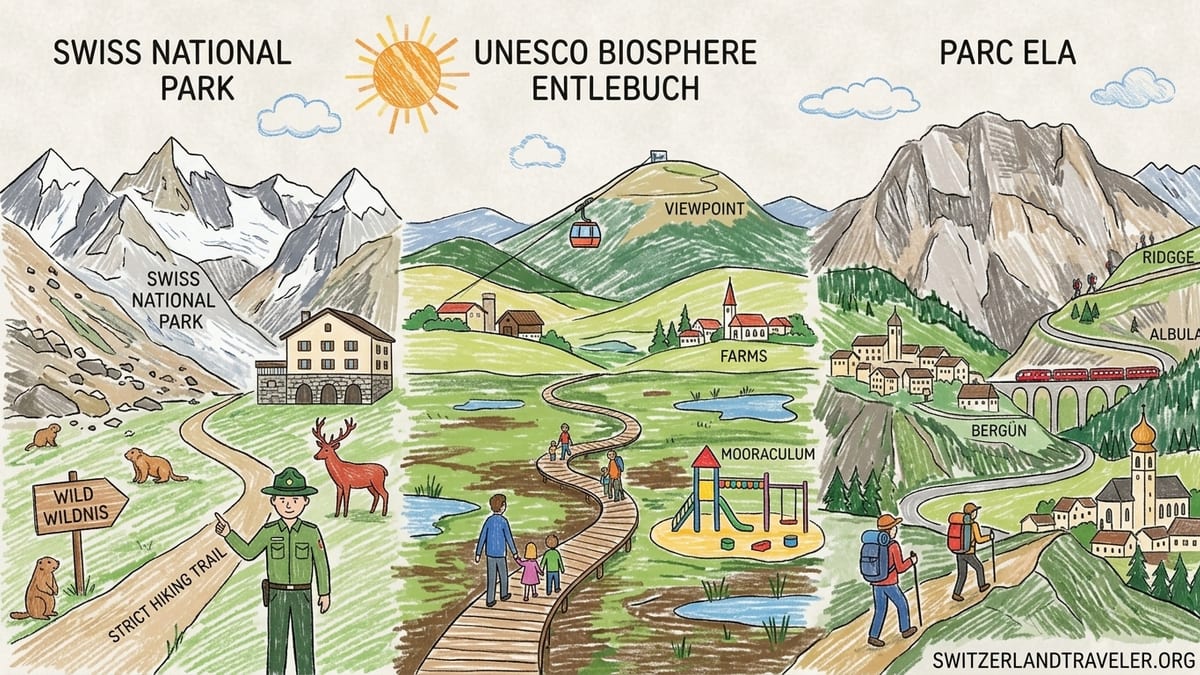
How these three parks differ at a glance
The Swiss National Park in eastern Switzerland is the country’s only national park in the strict sense. Founded in 1914 and managed to the highest international protection standard, it is a true wilderness reserve where nature comes first. Visitors are welcome, but must stay on marked paths, accept that facilities are minimal inside the park boundary, and treat it more like an open-air laboratory than a leisure resort. Expect marmots, red deer and perhaps bearded vultures, but also clear rules and fines if you step off trail.
The UNESCO Biosphere Entlebuch, southwest of Lucerne, protects an unusual mix of raised bogs, moorlands and karst landscapes while remaining closely intertwined with local villages. Here, boardwalks through peat bogs, family-oriented attractions such as the Mooraculum play and learning area above Sörenberg, and accessible ridgeline walks sit side by side with traditional dairy farms. It feels less remote than the national park, and much of the biosphere can be explored on easy half-day strolls.
Parc Ela in the canton of Graubünden is currently Switzerland’s largest nature park by area, stretching around Piz Ela and the Albula and Julier passes. Rather than being an empty core reserve, it includes lived-in valleys, historic villages such as Bergün and Savognin, and a web of multi-day hiking routes like the Parc Ela Trek and the Trans Parc Ela three-passes tour. It is the obvious choice if you want big Alpine landscapes, cultural history and long-distance hiking without the very strict rules of the national park.
In practical terms, think of the three as points on a spectrum. At one end sits the Swiss National Park, maximising wilderness and restricting visitor behaviour. At the other sits Entlebuch, where conservation coexists with everyday rural life and tourism infrastructure. Parc Ela occupies the middle ground: far wilder than the hills above Lucerne, yet with villages, mountain inns and pass roads that make it easier to string together long routes with comfortable overnights.
Landscape and atmosphere: what you actually see and feel
The Swiss National Park occupies a compact but dramatic block of high mountain terrain above the Ofen Pass, with deep forests, steep scree slopes, and wide, glacially carved valleys. Trails like the route from Il Fuorn to Val Müstair or the climb into Val Trupchun give you huge views but very few signs of human presence beyond the path itself. You will not find ski lifts, mountain restaurants or souvenir shops inside the park boundary, and even benches are relatively sparse. The atmosphere is one of quiet and restraint, especially early in the morning when animal life is most active.
Entlebuch’s landscapes feel softer at first glance, especially if you enter via the rolling pastures around Schüpfheim or the gentle hills above the Kleine Emme river. Its signature scenery reveals itself in the high moorlands around Sörenberg and Rossweid, where raised bogs, small ponds and stunted pines form a rare Central European ecosystem. Boardwalks and interpretive panels lead you through peatlands that are normally too fragile to enter, and you can combine them with panoramic ridge walks towards the Brienzer Rothorn. The karst areas, with their sinkholes and limestone pavements, add a geological twist that older children and geology enthusiasts tend to love.
Parc Ela is dominated by big, rugged massifs and broad valleys shaped by historic trade routes. The Bergüner Stöcke mountains rise sharply above Bergün, while Piz Ela itself stands like a fortress between the Albula valley and Val Surses. You see old Roman and medieval routes over the Julier and Septimer passes, ornate baroque churches in villages such as Tiefencastel, and dry-stone walls and hay barns scattered across steep meadows. Much of the park is above 2,000 metres, so the light can be sharp and clear in summer and the seasons short, but the overall impression is of a working high-mountain landscape rather than a sealed-off reserve.
This difference in atmosphere affects how your days feel. A day in the Swiss National Park is usually a single, carefully chosen hike with a picnic in your backpack, followed by a quiet evening in Zernez or at the Il Fuorn hotel. In Entlebuch you might start with a stroll on duckboards through the moor, have lunch on a terrace in Sörenberg, then ride a cable car for a short afternoon walk with views over Lake Lucerne. In Parc Ela a typical day might involve a high-level traverse between villages, stopping in an alp dairy for cheese and ending with dinner in a small hotel along the route.
Protection levels and park rules: how wild is “wild”?
The Swiss National Park is one of the strictest protected areas in Europe and is recognised by the International Union for the Conservation of Nature as a top-category strict nature reserve. Within its boundaries, visitors must stay on marked paths at all times, and it is forbidden to pick flowers, disturb animals, collect wood or stones, or camp. Dogs are not allowed in the park, even on a leash, to avoid disturbance to wildlife. Park wardens patrol the area and fines for infractions such as leaving the trail or lighting fires are significant, so this is a park for travellers who respect and embrace firm rules.
UNESCO Biosphere Entlebuch operates under a different philosophy. As a biosphere reserve, it aims to balance conservation of moorlands and karst with sustainable living and tourism. Protected zones, particularly in sensitive bogs and wetlands, are clearly marked, and leaving boardwalks and paths in these areas is not allowed. However, you can still walk across farm tracks, visit mountain restaurants and participate in local activities such as cheese-making workshops. Dogs are usually allowed on leash, except in specific zones where signs prohibit them to protect nesting birds or grazing livestock.
Parc Ela, as a regional nature park, also integrates human settlement and land use within its boundaries. Strict reserves exist in certain core habitats, but large areas are managed pasture, forest and village land. The focus is on promoting low-impact tourism, regional products and cultural heritage rather than excluding people altogether. Wild camping and bivouacking are restricted by national and cantonal rules, but in practice most visitors stay in established accommodation. Hiking trails range from easy yellow-signed paths to more serious alpine routes, but you are not generally confined to a narrow network inside a fenced reserve as you are in the national park.
If your personal definition of “wild” means landscapes where human activity is kept to an absolute minimum, the Swiss National Park is unmatched. If you prefer a model where locals live, farm and host visitors inside the protected area, Entlebuch and Parc Ela are better fits. For many travellers, the question becomes one of ethics and comfort: are you happy to follow strict regulations in exchange for intact ecosystems, or do you feel more at ease in places where daily life goes on alongside conservation?
Hiking style and difficulty: day walks vs multi-day treks
Hiking in the Swiss National Park is based around a network of roughly 100 kilometres of marked paths, from half-day walks such as the nature trail at Il Fuorn to more demanding alpine-style routes. Elevation gains can be substantial, and some paths climb steeply on loose gravel or narrow shelves, but there are no via ferrata or technical climbing sections on the standard routes. Because you cannot leave the paths, this is not the place for off-trail exploration. Instead, you choose one of the official itineraries, often posted at trailheads with distance and estimated time, and follow it out and back or in a loop. Most visitors base themselves in Zernez or Scuol and do one serious hike per day.
Entlebuch offers a gentler hiking profile overall, with many routes designed for families and casual walkers. Around Sörenberg, the Rossweid gondola whisks you directly to the Mooraculum area, where themed trails loop through the moorlands and forest in under two hours. Signposted moorland trails crisscross the biosphere, some as long-distance themed walks that can be broken into segments, but you can also choose short, nearly flat circuits that are manageable for grandparents and young children. The karst areas can involve rockier footing, but this is still very much hill-walking rather than serious Alpine mountaineering.
Parc Ela is the obvious choice for ambitious hikers who want multi-day routes without the crowds of the Bernese Oberland. The Parc Ela Trek links sections of high trail between villages on a multi-stage itinerary, while the Trans Parc Ela three-passes hike begins above Bergün and ends in Savognin, crossing remote mountain passes in between. Daily stages can involve 1,000 metres of ascent or more, and some sections are on red-white mountain trails that require surefootedness and a head for heights. That said, the park also contains easy valley paths, lakeside strolls and gentler routes like the Segantini trail above Savognin, so mixed-ability groups can still find suitable options.
When comparing the three for hiking difficulty, consider both terrain and logistics. The Swiss National Park offers relatively short but intense days from fixed bases, with no opportunity to shorten routes once you start. Entlebuch excels at flexible half-day outings that you can easily combine with other activities. Parc Ela supports full-on hut-to-hut or village-to-village trekking with heavier daily elevation but the reward of changing scenery every day. If you imagine yourself carrying only a daypack and returning to the same hotel each night, Entlebuch or the national park region will feel more natural. If you want to move through the landscape, Parc Ela stands out.
Accommodation, access and public transport
Accommodation in and around the Swiss National Park is deliberately limited within the park boundary. Inside, you have a single mountain hut, the Cluozza hut, and one hotel at Il Fuorn on the Ofen Pass road. Most visitors stay just outside the park in villages like Zernez, which acts as the main gateway with a national park visitor centre, or in nearby Engadine towns such as Scuol and S-chanf. Expect typical Swiss hotel prices, with mid-range double rooms in summer often in the region of 180 to 260 Swiss francs per night including breakfast, though guesthouses and apartments can be cheaper. Access by public transport is straightforward: long-distance trains reach Zernez, and yellow postbuses run up the Ofen Pass, stopping at main trailheads.
Entlebuch benefits from its Central Swiss location. The town of Entlebuch and neighbouring Schüpfheim lie on the rail line between Lucerne and Bern, so you can overnight in the biosphere and still reach Lucerne’s old town in under an hour by train. In the higher section around Sörenberg, accommodation runs from simple guesthouses and family-run hotels to self-catering apartments and a few campsites. Summer offers like family packages with gondola inclusions are common. Cable cars and chairlifts shorten ascents, and postbuses connect scattered hamlets and trailheads. For many visitors without a car, Entlebuch is the easiest of the three parks to integrate into a broader Swiss itinerary because it fits neatly between major cities and other famous mountains.
Parc Ela’s villages are more remote but still well served by the Swiss network. Bergün and Filisur sit on the Albula railway line, famous for its viaducts and spiral tunnels, while Savognin and Bivio are reached by regional buses from Chur or Tiefencastel. Accommodation includes traditional inns with carved wooden dining rooms, small design-oriented hotels, basic pensions, and several mountain huts in the high terrain. Prices are similar to other Alpine regions, with the advantage that demand is usually lower than in hotspots like Zermatt, so last-minute bookings can be easier outside peak school holidays. For hikers, the fact that public transport serves both ends of long routes such as the Trans Parc Ela is a major logistical advantage.
For travellers on tighter budgets, Entlebuch and Parc Ela often offer better value than the Engadine. Self-catering apartments in villages like Schüpfheim or Savognin can undercut equivalent options near the national park, and food prices in local supermarkets are the same as elsewhere in Switzerland. However, if your priority is to avoid transfers and settle into one base with direct rail access from Zurich or Geneva, Zernez and the nearby Engadine towns remain very convenient despite higher prices.
Families, wildlife encounters and trip length
Families with younger children usually find Entlebuch the most straightforward introduction to Swiss protected areas. Attractions like the Mooraculum above Sörenberg combine playground elements with educational stations about bogs and peat, and the short moorland loops are ideal for children who cannot yet manage full-day hikes. The presence of gondolas, picnic areas and mountain restaurants takes pressure off parents who need flexibility. From a base in Entlebuch or Sörenberg, you can also add day trips to Lake Lucerne, Mount Pilatus or even Bern, keeping non-hiking relatives interested.
The Swiss National Park suits families with older children or teenagers who are already comfortable walking for several hours and can understand the logic of strict rules. Wildlife watching is a major draw: it is relatively common to see marmots close to the path, especially in late spring and early summer, and red deer may be visible at dawn and dusk on valley slopes. With binoculars, you might spot chamois or ibex, and very lucky visitors glimpse golden eagles or bearded vultures. The trade-off is less freedom to roam and play, since children must stay on the trail and cannot collect flowers or stones as souvenirs.
Parc Ela occupies a sweet spot for active families and groups. You can plan shorter valley walks one day and more ambitious high-level routes the next, always with the option of returning to comfortable village accommodation. Themed trails such as the Segantini walk in Savognin give younger hikers a story to follow, while adults enjoy the history and views. Wildlife is present, but less concentrated and visible than in the national park, partly because of ongoing pastoral activity. For many visitors, the memorable encounters here are as much with village life, local festivals and alp dairies as with animals.
In terms of trip length, the Swiss National Park can be experienced in a focused two or three days if you combine a couple of classic hikes with time in the visitor centre in Zernez. Entlebuch can also fit into a two or three-day window, but its proximity to Lucerne and Bern makes it a convenient base for a full week if you mix hiking with city and lake excursions. Parc Ela comes into its own when you have at least four or five days, especially if you want to attempt a multi-stage trek that crosses the park from one valley to another. With a week or more, you can combine several valleys and passes and still have rest days in characterful villages.
Which park is best for you?
If your priority is to experience one of the most strictly protected mountain landscapes in Europe, with the sense that you are a guest in an ecosystem largely left to itself, the Swiss National Park should be at the top of your list. Accept that you will follow rules, stay on specific paths and base yourself in gateway villages rather than inside the park, and you will be rewarded with quiet valleys, abundant wildlife and a powerful sense of what the Alps looked like before ski lifts and roads.
Choose UNESCO Biosphere Entlebuch if you are based in Central Switzerland, are travelling with mixed-ability companions, or want to explore rare moorlands and karst without committing to big mountain days. It integrates smoothly into itineraries that also feature Lucerne, Mount Pilatus, Lake Brienz or even urban days in Bern. For many first-time visitors who are unsure about all-day hikes but still want “real nature,” Entlebuch offers an ideal test ground.
Opt for Parc Ela if you imagine long ridge walks, several passes in a row, nights in small inns and the feel of moving through a lived-in Alpine region. It is particularly attractive to hikers who have already visited the headline destinations of the Bernese Oberland and Valais and now want something quieter and more expansive. Because it is Switzerland’s largest nature park, there is room to design very different trips within its borders, from gentle weeks along the valleys to demanding hut-to-hut traverses.
In the end, the “best” park is the one whose rules and rhythm match your travel style. If in doubt, many repeat visitors start with Entlebuch on a first trip, then plan a dedicated hiking holiday in Parc Ela or a wildlife-focused stay near the Swiss National Park once they know how much mountain walking they truly enjoy.
FAQ
Q1: Is the Swiss National Park too strict for casual hikers? Casual hikers can still enjoy the Swiss National Park if they are comfortable with clear rules such as staying on marked paths, not bringing dogs and carrying out all waste. The trails themselves range from moderate to demanding, but the main limitation is behavioural: you cannot picnic anywhere you like, wander off trail or let children run free across meadows, so it suits visitors who accept structure in exchange for intact wilderness.
Q2: Which park is easiest to reach by public transport from Zurich or Lucerne? UNESCO Biosphere Entlebuch is the most accessible, with towns like Entlebuch and Schüpfheim on the rail line between Lucerne and Bern and frequent connections to Zurich via Lucerne. From there, buses connect to Sörenberg and other mountain villages, making it realistic to visit without a car even for just a day or two.
Q3: Where will I see the most wildlife? The highest chance of concentrated wildlife sightings is in and around the Swiss National Park, thanks to its strict protection and absence of hunting within the core area. Marmots, red deer and chamois are regularly observed from trails, especially early or late in the day. Entlebuch and Parc Ela also host rich fauna, but ongoing farming and a more open access model mean animals are generally more dispersed and wary of people.
Q4: Which park is best for a family with small children? Entlebuch usually works best for families with young children, thanks to short themed trails, attractions like the Mooraculum near Sörenberg, cable cars that reduce climbing, and easy access back to Lucerne for non-hiking days. Parc Ela can suit active families with slightly older children who can handle longer walks, while the Swiss National Park is more appropriate for teenagers used to hiking and following rules.
Q5: Can I do multi-day hut-to-hut hikes in all three parks? Multi-day traverses are most natural in Parc Ela, which offers established routes such as the Parc Ela Trek and the Trans Parc Ela across several passes, with huts and village inns at stage ends. The Swiss National Park lends itself more to day hikes from bases like Zernez or Il Fuorn, although you can include the Cluozza hut as an overnight. In Entlebuch, multi-day routes exist but are generally lower in altitude and often designed as themed trails rather than classic Alpine hut circuits.
Q6: How do accommodation prices compare between the parks? Prices vary by season and specific property, but the Engadine region around the Swiss National Park is typically at the higher end of the scale, with many traditional hotels and fewer budget options. Entlebuch and Parc Ela often offer better value, with a mix of small hotels, guesthouses and self-catering apartments that can reduce costs, especially for families or groups willing to cook some meals.
Q7: Which park offers the most dramatic mountain scenery? All three offer beautiful views, but Parc Ela generally delivers the biggest, most varied Alpine panoramas, with high passes, rugged peaks and broad valleys framed by historic routes. The Swiss National Park feels wild and pristine but within a more compact area, while Entlebuch’s drama lies more in its moorlands and views towards surrounding ranges than in towering peaks directly above you.
Q8: Is it possible to combine two of these parks in one trip? Yes, especially if you have at least a week. A common pairing is Entlebuch with Parc Ela, linking Central Switzerland and Graubünden while mixing softer moorland walks with more demanding Alpine hiking. Combining Entlebuch with the Swiss National Park is also feasible by rail via Lucerne and the Engadine, but the journey is longer and works best if you dedicate several nights to each region.
Q9: Do I need special equipment to hike in these parks? In summer, sturdy hiking shoes or boots, weather-appropriate layers, sun protection and a daypack are sufficient for most marked trails in all three parks. For higher, more exposed routes in Parc Ela or the Swiss National Park, trekking poles and a basic understanding of mountain weather are recommended. Outside the main summer season or if snow lingers at altitude, local tourist offices can advise whether additional gear such as microspikes is advisable.
Q10: If I only have two full days, which park should I prioritise? With just two days and a base around Zurich or Lucerne, Entlebuch is the most efficient choice, allowing you to fit in moorland walks and a ridgeline excursion without long transfers. If you are already heading to the Engadine for other reasons, dedicating two days to the Swiss National Park will give you a concentrated taste of strict Alpine wilderness. Parc Ela deserves at least three or four days to appreciate its multi-valley scale, so it works best when you can stay a little longer.