


The Swiss National Park in the Engadin is one of Europe’s most strictly protected reserves, with pristine valleys, strict trail rules and only two places to sleep inside its boundaries. For most visitors, the real planning challenge is not which trail to hike, but where to base themselves outside the park. Zernez, Scuol, S-chanf and the Ofen Pass and Val Müstair area each offer a different mix of hotel styles, trailhead access, public transport and practical hiking services such as early breakfasts and packed lunches.
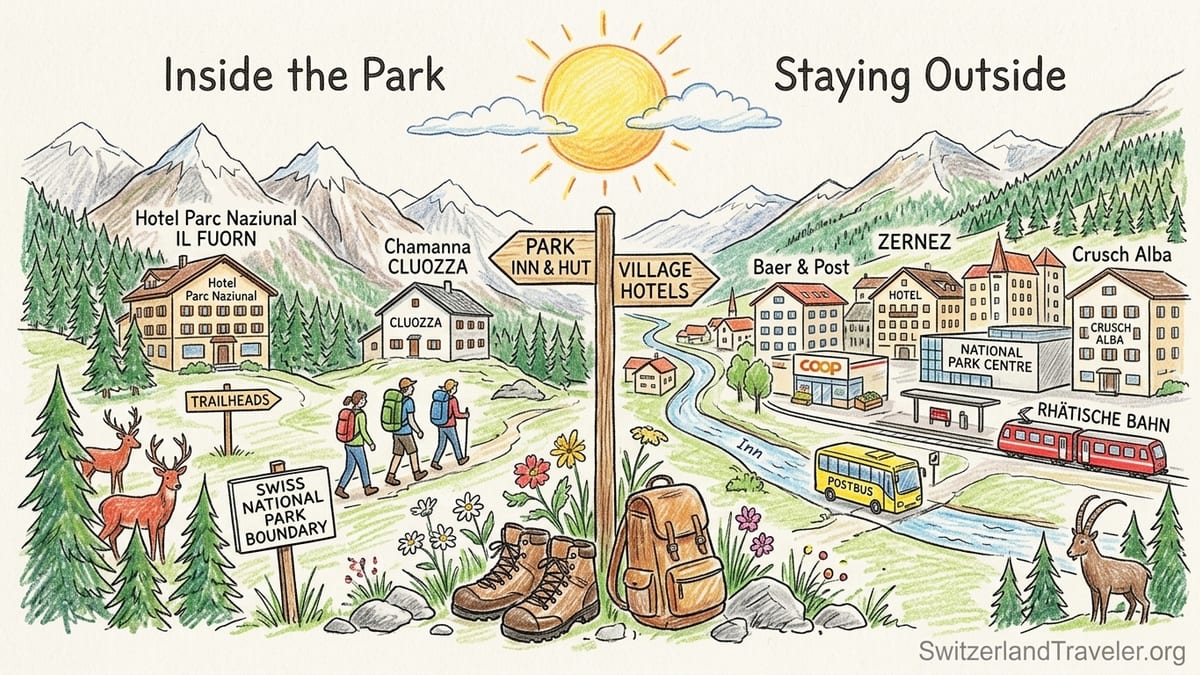
Inside the Park vs Staying Just Outside
The Swiss National Park is unusual in that almost all commercial development is kept outside its borders. There are only two places you can legally spend the night within the park itself: Chamanna Cluozza, a simple catered mountain hut above Zernez, and Hotel Parc Naziunal Il Fuorn, a traditional inn on the Ofen Pass road. Everything else, from four-star spa hotels to simple guesthouses, sits in the villages around the park’s perimeter. For most travelers, that means choosing between the rare privilege of waking up inside the reserve and the comfort and flexibility of basing in a nearby Engadin village.
Chamanna Cluozza is reached only on foot, via several four to five hour hiking routes that climb from Zernez through dense forest into a wild lateral valley. It offers dorm-style bunks, shared facilities and hearty hut meals rather than hotel comforts. Hotel Parc Naziunal Il Fuorn, by contrast, sits directly on the Ofen Pass road, with private rooms, a restaurant and a large breakfast buffet, yet it is still surrounded by the park’s core zone and several popular signed trails start near its door. Staying at either feels immersive, but availability is limited and both options require advance booking, especially in peak summer and autumn.
By comparison, villages like Zernez, Scuol, S-chanf and those in Val Müstair have a broader range of conventional hotels with private bathrooms, family rooms, wellness areas and flexible check-in. Prices typically start around the equivalent of 180 to 220 US dollars per night for a mid-range double room in high season in Zernez, with more upscale properties often well above that. These bases also give you quick access to the Rhätische Bahn railway and yellow PostBus network, which matter a lot if you plan one-way hikes or want to adjust daily plans according to weather.
The trade-off is time and atmosphere. Sleeping inside the park removes the daily commute and gives you sunsets and early morning light on empty trails, but you lose choice and comfort. Staying outside adds a short bus ride to many trailheads, yet you gain reliable supermarkets, more dining options and the safety of back-up accommodation if a hut is fully booked or weather turns.
Zernez: The Gateway Hub With the Best Overall Access
Zernez calls itself the gateway to the Swiss National Park for a reason. The village sits at the junction of the Upper and Lower Engadin, right where the PostBus climbs toward the Ofen Pass and Val Müstair. The National Park Centre, a modern visitor and information building, stands a short walk from Zernez railway station and is open daily from mid May to the end of October. It is the logical first stop to pick up free trail leaflets, buy detailed maps and ask rangers about current conditions, closed paths and wildlife sightings.
For accommodation, Zernez has a compact but varied hotel scene. Traditional three to four star properties such as Hotel Baer & Post, Hotel Crusch Alba, Hotel Acla Filli, Hotel Alpina and Hotel Pizzeria Selva cluster within a few minutes’ walk of the station and visitor centre. As of mid 2026, mid-range doubles at places like Hotel Baer & Post or Crusch Alba often run from roughly 220 to 320 US dollars per night in summer, including breakfast, with simpler options usually a little lower. Several hotels here emphasize being hiker friendly, offering early breakfast on request, luggage storage and local trail advice at reception.
Trailhead access from Zernez is excellent without a car. Frequent regional trains connect to Samedan and St Moritz to the west and to Scuol-Tarasp to the east, while PostBuses fan out south over the Ofen Pass to Il Fuorn and on to Valchava and Müstair. This allows easy one-way routes, for example taking the early bus up to Il Fuorn and walking one of the themed trails back down to another bus stop, or hiking from the park edge and returning by train to Zernez in the afternoon. Many hikers also use Zernez as a base the night before or after a stay at Chamanna Cluozza, as its trailheads begin just across the Inn river from the village.
For multi-night stays, Zernez has two practical advantages. First, most hotels include free or discounted regional transport passes for guests staying two or more nights, which can reduce the cost of daily train and bus rides across the Engadin. Second, supermarket opening hours and multiple restaurants mean you can flex between eating out and picnic lunches. It is realistic, for instance, to have an early hotel breakfast at 7:00, pick up extra snacks at the Coop by 7:30 and be at the Zernez PostBus stop in time for an 8:00 departure to Il Fuorn for a full day in the park.
Scuol and Lower Engadin: Comfort, Spas and Longer Transfers
Scuol, at the eastern end of the Lower Engadin railway, offers a very different feel from quiet Zernez. It is a larger spa town, with thermal baths, a historic village core and a wide spread of hotels from modest garni guesthouses to sizeable wellness resorts. The line between Scuol-Tarasp and Zernez is a scenic Rhätische Bahn route, typically taking under an hour, so day trips into the park from Scuol are entirely realistic if you are prepared for slightly longer morning and evening transfers.
Travelers who value wellness amenities often choose Scuol over Zernez. Several four star properties here feature full spa areas, indoor pools and direct access to the Bogn Engiadina thermal baths, which can feel luxurious after days of strict park rules that forbid bathing in rivers or leaving the marked tracks. Room rates in high season generally start somewhat above comparable mid-range hotels in Zernez, reflecting the resort character and demand for spa stays, but you gain a richer dining scene and evening atmosphere in town.
Public transport makes Scuol surprisingly functional as a base for hikers who do not mind the commute. Early trains run west along the valley floor, connecting with national park buses at Zernez. A typical pattern for an active day might be a 7:30 breakfast in Scuol, a train just after 8:00 and a connecting bus at Zernez that has you walking from an Ofen Pass trailhead before 10:00. On the return, late afternoon buses from Il Fuorn and Val Müstair can link back via Zernez to Scuol in time for dinner.
For multi-night stays, Scuol also benefits from the Engadin guest card system, under which many hotels provide free or reduced-cost local transport and sometimes discounted gondola rides. That can offset the added distance to the park. The trade-off is that if your main goal is to spend every day on Swiss National Park trails, you will spend more time on trains and buses staying in Scuol than in Zernez or near the Ofen Pass.
S-chanf and Val Trupchun: A Quiet Gateway for Wildlife Lovers
S-chanf, a small village on the railway between Zuoz and Zernez, provides one of the most atmospheric pedestrian gateways into the Swiss National Park. The Engadin Skimarathon famously finishes here in winter, but in summer and early autumn the main draw is Val Trupchun, a side valley that enters the park and is renowned for red deer rutting in September and October. Unlike Zernez or Scuol, S-chanf feels more like a traditional Engadin village than a resort, but that quietness is exactly what many nature-focused travelers seek.
From the station at S-chanf or the nearby hamlet of Cinuos-chel-Brail, you can either walk or take a short local bus ride to the Val Trupchun car park. From there, well-marked trails lead into the park, where you must continue on foot. Because S-chanf sits slightly away from the main highway, it is often calmer at night than Zernez, and some hotels and guesthouses here have balconies that look directly onto open meadows and forested slopes. It is an excellent base if your focus is a couple of long wildlife-oriented days rather than covering the whole park.
Accommodation in S-chanf is more limited in number but typically high in character, with historic Engadin houses converted to small hotels or bed and breakfasts. Prices are roughly comparable to Zernez for similar standards, though you will find fewer budget options. Breakfast times tend to be flexible, and many hosts are used to guests leaving early with binoculars in hand for sunrise wildlife viewing, particularly in the rutting season. Packed lunches can often be arranged if requested the evening before, but it is wise not to assume this and to ask at check-in.
Because S-chanf lies on the same railway line as Zernez, you still benefit from easy public transport. You can ride a morning train west or east, then connect to buses for other sections of the park, making S-chanf viable as a base for three or four nights even if you want to explore more than Val Trupchun. The trade-off is that you will usually have one more train segment compared with starting directly from Zernez for Ofen Pass or Val Müstair hikes.
Ofen Pass and Val Müstair: Il Fuorn and Remote Valleys
The Ofen Pass road, climbing from Zernez over into Val Müstair, cuts through the southern part of the Swiss National Park. Midway along stands Hotel Parc Naziunal Il Fuorn, the only conventional hotel sitting fully inside the park. It combines the feel of a mountain inn with the convenience of private rooms and a restaurant serving local specialties. Reviews often highlight a generous breakfast buffet and the possibility to order packed lunches, with one typical offering costing around 16 Swiss francs for a sandwich, drink and protein bar. That kind of on-site provisioning is particularly useful because there are no shops or alternative eateries nearby.
From Il Fuorn, several signed park routes begin right at or near the hotel. These include educational circuit walks that climb to viewpoints above the valley and one of the park’s most popular themed trails, which requires four to five hours of walking and starts at the hotel before looping through wildlife-rich habitats and returning to the road. For hikers who want to immerse themselves in the park for two or three days without giving up a real bed and private bathroom, Il Fuorn is a compelling choice, but rooms are limited and often booked months in advance for peak July to October weekends.
Beyond the pass, the valley opens into the culturally distinct Val Müstair, where villages like Tschierv, Fuldera, Valchava, Sta. Maria and Müstair scatter along the road toward the Italian border. These settlements are outside the national park but feel quite remote compared with the main Engadin valley. A handful of family-run hotels and guesthouses here cater to hikers who want quieter evenings and easy access to less-visited trailheads on the park’s southern side. Room prices are often a little lower than in the Engadin heartland, though there is less choice at each price point.
Public transport links along the Ofen Pass are solid but less frequent than valley trains, so checking current PostBus timetables matters. Buses usually run several times per day in summer between Zernez and Müstair, stopping at Il Fuorn and other access points. For a flexible multi-day plan, many travelers spend a couple of nights in Zernez or S-chanf to explore the northern and central sectors of the park, then shift to Il Fuorn or a Val Müstair village for another two or three nights focused on southern routes and cross-border excursions into Italy.
Breakfast, Packed Lunches and Hiker-Friendly Services
In a park where leaving the marked trails and lighting fires is forbidden, your daily logistics become more important than in looser hiking regions. Breakfast timing is critical if you want to catch early wildlife, avoid midday heat on exposed slopes or reach longer circuits before afternoon storms build. In Zernez and S-chanf, most hotel breakfast rooms open between 7:00 and 7:30, with some willing to prepare a simplified earlier breakfast or a tray you can take to your room if you discuss it when booking. Larger hotels in Scuol often maintain similar hours but may be less flexible on very early starts unless they have many hiking guests.
Packed lunches are common but not universal. Hotel Parc Naziunal Il Fuorn clearly advertises a packed lunch option for hikers, with a simple bundle of sandwich, drink and snack designed to travel in a daypack. Many Zernez and S-chanf hotels will also make sandwiches on request, usually for a modest surcharge, though guests sometimes prefer to shop at the local supermarket and assemble their own combinations of bread, cheese, dried meat and fruit. In Val Müstair, where supermarkets are smaller and sometimes close for longer midday breaks, arranging a hotel-prepared lunch can be especially helpful on days with long routes.
Hut life at Chamanna Cluozza is more structured. Because everything must be carried in to the hut, meals are served at fixed times and the menu is set. Breakfast is typically served early enough to allow a full hiking day back toward Zernez or on to another trail, and a packed lunch can often be arranged if requested at dinner or at booking. However, you will not find a hotel-style buffet here, and dietary restrictions need to be communicated well in advance rather than at check-in.
Another practical point is luggage. Many Engadin hotels, especially in Zernez and Scuol, are accustomed to guests leaving a suitcase for a night or two while they stay at a hut. A common pattern is to check into a Zernez hotel, enjoy a first day hike, leave most luggage there, hike up to Chamanna Cluozza with just a small backpack for one night, then return to Zernez the next afternoon to collect the stored bag. This approach also works if you split a week between Zernez and the Ofen Pass or Val Müstair, reducing the stress of carrying everything on every leg.
Using Engadin Public Transport and Multi-Night Strategies
The Engadin and Val Müstair are among the easiest Alpine regions to explore without a car. The Bever to Scuol-Tarasp railway line links the whole valley, with all trains stopping at Zernez and S-chanf, while PostBus routes climb over the Ofen Pass to Il Fuorn and Müstair. This network lets you combine train and bus to create elegant one-way hikes. For example, you can leave Zernez by early bus, hike a full day from one pass-side stop to another, then ride back from your exit point, all without retracing your steps.
For hotel planning, this means you do not need to stay at the same base for your entire visit. One realistic itinerary is to spend three nights in Zernez, focusing on central park routes and a night at Chamanna Cluozza, then shift by bus for two nights at Il Fuorn or in Val Müstair to cover southern circuits. Another is to combine S-chanf and Scuol, giving yourself quiet wildlife watching in Val Trupchun and spa recovery days at the thermal baths while still reaching Zernez and the park within a morning transfer.
Many hotels in Zernez, Scuol and S-chanf participate in regional guest card schemes that provide free or discounted travel on local trains and buses when you stay multiple nights. While conditions vary, this can substantially reduce the cost of moving bases. It also encourages flexibility. If a forecast suggests heavy rain near the Ofen Pass but brighter skies over the Lower Engadin, you might decide over breakfast to switch a planned Il Fuorn circuit for a valley-side walk near Scuol, confident that the transport cost is already covered by your guest card.
When comparing conventional hotels with the two options inside the park, factor in those transport benefits as part of the overall picture. Staying in a Zernez hotel with free public transport included for a week may, for some travelers, be more practical than splitting nights between a park hotel and distant villages. Others will happily pay extra and juggle bus timetables in order to spend a couple of nights at Il Fuorn or Chamanna Cluozza for the once in a lifetime experience of hearing deer or seeing stars from inside Switzerland’s only national park.
The Takeaway
Choosing the best hotel near the Swiss National Park is less about star ratings and more about how you want to experience this strict and beautiful reserve. Zernez is the most versatile gateway, with several mid-range hotels, quick access to the National Park Centre and excellent transport in all directions. Scuol offers more comfort and spa culture with the trade-off of longer daily transfers. S-chanf gives you a quiet village feel and direct routes into Val Trupchun, a prime wildlife valley, while Val Müstair and the Ofen Pass provide remoteness and the rare option of staying inside the park boundaries at Hotel Parc Naziunal Il Fuorn.
Because there are only two overnight options within the park, almost every visitor needs a base in one of these surrounding villages. That base shapes everything from what time your hiking day starts to whether you can improvise one-way routes or need to return to your car every afternoon. A couple willing to wake early for hotel breakfasts, ride buses and carry packed lunches can see a great deal of the park from a single base in Zernez, while others may prefer a multi-base strategy that strings together nights in Zernez, Il Fuorn and a quieter village like S-chanf or a Val Müstair hamlet.
Whichever base you choose, the keys are to book early in high season, especially for Il Fuorn and Chamanna Cluozza, to confirm breakfast times and packed lunch options with your hotel, and to familiarize yourself with the current rail and bus timetables before you arrive. Do that, and the strict rules of the Swiss National Park will feel less like constraints and more like an invitation to slow down and experience one of the Alps’ last truly wild corners in a thoughtful, well supported way.
FAQ
Q1. Can I stay anywhere I like inside the Swiss National Park?
Q1. No. Overnight options inside the park are limited to Chamanna Cluozza, a catered mountain hut reached on foot, and Hotel Parc Naziunal Il Fuorn on the Ofen Pass road. All other hotels and guesthouses are located outside the park boundaries.
Q2. Is Zernez the best base if I will not have a car?
Q2. For most visitors without a car, yes. Zernez combines a railway station, the National Park Centre, multiple hiker friendly hotels and PostBus links toward the Ofen Pass and Val Müstair, making it the most practical all round base.
Q3. How early do hotel breakfasts usually start for hikers?
Q3. In Zernez, S-chanf and Scuol, breakfast rooms typically open between 7:00 and 7:30. Many hotels will prepare an earlier tray or simple breakfast if you request it when booking or at check-in.
Q4. Do hotels near the park offer packed lunches?
Q4. Quite a few do, especially Hotel Parc Naziunal Il Fuorn and smaller hiker focused hotels in Zernez and S-chanf. It is important to ask in advance, as some properties expect guests to shop at local supermarkets instead.
Q5. Is Scuol too far from the Swiss National Park for day hikes?
Q5. Scuol is farther than Zernez, but it is still realistic for day trips. Trains connect Scuol to Zernez in under an hour, where you can change to buses into the park. The trade-off is more time spent commuting compared with staying in Zernez.
Q6. What makes S-chanf a good alternative base?
Q6. S-chanf is quieter than Zernez and gives direct access to Val Trupchun, a valley known for wildlife, especially red deer in autumn. It has fewer hotels but offers a traditional village atmosphere and rail connections to the wider Engadin.
Q7. How far in advance should I book Il Fuorn or Chamanna Cluozza?
Q7. For July to early October weekends, it is wise to book several months ahead, especially for Il Fuorn and the smaller Chamanna Cluozza. Midweek and shoulder season dates can sometimes be found closer to arrival, but availability varies year by year.
Q8. Are there benefits to staying several nights in one village instead of moving around?
Q8. Yes. Multi night stays often unlock regional transport passes from your hotel, reduce packing stress and give flexibility to adjust plans with the weather. From Zernez in particular, you can reach many different trailheads by train and bus without changing bases.
Q9. Is Val Müstair a good choice if I want a quieter stay?
Q9. Val Müstair villages such as Tschierv, Fuldera and Valchava feel more remote and less resort like than the main Engadin valley. They offer simple hotels and guesthouses, good access to the southern side of the park and calmer evenings.
Q10. Do I need a car to combine several bases around the park?
Q10. No. The Engadin railway and PostBus system connect Zernez, S-chanf, Scuol, Il Fuorn and Val Müstair. With some timetable planning, it is entirely feasible to move between these bases and hike different sections of the park using only public transport.