

Planning a hiking holiday in Switzerland no longer has to mean juggling hotel bookings, luggage logistics and paper maps on your own. Through the official Swiss Parks network, walkers can now buy ready-made packages that bundle overnight stays, luggage transport and detailed route documentation into one product. At the center of these offers is the Three Parks Tour, a six-day inn-to-inn trek across three regional nature parks, currently sold from around CHF 1,185 per person for 6 days and 5 nights including accommodation, luggage transfer and maps. This guide explains how these walking packages work in practice, compares single-park and multi-park trips, and shows what you gain over organizing every element independently.
What Makes Swiss Parks Hiking Packages Different
The Swiss Parks Network brings together more than a dozen nature and regional parks, from Diemtigtal in the Bernese Oberland to Parc Ela in Graubünden. In partnership with specialist tour operators, the network sells pre-packaged hiking holidays that combine hotel stays, daily luggage transfer and clear route documentation on a fixed itinerary. Rather than simply suggesting routes, these are bookable products with specific dates, prices and inclusive services managed by a professional organizer.
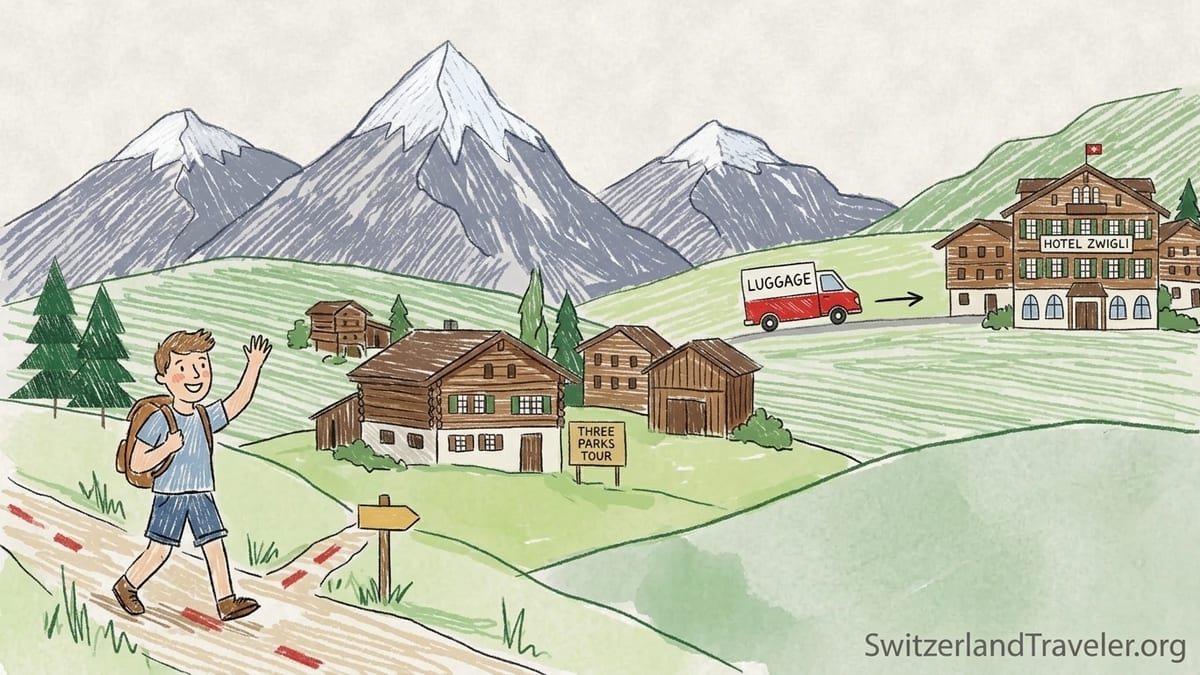
A typical example is the official Three Parks Tour hiking holiday, promoted through Switzerland Tourism and the parks themselves. The package is described as a six-day hike through landscapes shaped by alpine farming, traditional cheese production and historic wooden architecture, running from Diemtigtal Nature Park through Gantrisch Nature Park and on to Gruyère Pays d’Enhaut Regional Nature Park. For roughly CHF 1,185 per person in a double room, hikers receive five nights of accommodation with breakfast, luggage transfer between each stop and comprehensive route documentation including maps and local information. Exact inclusions can vary by provider, but the structure is consistent: you walk with a light daypack while someone else handles your bag and the underlying logistics.
This approach is mirrored in other Swiss Parks packages. Some focus on a single park, such as short hiking breaks in Diemtigtal that combine two or three nights in local guesthouses with suggested routes and optional luggage transfer. Others are themed multi-day cycling tours around the Swiss National Park or through the Jura Vaudois, again packaged with hotels and route documentation. For international travelers, the key differentiator is that these are turnkey holidays: you pay once and arrive in Switzerland with most of the planning done.
Inside the Three Parks Tour: Route, Parks and Daily Rhythm
The Three Parks Tour is designed as an accessible inn-to-inn trek that balances scenic walking with cultural encounters. While exact start and end points vary slightly by season and operator, the route typically begins in or near the village of Oey in the Diemtigtal Nature Park, easily reached by train from Bern or Thun. From there, walkers climb into rolling alpine pastures framed by the valley’s farmhouse-dotted slopes, staying in small hotels or guesthouses in villages such as Grimmialp or Zwischenflüh. Daily stages are usually in the region of 4 to 6 hours of walking, with altitude gains that feel moderate for fit hikers but remain achievable for those with limited high-mountain experience.
Crossing into Gantrisch Nature Park, the character shifts subtly. Gantrisch is popular among panorama lovers for its ridgeline views across the Bernese Alps and towards the Mittelland plateau. On the Three Parks Tour, this might mean a day that starts with a forested climb, continues over open ridges with views of peaks like Gantrisch and Nünenenfluh, and ends in a quiet village where your bag already awaits in your room. The route tends to stay on well-marked mountain paths rather than exposed high-alpine terrain, with waymarks that match the Swiss national hiking standards.
In the final stages, walkers enter Gruyère Pays d’Enhaut Regional Nature Park, known for its patchwork of pastures, gorges and traditional timber architecture. One day might combine balcony paths above the Sarine River with a stop at a small alpine cheese dairy, followed by an overnight in a village like Charmey or Château-d’Oex. Documentation supplied in the package often highlights specific cultural stops, from heritage sawmills to chapels, so that the walk doubles as a slow-tourism introduction to rural French-speaking Switzerland.
Because it is a point-to-point itinerary, each day ends at a different accommodation, typically mid-range three-star hotels or good guesthouses that know how to cater to hikers: early breakfast options, drying space for boots, and straightforward access to the trail the next morning. The walking days are structured so that you can arrive mid-afternoon, shower, and still have time to explore the village or visit a local museum before dinner.
What Your Money Buys: Hotels, Luggage Transfer and Route Maps
On paper, the Three Parks Tour’s headline price of about CHF 1,185 for 6 days and 5 nights might look high when compared with booking a budget guesthouse and carrying your own pack. To understand the value, it helps to unpack the main components. First are the hotel nights themselves. Mid-range double rooms in Swiss rural areas commonly run around CHF 150 to CHF 200 per night with breakfast. Five nights in that range already account for CHF 750 to CHF 1,000, especially in high summer or during local festivals when demand rises.
The second pillar is luggage transfer. In the Three Parks Tour package, your suitcase or large backpack is moved each morning from one hotel to the next, allowing you to walk with only a daypack. Independent baggage transport along rural routes in Switzerland is available but not cheap; same-day transfers between small villages can easily cost CHF 60 to CHF 100 per stage if arranged privately, particularly if a dedicated vehicle is required to reach a single inn or guesthouse. Spread over four or five walking days, that can quickly add up to several hundred francs for a couple.
The third component is route documentation. Official Swiss Parks packages usually provide a detailed itinerary with daily stage descriptions, elevation profiles and estimated walking times, often supplemented by printed maps or access to digital mapping tools. While Switzerland’s national mapping agency and commercial publishers sell excellent maps separately, many visitors underestimate the time needed to assemble an inn-to-inn route with logical overnight stops, realistic daily distances and safe alternatives in bad weather. The package documentation aims to solve that problem by giving you a ready-to-walk route that has already been tested and timed.
Finally, there is the hidden value of coordination. When you buy the Three Parks Tour through a recognized operator, a single partner is responsible for confirming room availability across the entire route, synchronizing luggage pickups and drop-offs, and providing a contact point in case of delays, illness or route closures. For travelers unfamiliar with Swiss rural transport or who do not speak German or French, that consolidated support can make the difference between a relaxed walking holiday and a week of troubleshooting.
Single-Park Packages vs Multi-Park Tours
Swiss Parks holiday products fall broadly into two categories: single-park packages that focus on one region, and multi-park tours like the Three Parks itinerary. Single-park trips are often shorter, such as a three-night hiking break in the Diemtigtal Nature Park with two full walking days framed by arrival and departure. These may include one base hotel, optional luggage transfer from the nearest station, and a choice of circular routes or short transfers to trailheads. For visitors who prefer not to change hotels every night, this hub-and-spoke model has clear appeal.
Multi-park tours, by contrast, are inherently itinerant. The Three Parks Tour moves through three officially recognized parks in less than a week, linking them on foot so that each overnight stop sits in a new landscape and often a new cultural context. Other Swiss Parks offers follow a similar pattern, such as cycling holidays that combine the Jura Vaudois Nature Park with neighboring regions or walking tours that weave between Parc Ela and adjoining valleys. In each case, the attraction is variety: new scenery, new villages and often a change of language or cuisine over the course of a few days.
In practical terms, single-park packages tend to involve lower total travel time and fewer variables. If you spend four nights in one village hotel in a park like Parc Ela, a single weather front has less impact because you can move walking days around or choose different local routes based on conditions. Multi-park tours offer less flexibility once started, because hotel bookings and luggage transfers are locked to a set sequence. However, they reward that commitment with the feeling of an actual journey, a sense of crossing a region rather than circling a single valley.
Price-wise, multi-park inn-to-inn tours that cover more ground and use several accommodations can cost slightly more per person per night than base-camp style packages. But they often compare favorably to booking separate hotels in high-demand tourist hubs such as the central Bernese Oberland or Engadin, especially when you factor in that the included hotels are distributed across quieter villages inside the parks, where seasonal price spikes are sometimes less sharp than in famous resort towns.
Packages vs DIY: Is It Worth Booking Through Swiss Parks?
For experienced hikers who are comfortable with route planning, reading topographic maps and calling rural guesthouses in German or French, organizing a Swiss park-to-park trek independently can certainly work. Many do exactly that by piecing together sections of national trails like the Via Alpina or regional routes signposted through nature parks. When you go fully DIY, you gain maximum flexibility in daily distances, accommodation standards and rest days, which can be especially appealing for long trips of two weeks or more.
However, the official Swiss Parks packages, and the Three Parks Tour in particular, exist because many travelers want a simpler path. If you tried to replicate the same 6-day route on your own, you would spend time identifying villages with suitable hotels, checking that each property accepts one-night stays during your dates, coordinating check-in times with luggage logistics, and sourcing accurate maps. You might use national baggage services for train-accessible stages, then still need local taxis for hotels far from rail lines. None of that is impossible, but it introduces numerous potential friction points into a short holiday.
By comparison, the package model resembles a self-guided group tour: the route and bookings are fixed, yet you walk independently at your own pace. You know in advance that each overnight stop has secure luggage storage, that breakfast will be timed with your walking day, and that route notes will highlight detours or shortcuts if the weather turns. For many visitors, especially those flying in from overseas with limited vacation time, that reduction in uncertainty is worth the modest price premium over a bare-bones DIY trip.
There is also a sustainability angle. Swiss Parks are heavily involved in promoting car-free access, often cooperating with public transport providers under initiatives that can include discounted or half-price travel when you book multi-night stays in partner accommodations. A pre-packaged hiking holiday that assumes train or bus access from the outset can nudge visitors away from hiring cars and towards lower-impact travel, which aligns with the conservation goals of the parks themselves.
How Route Documentation and Maps Shape the Experience
One of the most underrated advantages of official Swiss Parks walking holidays is the quality of route documentation. On the Three Parks Tour, the supplied materials typically include day-by-day descriptions that specify approximate walking time, cumulative ascent and descent, waymark numbers at key junctions and suggestions for lunch or snack stops. This goes beyond simply handing over a generic topographic map. It is curated guidance built around how an average hiker is likely to move through the terrain over a fixed schedule.
For instance, a stage might be described as 5 hours of walking with 700 meters of ascent and 600 meters of descent, highlighting a recommended morning coffee stop at a mountain inn and pointing out where you can shorten the route in bad weather by descending to a valley bus stop. In some cases, you may gain access to GPS tracks compatible with common hiking apps, allowing you to follow the route line on your phone even when cloud or fog reduces visibility. Paper maps still play a critical safety role, but the layered documentation reduces the cognitive load of constant navigation decisions.
Switzerland’s national hiking sign network is excellent, yet the sheer density of waymarked routes can be confusing without context. A single intersection in Gantrisch Nature Park might offer signposts to multiple summits, passes and villages, each with estimated times but no indication of which choice best fits your day’s goal. Having route notes that explicitly say “follow the signs to X until Y junction, then switch to Z” removes guesswork, particularly when you are tired at the end of a stage.
For travelers accustomed to spontaneous day hikes, this kind of structured documentation can initially feel restrictive. In practice, many find it liberating. With the big decisions made in advance, you can spend more attention on the landscape itself: watching farmers move cattle to new pastures, pausing at educational panels about peat bogs or alpine flora, or simply noticing how the architecture evolves as you cross from German- to French-speaking regions within the same tour.
Who Benefits Most from Swiss Parks Walking Packages
Swiss Parks hiking packages are not only for veteran trekkers. In fact, the Three Parks Tour is often marketed as suitable for reasonably fit walkers with some mountain experience rather than as a technical alpine challenge. Daily distances are calibrated so that most people who regularly walk several hours at home can manage the stages, provided they are comfortable with some steeper sections and uneven paths. That makes it an attractive first multi-day trek for couples or small groups who want to test inn-to-inn hiking without the pressure of hut life or carrying a full pack.
They also appeal to travelers who value comfort and local food culture as much as the walking itself. Because the packages are based in small hotels and guesthouses rather than large resorts, dinner might feature regionally specific dishes, from Bernese rösti variations in Diemtigtal to Gruyère cheese specialities in the final stages. Package descriptions often list whether half-board is available or can be added, giving guests the opportunity to enjoy a multi-course menu after a day on the trail without having to hunt for restaurants in small villages.
Solo travelers can particularly benefit from the logistical support embedded in a Swiss Parks package. While a single supplement typically applies, walking alone with a daypack on a well-documented, pre-booked route can feel safer than improvising accommodations each night. Knowing that hotel staff expect your arrival, that your luggage is being tracked, and that a contact number exists for emergencies provides psychological comfort in unfamiliar terrain, even though Swiss hiking areas are generally safe.
Finally, these packages help families and older hikers who want the sense of an overland journey but prefer to avoid heavy backpacking. A multi-generational group might, for example, book the Three Parks Tour and decide that one member rides a bus shortcut on the longest day while others complete the full stage, regrouping at the same hotel in the evening. Because the accommodations are fixed and luggage is transferred automatically, each person can adjust the walking distances to their ability without compromising the overall structure of the trip.
The Takeaway
Swiss Parks hiking holiday packages, and the flagship Three Parks Tour in particular, sit at the intersection of independent trekking and fully guided travel. They allow you to experience three distinct nature parks on foot in just under a week, staying in comfortable local hotels while your luggage quietly moves from one stage to the next. The headline price around CHF 1,185 for 6 days and 5 nights reflects not only room nights, but also the cost of coordinated baggage transfers, curated route documentation and on-the-ground support.
Compared with arranging everything yourself, these packages trade some flexibility for a smoother experience, especially if you are short on planning time, new to multi-day hiking or traveling from overseas. Single-park options suit those who prefer a base-camp approach, while multi-park tours like the Three Parks route reward walkers with a genuine sense of progression through changing landscapes and cultures. If your goal is to maximize time on the trail and minimize time on booking platforms and timetables, letting the Swiss Parks network handle the logistics can be an excellent investment in your holiday.
FAQ
Q1. What exactly is included in the Three Parks Tour package price?
The Three Parks Tour typically includes 5 nights of accommodation in mid-range hotels or guesthouses, breakfast, daily luggage transfer between each stage and detailed route documentation with maps and stage descriptions. Some providers offer optional half-board dinners and extras such as arrival-day information meetings, but these are not always included in the base price, so it is important to check the current offer description before booking.
Q2. How difficult is the hiking on the Three Parks Tour?
The route is designed for reasonably fit walkers rather than expert mountaineers. Most days involve 4 to 6 hours of hiking with moderate ascent and descent on marked mountain paths. Trails are generally non-technical, but you should be comfortable with uneven surfaces, occasional steeper sections and changes in weather. If you regularly walk several hours at home and have some experience on hilly or mountainous terrain, you are likely to find the difficulty level appropriate.
Q3. Can I book extra nights before or after the Three Parks Tour?
Yes, most operators and partner hotels allow you to add pre- and post-tour nights in the region or in gateway cities such as Bern or Thun. This can be a good way to recover from jet lag before starting the walk or to explore additional sights after finishing, such as visiting the historic center of Gruyères or taking a boat trip on Lake Thun. Extra nights are usually charged separately from the core package price.
Q4. Is luggage transfer available if I organize my own route?
Independent hikers can often arrange luggage transfer through a combination of national rail baggage services and private local providers, but availability and cost vary significantly. In rural park villages not directly on main rail lines, you may need to hire taxis or small transport companies for door-to-door service, which can be expensive on a per-day basis. Booking an official Swiss Parks package where luggage transfer is included can be simpler and often better value than organizing ad hoc services on your own.
Q5. How do single-park packages differ from the Three Parks Tour?
Single-park packages typically focus on one nature park and use a single hotel or a small number of nearby accommodations as a base for several days of walking. You might stay four nights in one village and choose from a menu of local hikes, sometimes with optional luggage transfer from the nearest station. The Three Parks Tour, by contrast, is an inn-to-inn itinerary that moves through three parks in sequence, so you change hotels almost every night and follow a continuous route rather than a series of day hikes.
Q6. Do I need advanced navigation skills if route maps are provided?
Official route documentation and maps significantly reduce the demands on navigation, but basic skills remain important. You should be able to read trail signposts, interpret simple elevation profiles and orient yourself using a paper map if necessary. Many walkers also use GPS tracks on their phones as a backup. The package materials are designed so that an attentive hiker with modest map-reading experience can follow the route without difficulty in normal weather conditions.
Q7. When is the best time of year to hike the Three Parks Tour?
The Three Parks Tour is usually available during the main summer hiking season, roughly from late June to early October, depending on snow conditions and local infrastructure such as mountain inns. July and August bring the warmest temperatures and the most reliable trail access, but also higher demand and potentially busier paths. June and September can offer quieter trails and cooler walking temperatures, though some high sections may still be affected by late snow or early autumn weather.
Q8. Are these packages suitable for families with children?
Some Swiss Parks walking holidays are suitable for active families, particularly with older children who enjoy full-day hikes. The Three Parks Tour involves multiple consecutive walking days and daily changes of hotel, which can be demanding for very young children. Families may prefer a single-park package with a fixed base and the flexibility to choose shorter or easier trails on some days. It is wise to discuss your children’s ages and hiking experience with the booking partner before committing.
Q9. How does booking through the Swiss Parks network support local communities?
Packages developed with the Swiss Parks network typically prioritize locally owned hotels, guesthouses and service providers such as guides or small transport companies. The itineraries often include visits to local farms, cheese dairies or heritage sites that benefit directly from visitor spending. By channeling overnight stays and activities into designated park communities, these holidays support rural economies while encouraging conservation-friendly tourism practices.
Q10. Can I combine a Swiss Parks hiking package with cycling or other activities?
Yes, it is quite common to combine a walking package with additional activities before or after the tour. The parks network and its partners also offer cycling and e-biking holidays, as well as themed experiences such as culinary trails or wildlife observation days. You might, for example, book the Three Parks Tour and then add a two-day cycling break near the Swiss National Park or a scenic train journey to a different region of Switzerland. Planning these add-ons at the time of booking helps ensure smooth connections and coordinated luggage arrangements.