


Few journeys feel as effortless and spectacular as crossing the Swiss Alps entirely by train. Linking the Jungfrau Region, Zermatt, Andermatt and St. Moritz, you can stitch together a week or two of panoramic rail rides, car-free villages and high‑alpine excursions without ever needing a rental car. This guide explains how to turn these famous mountain resorts into one coherent rail-based itinerary, with practical advice on passes, reservations, luggage and where to stay along the way.
Why Link Jungfrau, Zermatt, Andermatt and St. Moritz by Train
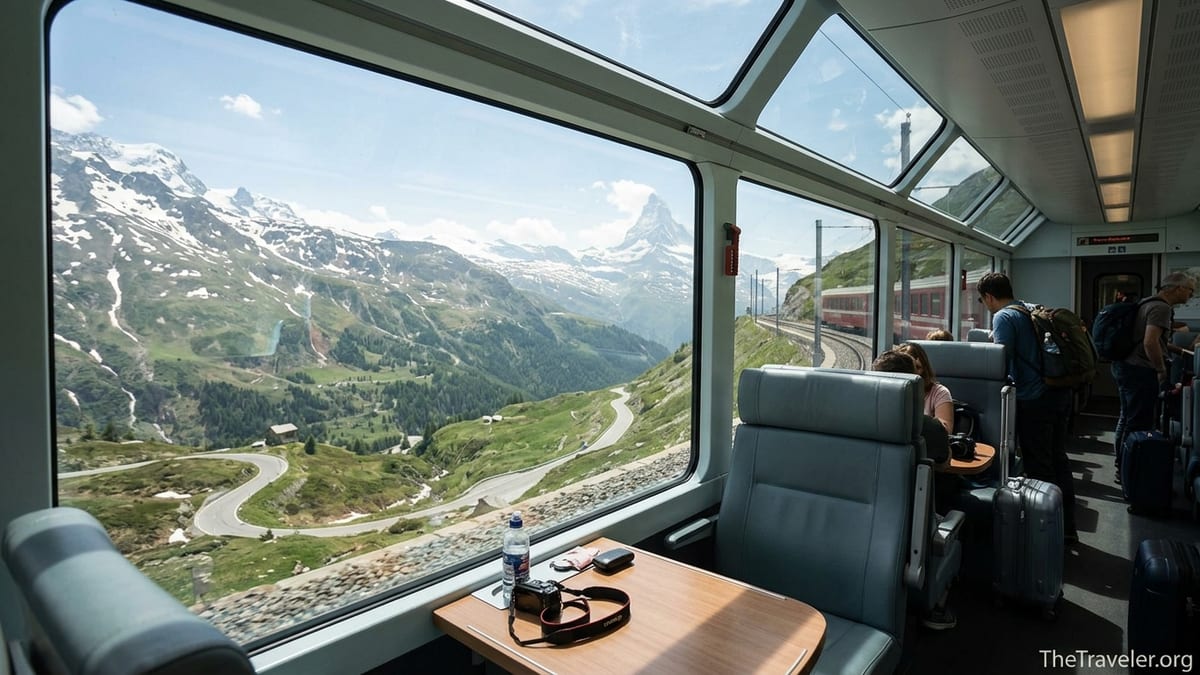
This route strings together four of Switzerland’s most scenic mountain areas on one continuous rail journey. You begin in the Jungfrau Region above Interlaken, where cog railways climb towards the Eiger and Jungfraujoch. From there you head south to car‑free Zermatt for Matterhorn views, then over the spine of the Alps via Andermatt, before rolling into St. Moritz and the Engadin valley. Each section is connected by regular trains, and the core Zermatt–Andermatt–St. Moritz leg is the historic Glacier Express route, famous for its panoramic cars and all‑day traverse of the Alps.
For many visitors, this forms the backbone of a personal version of the Grand Train Tour of Switzerland, using a single rail pass to ride almost every train, bus and boat involved. With a Swiss Travel Pass valid 3, 4, 6, 8 or 15 days in 1st or 2nd class, you can cover the entire mainline network and most mountain access trains, paying only supplements or discounted surcharges on a few premium segments like Jungfraujoch and certain scenic trains.
The advantage over a road trip is predictability and comfort. Timetables are frequent on key stretches such as Interlaken to the Jungfrau villages, and the narrow‑gauge lines run year‑round apart from short maintenance closures, especially on the Glacier Express. You can step off trains directly in resort centres like Wengen, Mürren, Zermatt and St. Moritz, with no transfer from a distant highway involved.
Finally, Switzerland actively designs its infrastructure around rail‑based holidays. Family rooms in midrange hotels often sit within a five‑minute walk of the station, luggage forwarding services are widely available, and tickets and reservations can be managed centrally through national rail channels or the dedicated Glacier Express system.
Best Rail Passes, Tickets and Approximate Costs
For most international visitors planning a 7–14 day trip that links multiple regions, the Swiss Travel Pass is usually the simplest backbone. It provides unlimited travel on trains, most buses and boats nationwide for 3, 4, 6, 8 or 15 consecutive days in 1st or 2nd class. As of the current price table, a 6‑day 2nd‑class Swiss Travel Pass is listed at around 400 Swiss francs for adults, while 8‑day and 15‑day versions rise to the mid‑400s and just under 500 francs respectively. A 4‑day 1st‑class pass is typically just under 500 francs. Exact prices can vary by sales channel and promotions, so it is worth checking shortly before purchase.
The Swiss Travel Pass covers standard trains on the entire Interlaken–Jungfrau Region access lines, along the Matterhorn Gotthard Railway from Brig to Zermatt and Andermatt, and on the Rhaetian Railway around St. Moritz. It also includes travel on panoramic trains such as the Glacier Express itself, though separate mandatory seat reservations and surcharges apply. On mountain excursions, the Swiss Travel Pass often provides reductions rather than full coverage. For example, the journey from the Jungfrau Region up to Jungfraujoch is discounted rather than fully free, and similar partial reductions apply on many cable cars.
On the Glacier Express between Zermatt and St. Moritz, there are two separate items: the travel ticket (which can be your Swiss Travel Pass or a regular point‑to‑point ticket) and the compulsory seat reservation. Reservation charges are dynamic and vary by season and distance, but for a full‑route, high‑season day in 2nd class, travellers typically budget several dozen francs per person on top of their pass. The Glacier Express timetable usually offers at least one daily departure in each direction for the full Zermatt–St. Moritz route, with additional seasonal trains, but seats can sell out weeks in advance for July and August.
Regionally focused passes can make sense if you extend time in one area. The Jungfrau Travel Pass, for example, provides unlimited use of many lifts and mountain trains in the Jungfrau Region for several days, and is often chosen by visitors staying four nights or more in Grindelwald or Wengen. Some travellers combine a Jungfrau Travel Pass for intensive local exploration with a shorter Swiss Travel Pass for the inter‑region travel days, especially on longer 12–14 day trips.
Designing a 7‑Day Highlights Itinerary
A compact one‑week itinerary focuses on a single base in each region and one major scenic train. One practical example starts in Interlaken and ends in St. Moritz, using a 6‑day Swiss Travel Pass in 2nd class plus a Glacier Express reservation for the Zermatt–St. Moritz sector.
Day 1 and 2 can be based in the Jungfrau Region. Many visitors stay in car‑free Wengen or the valley village of Lauterbrunnen rather than Interlaken itself, because trains from Interlaken Ost reach Lauterbrunnen in around 20 minutes and Grindelwald in about 30 minutes, with onward mountain railways climbing from there. A typical arrival day might see you land in Zurich or Geneva in the morning, ride to Interlaken Ost by midday, then connect to Wengen in time for an afternoon walk above the Lauterbrunnen valley cliffs.
On Day 2 you could dedicate the morning to a trip to Jungfraujoch, timing your departure from Wengen or Grindelwald early enough to reach the summit while skies are often clearest. The full ride from Interlaken Ost to Jungfraujoch via Grindelwald Terminal and the fast Eiger Express gondola is about an hour and a half, while the classic rail route via Lauterbrunnen and Kleine Scheidegg is closer to two hours. After exploring the Ice Palace and Sphinx observatory, you descend in mid‑afternoon and return to your base for a quieter evening.
Day 3 is your transfer to Zermatt. You ride back down to Interlaken Ost, continue along the lake to Spiez, then change toward Brig and on to Visp, before taking the narrow‑gauge train up the valley to Zermatt. With well‑timed connections, the whole trip is usually around 2.5 to 3.5 hours. Check into a hotel within walking distance of Zermatt’s station, which is easy in this compact car‑free village. If weather cooperates, you may still have time for a short ride on the Gornergrat Railway for an evening view of the Matterhorn.
Days 4 and 5 split between Zermatt and the Glacier Express. Spend one full day exploring Zermatt’s lifts, for instance using your pass discount on the Gornergrat Railway or gondolas towards Rothorn. On Day 5, join the morning Glacier Express from Zermatt. The full journey to St. Moritz takes about eight hours, crossing the Oberalp Pass above Andermatt and threading through deep gorges and high valleys before arriving in the Engadin early evening. Staying near St. Moritz’s lakeshore or by the railway station keeps logistics easy on arrival.
The final two days, 6 and 7, belong to St. Moritz and the Engadin. One day could feature an excursion on a regional Rhaetian Railway train along part of the Bernina line toward Poschiavo, or a loop to nearby alpine lakes. Another day can be spent on local hikes from Corviglia or Muottas Muragl, both served by funiculars or cableways, before departing St. Moritz by rail to Zurich or Milan on your final travel day.
Building a 10–14 Day Slow‑Travel Circuit
With 10 to 14 days you can add extra bases and overnights along the route, smoothing out long days and opening time for bad‑weather flexibility. One common strategy is to insert an overnight or two in Andermatt between Zermatt and St. Moritz, and to add a second base within the Jungfrau Region itself, for example splitting nights between Lauterbrunnen and car‑free Mürren or Grindelwald.
On a 10‑day version, you might spend four nights in the Jungfrau Region, three in Zermatt, one in Andermatt and two in St. Moritz. After your initial nights in Wengen, move up to Mürren for two more, using the cable cars and funiculars above the Lauterbrunnen valley to visit Schilthorn or hike between Allmendhubel and Grütschalp. A regional Jungfrau pass starts to make financial sense at this length of stay, since you are riding multiple mountain lifts each day.
Leaving the Jungfrau Region, you can add a night in Brig or Leukerbad to break the journey before reaching Zermatt, especially if you want to visit thermal baths or vineyards in Valais. Once in Zermatt, three or even four nights let you plan around weather for peak viewpoints like Gornergrat or Klein Matterhorn, where cloud cover can change every hour. During a longer stay, some travellers choose to ride the Glacier Express only from Zermatt to Andermatt instead of the full route, then switch to regular regional trains on staggered days from Andermatt through Chur and into St. Moritz.
Andermatt itself has transformed into a year‑round mountain resort with easy rail access. The Matterhorn Gotthard Railway runs through its compact station, with regional trains connecting toward both Brig and Disentis, and the Glacier Express passing through as well. Spending one or two nights here lets you take half‑day trips over the Oberalp Pass or down the valley with minimal packing and unpacking.
By the time you reach St. Moritz, a 14‑day itinerary can afford three or four nights in the Engadin. This allows not only for a full excursion on the Bernina line in one direction, perhaps continuing by bus or regional train toward Tirano before looping back, but also for recovery days by the lake or shorter hikes around Pontresina. A 15‑day Swiss Travel Pass aligns neatly with such an extended circuit, removing the need to track separate tickets across the two weeks.
Luggage, Seating, and Reservations on Scenic Trains
Travelling this circuit with luggage is straightforward if you follow a few habits. Swiss regional and long‑distance trains allow passengers to bring their suitcases without extra fees, storing them in overhead racks, between seat backs or in dedicated luggage zones near doors. On the narrow‑gauge trains up to Zermatt or across to Andermatt and St. Moritz, these spaces can fill up at peak times, so boarding a little early at terminus stations like Zermatt, Andermatt or St. Moritz helps you find room for large bags.
If you prefer not to handle heavy luggage on travel days, Swiss Federal Railways and partner companies sell station‑to‑station luggage forwarding, where you drop checked bags at one staffed station counter in the morning and collect them at your destination station later the same day or the next morning, depending on the service chosen. For example, on a Zermatt to St. Moritz transfer day that includes the Glacier Express, you can send large cases ahead and keep only a small daypack with you in the panoramic carriage.
The Glacier Express itself requires seat reservations in addition to a valid ticket or pass. Reservations open months in advance, with some periods temporarily blocked before each new timetable year is loaded. High‑season trains in July and August, and popular dates around Christmas and New Year, can show limited availability several weeks before departure. Travellers often report that booking three months ahead gives the best choice of class and seating, though it remains possible to secure individual seats closer in on shoulder‑season dates.
On board, 1st class on the Glacier Express offers slightly wider seats and a 2‑plus‑1 layout, while 2nd class uses a 2‑plus‑2 layout. Both have large panoramic windows. An even more premium Excellence Class includes a guaranteed window seat, multi‑course meal and dedicated bar, but must be booked specifically and costs significantly more on top of the base fare and reservation. Many visitors find 2nd class perfectly adequate for enjoying the scenery, while 1st class appeals to those who value extra space on the eight‑hour ride. On busy summer days, asking for seats on the right or left side of the train is largely a matter of personal preference, as highlights appear on both sides over the full route.
Choosing the Right Hotel Bases in Each Region
In the Jungfrau Region, the main decision is whether to stay down in Interlaken or ascend into the mountain villages. Interlaken offers a wider range of chain hotels and easier rail connections for very early or late arrivals, but it sits on the valley floor, separated from the most dramatic scenery. Villages like Wengen, Mürren and Grindelwald are perched higher up, reached by frequent trains or cable cars, and allow you to step straight from your hotel to alpine trails or lifts.
Wengen, accessible only by cog railway from Lauterbrunnen, offers classic Belle Époque hotels, car‑free streets and direct access to Kleine Scheidegg. Families and couples who want quieter evenings and easy access to the Jungfraujoch trains often choose it as a base. Grindelwald is larger and more spread out, with a wider range of apartments and chalets plus direct access to the Eiger Express gondola from Grindelwald Terminal. Mürren, reached by cable car and mountain railway from Lauterbrunnen, offers perhaps the most dramatic cliff‑edge setting above the valley but requires one additional connection step when arriving or departing with luggage.
In Zermatt, most visitors choose to stay within a 10‑minute walk of the main station. The village is car‑free, with only small electric taxis and hotel shuttles on its main street. Staying near the station and Gornergrat Railway terminus makes departure days especially easy, as you can roll your suitcase directly to the platform. For Matterhorn views from your balcony, properties in the higher Winkelmatten and Oberdorf districts are popular, though they involve a mild uphill walk from the station.
Andermatt’s hotel offering has expanded significantly, from traditional inns near the station to modern resorts near the Gütsch‑Express gondola. If you are using Andermatt primarily as a rail hub overnight, look for accommodation within a few minutes’ walk of the Matterhorn Gotthard Bahn platforms, since early departures often leave just after breakfast. In St. Moritz and nearby villages such as Celerina or Pontresina, a hotel that includes local transport cards can be good value, as many properties provide complimentary regional bus or lift access for guests during summer stays.
Practical Seasonal and Weather Considerations
The rail infrastructure on this circuit operates throughout the year, but seasonal variations affect what you see and which services run. The Glacier Express typically pauses for a maintenance break in late autumn, often from mid‑October through late November or early December on specific timetable years, during which you can still travel the full route by regular regional trains but not on the branded panoramic service. If you plan a November trip, expect to ride standard carriages with smaller windows but the same underlying scenery.
Winter brings snow and short daylight hours. On sunny days, the low angle of light across snowy slopes makes the Zermatt to Andermatt section particularly beautiful, though some high hiking trails and summer‑only lifts in the Jungfrau Region and Engadin will be closed. Many visitors combine this itinerary with skiing weeks, staying longer in one resort such as Andermatt or St. Moritz and using the trains for scenic rest days between ski sessions.
Summer from June to September offers the greatest flexibility for hiking and open lifts. It is also the busiest season on the Jungfraujoch line and Glacier Express, so booking reservations and key mountain excursions well in advance is advisable. Shoulder seasons in May and October can deliver quieter trains and lower hotel rates, but some cable cars and mountain restaurants may be closed for maintenance. Checking operating dates for key lifts like the Eiger Express or Gornergrat Railway before finalising your dates helps avoid surprises.
Weather in high alpine zones is changeable at any time of year. It is common to plan two possible summit days in each region, especially on 10–14 day itineraries. For example, keep both your first and second full days in the Jungfrau Region flexible and watch live webcams in the morning to decide whether to prioritise Jungfraujoch or a valley hike. Similarly, in Zermatt, you might wait for the clearest morning to ride to Gornergrat or Klein Matterhorn for the broadest Matterhorn panorama.
The Takeaway
Linking the Jungfrau Region, Zermatt, Andermatt and St. Moritz by rail lets you experience many of the Swiss Alps’ most iconic landscapes in one continuous, car‑free journey. By combining a Swiss Travel Pass with targeted local passes, planning Glacier Express reservations early, and choosing hotel bases close to railway stations, you can turn a 7–14 day itinerary into a smooth sequence of scenic rides and relaxed resort stays.
Whether you prefer a compact 7‑day highlights tour or a slower 14‑day circuit with extra nights in Andermatt and the Engadin, the key decisions revolve around season, pace and how much time to allocate for weather windows on big‑ticket excursions. Build in flexible days, use station‑to‑station luggage services if heavy bags are a concern, and take advantage of the dense timetable of regional trains that mirror the famous Glacier Express route.
With those pieces in place, the logistics recede into the background, leaving you to watch the landscape shift from the cliffs of Lauterbrunnen to the glaciers around Zermatt and the wide valley of the Upper Engadin. The Swiss rail network is designed to make this kind of journey uncomplicated, which is why so many travellers return to refine and extend their own version of this alpine rail itinerary.
FAQ
Q1. Do I need the Glacier Express, or can I use regular trains between Zermatt, Andermatt and St. Moritz?
The Glacier Express is the most famous way to travel the full route in one day, with panoramic windows and at‑seat service, but it is not the only option. Regular regional trains operated by the Matterhorn Gotthard Railway and Rhaetian Railway cover the same line with changes in places like Brig, Andermatt and Chur. These regional services are fully covered by the Swiss Travel Pass without extra reservation fees, though they use standard carriages with smaller windows and may require more transfers.
Q2. How far in advance should I reserve Glacier Express seats?
For peak summer months and popular winter holiday periods, reserving around three months in advance offers the best chance of securing your preferred date and class. Outside those times, it is often possible to find seats several weeks or even days before departure, especially if you are flexible on departure time or direction. Since reservations are compulsory in addition to a ticket or pass, you should not board the Glacier Express without a confirmed reservation.
Q3. Is a Swiss Travel Pass better than buying single tickets for this itinerary?
For a multi‑region trip of 7–14 days that includes long intercity rides and several mountain access lines, a Swiss Travel Pass is often more economical and certainly more convenient than buying every segment separately. A 6‑ or 8‑day pass can already cover most of a 7‑ to 10‑day route if you align your biggest travel days within its validity. However, if you plan only a few long train days and spend the rest of your time in one region without many lifts, it is worth comparing the total cost of point‑to‑point tickets plus any regional passes to the price of a national pass.
Q4. Where should I base myself in the Jungfrau Region for this route?
For a rail‑focused itinerary, Wengen, Lauterbrunnen, Grindelwald and Mürren are the main options. Wengen and Grindelwald are well placed for Jungfraujoch trips and have direct trains from Interlaken Ost, while Lauterbrunnen works well if you want to split time between the Schilthorn side and Wengen side of the valley. Mürren has the most dramatic cliff‑top setting but adds an extra cable car and mountain railway transfer when arriving or departing with luggage. If you have four or more nights, splitting your stay between Lauterbrunnen and either Wengen or Mürren gives you variety with short transfer distances.
Q5. Is it practical to travel this route with large suitcases?
Yes, provided you allow a little extra time for boarding and transfers. Swiss trains are designed with racks at the carriage ends and above seats, and platforms are usually level with train floors or connected by lifts or ramps. On very busy summer departures to and from Zermatt or Interlaken, luggage spaces can fill quickly, so boarding early at terminus stations helps. If you prefer to travel light during the day, you can use station‑to‑station luggage services, dropping bags in the morning and collecting them at your next station later on.
Q6. How many days should I spend in each region on a 10–14 day trip?
A balanced plan might allocate four nights to the Jungfrau Region, three nights to Zermatt, one or two nights to Andermatt and two to four nights to St. Moritz and the Engadin. This gives you at least two full days in each major region, plus weather flexibility for key viewpoints like Jungfraujoch, Gornergrat and the Bernina line. If you are particularly interested in hiking or skiing in one area, you could shift an extra night there and reduce Andermatt to a simple overnight stop between Zermatt and St. Moritz.
Q7. Do I need to reserve seats on other trains besides the Glacier Express?
On most standard Swiss domestic trains, including intercity services between Zurich, Bern, Interlaken and Brig, seat reservations are not required and many locals travel without them. Some international trains, such as certain services from Switzerland into Italy, do require reservations, and several premium panoramic trains besides the Glacier Express also charge a reservation fee. Within this specific itinerary, however, the Glacier Express is the only train where a seat reservation is compulsory as part of the journey between Zermatt, Andermatt and St. Moritz.
Q8. Is 1st class worth it on the Glacier Express and other trains?
On regular intercity and regional trains, 1st class offers more space and a quieter environment but the same speed and windows as 2nd class. Many budget‑conscious travellers find 2nd class perfectly comfortable. On the Glacier Express, 1st class adds wider seats and a 2‑plus‑1 seating layout, which can make the eight‑hour journey more relaxed, especially for couples wanting a pair of seats together on one side of the carriage. If your priority is scenery rather than cabin style, 2nd class is sufficient, but for a once‑in‑a‑lifetime splurge day, some travellers choose 1st class or the even more exclusive Excellence Class.
Q9. Can I do this itinerary in winter, or is it only for summer?
The core rail connections between Interlaken, Zermatt, Andermatt and St. Moritz operate year‑round, and all four regions are popular winter destinations. In winter, you will find snow‑covered landscapes, active ski areas and shorter daylight hours. Some high hiking trails and certain summer‑only lifts will be closed, and the Glacier Express has a planned pause for maintenance in late autumn. For a winter version of this trip, it is sensible to stay longer in one or two resorts for skiing or winter walks, using the scenic trains as transfers and sightseeing days between them.
Q10. Do I need to prebook mountain excursions like Jungfraujoch and Gornergrat?
While it is possible to buy tickets on the day, popular excursions such as Jungfraujoch can sell out on clear days in high season, and early‑morning departures are particularly sought after. Many travellers now reserve specific time slots in advance, especially for peak summer or holiday periods, then adjust their plans closer to the date based on weather forecasts if the ticket conditions allow. For Gornergrat, trains are frequent and capacity is higher, so prebooking is slightly less critical, but having tickets organised beforehand still saves time at the station during busy hours.