


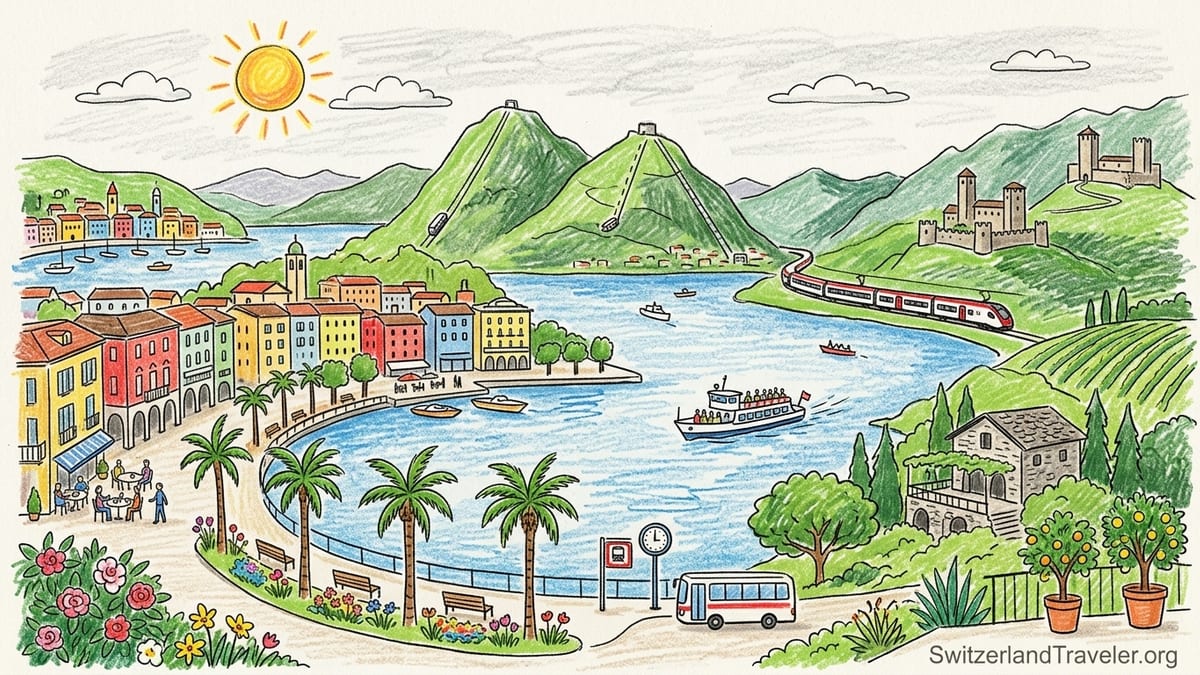
Southern Switzerland does not match the postcard image many travelers bring to mind. Instead of year-round snow and high peaks, Ticino, the country’s Italian-speaking canton, offers palm-lined lakes, vineyard hills, stone villages and medieval castles. This guide introduces the key destinations around Lugano and Lake Lugano, Locarno and Ascona on Lake Maggiore, Valle Verzasca and Vallemaggia, the Brissago Islands, Bellinzona and Mendrisiotto, to help first-time visitors understand the region and then dive deeper into dedicated accommodation, cruise and rail resources.
Southern Switzerland at a Glance: Why Ticino Feels Different
Ticino is Switzerland’s southern, Italian-speaking canton, separated from the German-speaking north by the Gotthard massif. Instead of dramatic glaciers and jagged four-thousand-metre peaks, the southern landscapes are built around lakes and mid-altitude mountains, with villages clustered on sunny slopes. Lugano sits on Lake Lugano, while Locarno and Ascona share the northern shore of Lake Maggiore. Bellinzona guards the main valley with its three UNESCO-listed castles, and to the south, Mendrisiotto rolls gently toward the Italian border with vineyards and historic hill towns.
Italian is the official language here, and it shapes everyday travel. You will see “via” instead of “strasse” on street signs, hear “buongiorno” on buses, and find espresso bars on almost every corner. Yet Ticino is still firmly Swiss in terms of punctual public transport, high safety standards and predictable pricing. A typical coffee at a bar in Lugano or Locarno costs around the same as in other Swiss cities, but the atmosphere is more Mediterranean, with locals lingering outdoors well into the evening from spring to autumn.
The climate underlines the contrast with the classic high-Alpine image. Around Lugano, average annual temperatures are above 12 degrees Celsius, with hot, often humid summers where daytime highs can climb above 30 degrees in July and August. Winters remain relatively mild along the lakeshores, and early spring often arrives weeks before it does in central Switzerland. Palm trees, camellias and citrus thrive along the promenades, which surprises visitors who might have packed only heavy hiking gear and ski jackets.
For planning, it helps to treat Ticino less as a winter-sports destination and more as a region for lakeside strolling, valley hikes, culture and food. Skiing is available in nearby small resorts, but most first-time visitors focus on boat trips on Lake Lugano or Lake Maggiore, excursions into the Verzasca and Maggia valleys, castle visits in Bellinzona and wine tasting in Mendrisiotto. Dedicated rail, cruise and accommodation pages can then help you build the details of your itinerary once you understand how these areas fit together.
Lugano, Morcote and Gandria: Lake Lugano’s Sophisticated South
Lugano is the main urban hub of Ticino and an ideal base for first-time visitors who want easy logistics. The city’s railway station sits on the north–south Gotthard rail line with direct trains toward Zurich and Basel, as well as frequent services to Milan. Regional rail operated by TILO and a dense local bus network run by Trasporti Pubblici Luganesi connect the lakefront with nearby hill districts and suburbs, so it is entirely feasible to stay without a car. From the station, it is a short walk or funicular ride down to the palm-lined lakeside promenade.
The town itself offers a blend of Italianate old streets and modern banking and conference buildings. You can spend a morning crossing Piazza della Riforma, ducking into churches and boutiques, then walk the flat promenade through Parco Ciani. For many visitors, the classic activity is a lake cruise: regular boats connect Lugano with smaller villages such as Gandria on one side and Morcote on another section of the lake. A typical one-way ticket for a short lake segment costs less than a mainline train journey, and various passes combine boat travel with local transport.
Gandria is a tiny, stepped village clinging to the lakeshore, accessible by boat or on foot along a scenic lakeside path from Lugano’s Cassarate area. Stone houses, narrow alleys and lakeside terraces give it a time-capsule feel. Morcote, on the opposite side of the lake near the Italian border, is larger and grander, with arcaded waterfront buildings and the hillside church of Santa Maria del Sasso reached by a long stairway. Both villages feel distinctly Mediterranean, with lush gardens, shaded grottos serving polenta and grilled meats, and outdoor tables set almost at water level.
Public transport wraps around these experiences. Boats on Lake Lugano run more frequently from spring through autumn and align well with day-trippers’ schedules, making it easy to do a loop that might include a ferry from Lugano to Morcote, a lakeside lunch, then a bus or boat back. From Lugano, funiculars bring you up to Monte Brè and Monte San Salvatore for panoramic hikes over the lake and surrounding mountains. Once you have decided whether you prefer a city hotel, lakeside resort or hillside guesthouse, it is straightforward to use more detailed accommodation and rail pages to match your location with your preferred views and connections.
Locarno, Ascona and the Brissago Islands: Lake Maggiore’s Mild Riviera
Locarno, on the northern tip of Lake Maggiore, feels smaller and more relaxed than Lugano, yet it is another key anchor for Southern Switzerland. The main train station sits a short walk from the historic center and lakefront, and regular regional trains link the town to Bellinzona, Lugano and the Centovalli line toward Italy. Locarno’s Piazza Grande, famous for hosting the Locarno Film Festival in August, is ringed with cafes and arcades that fill on mild evenings as locals gather for aperitivo.
Next door, Ascona spreads around a curved waterfront that feels almost seaside in summer. Colorful facades, restaurant terraces and small boats bobbing at the marina define the view. Ascona does not have its own train station, so most visitors arrive via bus or on foot from Locarno. Once there, daily rhythms revolve around the promenade: a morning cappuccino, a stroll past the art galleries in the backstreets, then perhaps a swim from one of the lidos or lake access points. Prices for lakeside dining can be higher here than in inland towns, but you are paying for the prime setting as much as the meal.
From both Locarno and Ascona, boats on Lake Maggiore fan out to nearby villages and to the Brissago Islands. These two small islands, just off the Swiss shore, host a botanical garden that feels much more subtropical than the latitude would suggest, with species from Mediterranean, subtropical and even some humid climate regions flourishing thanks to the lake-moderated temperatures. Regular passenger boats from Locarno, Ascona, Porto Ronco and Brissago itself make the islands an easy half-day excursion. Visitors typically combine a gentle walk through the gardens with lunch on the terrace and views back toward the mountains.
Lakeside promenades and boat schedules shape how you plan your stay. If your priority is stepping straight from your hotel into a lakeside evening stroll, consider accommodation in Ascona or close to Locarno’s lakefront, then use rail pages to connect your arrival route via Bellinzona. If you want to integrate a cruise-heavy itinerary focused on Lake Maggiore and its islands, looking up current boat timetables and special combined tickets on dedicated cruise pages is essential, particularly in shoulder seasons when frequencies and last departure times shift.
Valle Verzasca and Vallemaggia: Authentic Stone Villages and River Landscapes
North of Locarno and Lake Maggiore, the mountains fold into narrow, deeply carved valleys. Valle Verzasca and Vallemaggia are among the most accessible, yet they retain a markedly traditional feel. Postbuses leave from Locarno and nearby Tenero and follow the Verzasca river upstream, passing villages such as Vogorno, Corippo and Lavertezzo before reaching Sonogno near the valley’s head. In summer, the turquoise river pools and polished rock slabs near Lavertezzo attract swimmers and sunbathers, although currents can be strong and safety regulations are strict.
Vallemaggia, the Maggia Valley, stretches northwest from the shores near Locarno. The lower valley is wide, with easily reached bathing spots along the river and family-friendly walking trails. As you continue by bus or car, the valley splits into side branches such as Valle Bavona and the high village of Bosco Gurin, known for its Walser heritage. These upper sections feel more Alpine, with steeper slopes, stone barns and waterfalls, yet the climate in the lower reaches remains milder than in central Switzerland, allowing comfortable hiking from early spring into late autumn most years.
Public transport is a practical backbone for visiting both valleys. In high season, buses are timed to connect with trains in Locarno and run multiple times per day. Many visitors structure their day around a morning bus into the valley, a walk between villages such as Lavertezzo and Brione in Valle Verzasca or between mid-valley hamlets in Vallemaggia, and an afternoon return. Hiking guidebooks and local visitor centers recommend specific segments with estimated walking times, which helps you match your ambitions to bus departure times. Check rail and bus planning tools before you go; a missed last bus can mean a long and expensive taxi ride back to the lake.
Accommodation within the valleys is more limited and often simple, with stone guesthouses, mountain hostels and a handful of small hotels, so many first-time visitors choose to stay in Locarno or Ascona and treat the valleys as day trips. Dedicated accommodation pages can help you identify whether a rustic stay in a converted stone rustico or a full-service hotel on the lake suits you better. For those combining valleys and lakes, it is usually easiest to base yourself near Locarno’s transport hub and rely on buses and boats rather than switching hotels frequently.
Bellinzona and Mendrisiotto: Castles, Vineyards and Switzerland’s Southern Tip
Bellinzona, the cantonal capital, sits where the main north–south route through the Alps meets the side valleys of Ticino. For most rail travelers, it is the first major stop in the canton after the long Gotthard tunnel. The three medieval castles of Castelgrande, Montebello and Sasso Corbaro dominate the skyline and form a UNESCO World Heritage ensemble. Walking the fortress walls gives a strategic view of the valley and the rail lines threading north and south, making Bellinzona a useful stopover if you want to break a long cross-Swiss journey.
The town itself remains more workaday than Lugano or Locarno, but this is part of its appeal. On market days in warmer months, stalls fill the historic streets with local cheese, cured meats and seasonal produce. Accommodation options cluster near the station and in the old town, making it easy to arrive by InterCity train, drop luggage and explore on foot. From Bellinzona, regional trains and buses fan out into smaller valleys, but many visitors continue onward to the southernmost part of Ticino: Mendrisiotto.
Mendrisiotto, around the town of Mendrisio and the lower Lake Lugano area known as Basso Ceresio, forms Switzerland’s southern tip. The landscape shifts again from steep valley sides to rolling hills covered in vineyards and dotted with small historic centers. The region is one of Ticino’s main wine-producing areas, with hundreds of hectares under vine and a long tradition of Merlot. Visitors can join cellar tours, particularly during events like open-winery weekends, and sample local reds served alongside traditional dishes in grottos, informal stone-walled restaurants found around Mendrisio and in surrounding villages.
The area also carries significant cultural weight. Monte San Giorgio, rising above the lakeshore, is a UNESCO World Heritage site thanks to its rich collection of marine fossils from the Triassic period, showcased in the fossil museum. At the same time, the region hosts major shopping outlets and easy rail access to Italy, making it a crossroads between leisure, culture and commerce. If your itinerary includes wine tasting, easy access to Milan’s airports, and perhaps a visit to the fossil museum or scenic peak viewpoints such as Monte Generoso, it is worth studying dedicated Mendrisiotto accommodation and rail pages to decide whether to overnight in Mendrisio or treat the area as a day trip from Lugano.
Culture, Climate and Everyday Life in Ticino
Understanding the cultural and climatic context of Southern Switzerland helps first-time visitors set realistic expectations. Italian-speaking culture permeates daily routines: long lunch breaks, evening passeggiate along the lakefront and a strong coffee culture. Many shops in smaller towns still close for a few hours around midday, particularly outside main tourist zones. Restaurants often start dinner service later than in German-speaking Switzerland, and outdoor seating remains popular from April into October in sheltered spots.
Climatically, the lakes act as vast heat reservoirs. In Lugano and along Lake Maggiore, early spring can see trees flowering while northern Swiss cities are still shaking off winter. Summer brings heat and occasional heavy thunderstorms, especially in July and August, so packing light clothing along with a compact umbrella is advisable. Autumn is often one of the most pleasant times to visit, with warm days, cooler nights and vineyards turning color in Mendrisiotto. In winter, snow tends to remain on higher slopes while lake-level towns see more rain and grey days than deep freezes, though cold snaps are still possible.
Prices follow Swiss norms, but travelers who adapt to local habits can manage costs. Ordering a coffee or glass of house wine at the bar counter is usually cheaper than taking table service on a prime lakeside terrace. Lunchtime menus in local restaurants and grottos can be better value than dinner, and many visitors mix self-catering picnics bought from supermarkets with occasional restaurant splurges. Knowing that public transport is reliable and integrated across trains, buses and boats means you can consider staying slightly off the main squares for better accommodation rates without sacrificing convenience.
On the ground, the mix of Italian flair and Swiss order emerges in small details: ticket inspectors on boats and buses, well-maintained hiking paths up from Valle Verzasca villages, immaculate flower beds in Lugano’s parks and punctual last departures from lakeside piers. Using dedicated public transport and rail-planning resources before you travel helps you understand which passes cover both trains and lake cruises, and how best to string together journeys between headline destinations like Lugano, Locarno, Ascona, Bellinzona, Gandria and the Brissago Islands.
Getting Around: Public Transport, Passes and Practical Itineraries
For most first-time visitors, public transport is the most efficient way to explore Southern Switzerland. Long-distance trains bring you to Bellinzona, Lugano or Locarno from major Swiss cities and northern Italy. From there, a coordinated network of regional trains, postbuses and lake boats reaches the valleys and villages. Services like the TILO regional trains connect Bellinzona with Locarno and Lugano at least twice per hour during the day, while urban bus networks around Lugano and Locarno handle short hops to cable car bases, lidos and nearby suburbs.
Various travel passes can simplify costs and planning. National Swiss passes often include most trains, buses and some boat routes, while regional Ticino-focused passes cover local networks and may bundle in museum discounts or mountain transport. For example, a visitor who plans to combine a lake cruise on Lake Lugano, a day trip by bus to Valle Verzasca and local buses within Lugano and Locarno will usually find some form of regional card cost-effective compared with buying single tickets. Dedicated rail and public transport pages list current options, including validity periods, zones and whether specific lake cruise segments are fully included or only discounted.
Typical first-time itineraries build on this network. One classic loop is to arrive in Bellinzona by train, visit the castles, then continue to Locarno and Ascona for two or three nights focused on Lake Maggiore and the nearby valleys. From there, you might travel to Lugano for a couple of nights, using boat trips to Morcote and hikes on Monte Brè, followed by a final night in Mendrisio or around Basso Ceresio if you are departing via Milan. Because trains and boats are scheduled, you can plan each day with clear start and end times, and then use more detailed cruise, rail and accommodation pages to fill in the specifics.
If you choose to rent a car, be aware that narrow roads in Valle Verzasca and Vallemaggia can become congested at peak times and that parking in central Lugano, Locarno and Ascona is both regulated and relatively expensive. Many visitors who drive still park at edge-of-town lots and switch to buses and boats for final stretches. The combination of public transport and walking remains the most stress-free way to experience lakeside promenades, islands and historic centers, and it aligns well with the region’s environmental priorities.
The Takeaway
Southern Switzerland’s Ticino region offers a markedly different introduction to the country than classic high-Alpine resorts. Around Lugano and Lake Lugano, Locarno and Ascona on Lake Maggiore, the Verzasca and Maggia valleys, the Brissago Islands, Bellinzona and Mendrisiotto, travelers encounter a blend of Italian language, mild climate, lakeside promenades, stone villages and medieval castles. Public transport ties these areas together, while lake cruises and valley hikes add variety to even a short stay.
For first-time visitors, the key is to use this regional orientation as a framework. Decide whether you want a city-style base in Lugano, a lakeside retreat in Ascona or Locarno, a strategic overnight in Bellinzona, or time among Mendrisiotto’s vineyards, then turn to more detailed accommodation, cruise and rail resources to lock in the details. With realistic expectations about climate, culture and travel times, Southern Switzerland becomes less an add-on to an Alpine itinerary and more a destination in its own right, ideal for slow exploration and repeat visits.
FAQ
Q1. Is Ticino part of Italy or Switzerland?
Ticino is a canton of Switzerland, but Italian is the official language and everyday life feels culturally close to northern Italy.
Q2. When is the best time to visit Lugano, Locarno and Ascona?
Late April to October is ideal for lake promenades and boat trips, with July and August warmest and busiest and spring and autumn generally milder and quieter.
Q3. Do I need a car to visit Valle Verzasca and Vallemaggia?
No. Regular postbuses run from Locarno and nearby towns into both valleys, and most popular walks start and end at bus stops, making car-free visits straightforward.
Q4. How does the climate in Ticino differ from central Switzerland?
Ticino enjoys a milder, more Mediterranean-influenced climate, with warmer springs, hot summers moderated by the lakes and generally less persistent winter snow at lake level.
Q5. Are Lugano and Locarno good bases for exploring the Brissago Islands?
Locarno and Ascona are closer to the Brissago Islands, with regular boats to the botanical gardens, but Lugano also connects easily by train to Locarno for day trips.
Q6. Is Bellinzona worth a stop on a north–south rail journey?
Yes. Even a half-day stop allows you to visit at least one of the three medieval castles and get a feel for the historic gateway between northern and southern Switzerland.
Q7. What should I expect to pay for everyday expenses like coffee or simple meals?
Prices are broadly in line with the rest of Switzerland. A basic coffee often costs a few Swiss francs, while simple restaurant mains typically start in the low to mid double digits.
Q8. Can I combine a trip to Ticino with nearby Italian destinations?
Yes. Trains from Lugano and Mendrisio connect quickly to Milan, and Lake Maggiore links Ticino with Italian resort towns, making cross-border itineraries easy to arrange.
Q9. Is swimming allowed in Lake Lugano and Lake Maggiore?
Swimming is common in summer at designated lidos and lakeside areas. Always look for local safety signs and follow advice about currents, boat traffic and water quality.
Q10. How many days should a first-time visitor spend in Southern Switzerland?
A minimum of three to four days allows a taste of Lugano or Locarno and a valley or islands excursion, while a week offers time for multiple lakes, valleys and Mendrisiotto.