


Choosing where to sleep in Ticino is no longer just about views of Lake Lugano or proximity to Bellinzona’s castles. Thanks to the Ticino Ticket, your hotel, hostel or campsite can unlock free public transport across the canton plus generous discounts on boats, mountain railways and attractions. With more than 500 partner accommodations now participating, your overnight choice directly determines whether you receive this powerful regional pass or miss out entirely.
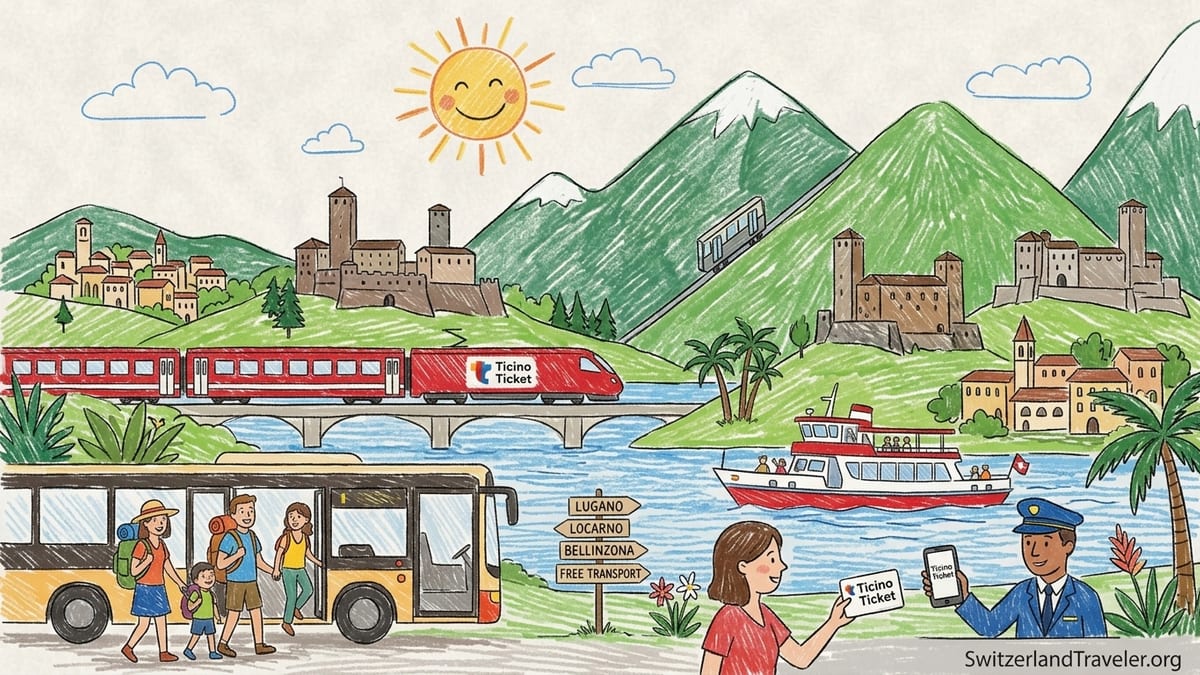
How the Ticino Ticket Works and Why It Matters
The Ticino Ticket is a regional guest card issued by participating accommodations in the Swiss canton of Ticino. When you stay in one of the more than 500 partner hotels, hostels or campsites, you receive a personal ticket that allows free travel on most public transport across the Arcobaleno fare network within Ticino, which covers the entire canton’s trains, regional buses and many urban bus lines. In addition, the card unlocks percentage discounts, typically around 20 to 30 percent, on selected lake boats, mountain railways and major tourist attractions.
The key detail is that you cannot buy the Ticino Ticket separately. It is not sold at train stations or tourist offices. Eligibility is tied to paying the local tourist tax at a partner accommodation, which is why your choice of hotel, hostel or campsite is so important. A traveler who books a non-partner apartment on a rental platform will pay full fare on every regional train and bus, while someone in a modest partner hotel a few streets away may ride for free from the day of arrival through departure.
In practical terms, the value adds up quickly. A typical point-to-point second class day ticket from Lugano to Locarno and back can easily cost the equivalent of 25 to 35 Swiss francs per adult, depending on the exact routing and time. Add local buses to reach cable car stations, plus a boat cruise on Lake Lugano or Lake Maggiore, and a couple could easily spend 60 to 80 francs per day on transport alone. With the Ticino Ticket provided by their accommodation, the train and bus journeys within the canton drop to zero, and only the discounted portions such as boats or mountain railways remain to be paid.
The ticket duration usually runs from check in through the end of your stay, often including the departure day. It is typically issued in digital form, with a QR code that conductors can scan on board the train or bus, and it can be stored on a smartphone via the MyTicino platform. For families or groups staying several nights, especially those planning to move around the canton rather than stay by the hotel pool, the cumulative savings can easily surpass the nightly rate differences between competing properties.
Where the Ticino Ticket Takes You for Free
The Ticino Ticket is valid across the integrated Arcobaleno network that covers the entire canton, from Airolo in the north near the Gotthard tunnels down to Chiasso on the Italian border, and from the Maggia and Verzasca valleys in the west to Mendrisio in the south. In practical terms, this means you can base yourself in Lugano and ride regional trains to Locarno for a film screening, buses up to the Verzasca Valley for hiking, or trains to Bellinzona to explore the UNESCO listed castles, all without buying extra tickets as long as you stay within Ticino.
Consider a couple spending three nights in Lugano. Without the Ticino Ticket, a single day might include a morning train to Bellinzona to see Castelgrande and Montebello, an afternoon connection to Locarno, and an evening return to Lugano. Standard second class fares for this sort of multi leg day trip can easily total 30 to 40 francs per person. With the Ticino Ticket, they can hop on and off trains and buses as they wish, showing the QR code to inspectors, and allocate their budget to castle entrance fees, gelato or a lakeside aperitivo instead.
Lake boats and mountain transport are treated slightly differently. Public transport style boats on the main lake routes are often included as “transport” in the sense that the Ticino Ticket grants free or discounted access only on specific lines or times, while most privately run sightseeing cruises offer percentage discounts to card holders. Mountain railways such as the funicular up Monte Brè near Lugano or the cable car to Cardada above Locarno typically extend 20 to 30 percent off the regular return fare to Ticino Ticket users, which can mean saving around 8 to 15 francs on a single excursion for two adults.
These reductions are especially meaningful for families. A family of four staying in a partner hotel near Locarno who uses the Ticino Ticket to take the bus into the Verzasca Valley, then a discounted entry to a popular adventure park or discounted chairlift, could see total daily savings of 60 francs or more compared with paying full transport and attraction prices. Over a four night stay, this could equate to more than 200 francs, enough to justify choosing a slightly higher category hotel that participates in the program over a cheaper, non participating apartment.
Lugano: Lakefront Hotels and Budget Stays With Ticino Ticket
Lugano is one of the easiest places for visitors to encounter the Ticino Ticket because a high proportion of centrally located hotels participate. Mid range properties such as Hotel Dischma in Lugano Paradiso explicitly advertise that the city tax they charge includes the Ticino Ticket, which they provide on arrival. For travelers arriving from Zurich or Milan, this means that as soon as they check in, they can ride regional trains and urban buses across Ticino without additional tickets, simply flashing the card when inspected.
For city break visitors who plan to explore primarily Lugano itself, the Ticino Ticket still has tangible value. Local bus fares within Lugano might appear modest in isolation, but they add up quickly for multiple short hops between the lakefront, San Salvatore funicular base station, and neighborhoods like Paradiso or Castagnola. Over three days, two travelers taking several rides per day could easily save 30 to 40 francs just on local buses and regional trains to nearby viewpoints.
Lakefront and boutique hotels around Lugano’s center and Paradiso district tend to command higher nightly rates, but the inclusion of the Ticino Ticket narrows the price gap when you factor in free transport. A couple choosing a slightly more expensive lakeview hotel that offers the ticket might pay 30 francs more per night than a non participating guesthouse located farther uphill. Yet if they avoid spending 25 to 35 francs per day on transport, the net difference becomes small, while the convenience of walking straight to the lake promenade and boarding buses or boats freely significantly enhances their stay.
Budget minded travelers should look closely at smaller garni hotels and simple business style properties in and around Lugano’s station and city districts. Many of these, while lacking luxury amenities, are official Ticino Ticket partners and provide the same level of transport benefits as five star hotels. For backpackers or rail pass holders who like to explore multiple towns in one day, these modest options can be ideal bases, allowing daily excursions to places like Gandria, Morcote or Bellinzona at minimal additional cost.
Locarno & Ascona: Lakeside Resorts, Hostels and Campsites
The Locarno and Ascona region on Lake Maggiore is particularly rich in Ticino Ticket partner accommodations, from classic lakefront hotels on the promenades to hillside boutique properties in Minusio and Orselina. Many long established hotels in Locarno’s old town and lakefront, including several mid range family run properties and international brands, now appear on the official partner lists. Guests at these hotels receive the same travel benefits as those in Lugano, but with an even stronger focus on lake boats and mountain railways.
For example, a guest staying at a boutique hotel in Minusio or Muralto can use the Ticino Ticket to reach Locarno’s center by train or bus, then apply discounts on the funicular and cable car combination to Cardada and Cimetta, a classic excursion that offers sweeping views of Lake Maggiore and the surrounding peaks. A standard return trip for two adults on this mountain route can approach 80 to 90 francs, so a typical Ticino Ticket discount could reduce that by around 15 to 25 francs. Add free transport to and from the valley station and discounted entry at selected museums, and a single day’s outings may save enough to cover a dinner pizza for two in the old town.
Locarno and Ascona also illustrate how hostels and campsites benefit budget travelers under this scheme. Several youth hostels in the region, as well as lakeside campgrounds in the Maggia and Verzasca valleys and around Ascona, are listed as partner accommodations. Even campers paying relatively low nightly rates receive a Ticino Ticket upon check in, which effectively turns a simple tent pitch into a pass for the canton’s buses and regional trains. A solo traveler staying at a campsite near Ascona who rides the bus to Locarno each day, then continues into the Maggia Valley for hikes, could easily offset the entire cost of the campsite fee through saved transport fares.
Families planning multi night stays on Lake Maggiore often balance the charm of lakefront hotels in Ascona against the greater concentration of partner options in Locarno itself. While Ascona’s old town hotels can be more expensive, many participate in the Ticino Ticket scheme, and parents who intend to make repeated trips to the valleys, Bellinzona’s castles or Lugano’s attractions should calculate how much they would spend on tickets without the card. Over six or seven days, the free and discounted travel can be worth several hundred francs for a family of four, which in some cases justifies choosing a higher rated, centrally located hotel that includes the ticket.
Bellinzona & the Valleys: Strategic Bases for Explorers
Bellinzona, the cantonal capital, is less of a resort town than Lugano or Locarno, but it has a growing collection of Ticino Ticket partner accommodations that can serve as efficient bases for rail focused travelers. Several smaller city hotels, garni properties and nearby guesthouses participate, providing guests with free travel across Ticino from a location that sits at the junction of major north south and east west rail lines. For travelers arriving by train from German speaking Switzerland, Bellinzona is often the first major Ticino stop and a logical place to stay.
A couple basing themselves in Bellinzona for three nights could use the Ticino Ticket to take quick trains to Lugano for a day on the lake, then to Locarno for another day, and still have time to explore Bellinzona’s own three hilltop castles, which form a UNESCO World Heritage Site. Without the ticket, their daily transport costs could easily reach 30 to 40 francs per person for the combination of regional trains and local buses. With the Ticino Ticket, those journeys fall to zero, and they only pay for castle admissions and any mountain or boat excursions where discounts rather than free travel apply.
Moving farther from the main towns, the Ticino Ticket becomes particularly attractive in smaller valley communities where regional buses are the lifeline. Guesthouses, mountain hotels and rustic inns in areas such as the Leventina, Blenio, Maggia and Verzasca valleys appear in the partner accommodation lists. Guests at these properties often choose them specifically to access hiking trails, waterfalls and quiet villages without a car. Since bus fares in the valleys are based on distance and zones, multiple rides over several days can become expensive. Having the Ticino Ticket means valley explorers can focus on trail choices instead of ticket machines, boarding whichever bus fits their schedule.
One practical example involves hikers staying in a small hotel or bed and breakfast near the Verzasca Valley who plan to tackle different sections of the river each day. They might ride the bus up to Lavertezzo on day one, continue higher into the valley on day two, and return to Locarno on day three for a rest day. The cumulative bus fares for multiple one way journeys and returns can easily exceed 50 francs per person over three days. With the Ticino Ticket, these bus trips are free, and any additional spending goes toward meals in local grotti or occasional mountain lift rides where discounts apply.
Hostels, Campsites and Apartments: Maximizing Value on a Budget
Travelers on tight budgets sometimes assume that regional guest cards like the Ticino Ticket are perks only available at mid range or upscale hotels. In Ticino, this is not the case. The partner list explicitly includes youth hostels, group accommodation centers and numerous campsites spread around the lakes and valleys. As long as the property appears as an official partner and charges the local tourist tax, guests receive the same Ticino Ticket benefits as those staying in more expensive establishments.
For backpackers, the combination of dormitory priced beds and free public transport across the canton can significantly extend their reach. Someone staying at a youth hostel in Lugano or Locarno might use the ticket each day to explore a different corner of Ticino, riding trains to Bellinzona one day, buses to the Valle Verzasca the next, and perhaps a lake boat with a discount on another. Without the Ticino Ticket, they would likely have to choose fewer excursions or cut costs elsewhere to afford multiple long distance trips in a single week.
Campsites may offer the most dramatic value because nightly fees are often substantially lower than even basic hotels. A couple paying a moderate rate for a lakeside campsite near Locarno that participates in the program can receive two Ticino Tickets and then ride buses and regional trains throughout the canton at no extra cost. Over a week long camping holiday that includes several excursions to valleys, castles and lakeside towns, their saved transport costs might exceed the total price of the campsite pitch itself.
Apartment style accommodations in Ticino present a mixed picture. Some serviced apartment hotels, aparthotels and residence style complexes are official partners and provide the Ticino Ticket, while private rental apartments or holiday homes arranged directly with owners often do not. Travelers who prioritize kitchen facilities and extra space should verify whether a specific property is listed as a partner. In cases where a non participating apartment is slightly cheaper per night than a competing aparthotel that includes the ticket, it is worth calculating expected transport spending. For a family planning daily outings, the free and discounted travel from the Ticino Ticket can quickly swing the overall cost in favor of the partner property.
How Much You Can Realistically Save
Estimating the value of the Ticino Ticket depends on your travel style, group size and length of stay. Solo travelers staying mainly in one town and walking most places might see modest savings, while active couples and families who plan daily excursions across the canton can extract substantial value. It helps to think in terms of typical daily patterns and standard public transport fares in Switzerland, which are generally high by international standards.
A realistic scenario for a couple spending four nights in Lugano could involve one day trip to Locarno and Ascona, one to Bellinzona, and one exploring nearby villages like Morcote and Gandria. Without the Ticino Ticket, their combined regional train and bus fares for these days could easily reach 150 to 200 francs, especially if they make spontaneous extra stops or decide on an evening stroll in another lakeside town. With the ticket, those journeys are free, and the only additional costs are discounts on boats and mountain lifts they choose to ride.
Families stand to gain even more. Consider a family of four staying five nights at a mid range hotel in Locarno that provides the Ticino Ticket. They plan to visit the Verzasca Valley, Bellinzona’s castles, take a boat trip on Lake Maggiore, and ride the Cardada cable car. Standard fares for regional trains and buses for four people across several days could surpass 250 francs, while mountain railways and boats might add another 200 francs at full price. With the Ticino Ticket, the family reduces public transport spending within Ticino to near zero and gains percentage discounts on the major excursions, potentially saving 200 to 300 francs over the course of their stay.
Even shorter stays benefit. A two night stopover in Bellinzona or Lugano en route between northern and southern Switzerland may involve several city bus rides, a regional train excursion and perhaps a cable car outing. Travelers who would otherwise buy individual tickets for every leg will see the Ticino Ticket rapidly offset any small nightly price difference between a partner and a non partner hotel. For many, the psychological freedom of boarding any train or bus within Ticino without worrying about extra costs is as valuable as the monetary savings, making it easier to adapt plans to the weather or spur of the moment ideas.
The Takeaway
Because the Ticino Ticket cannot be purchased outright, accommodation choice in Ticino directly determines whether you receive free public transport across the canton plus discounts on boats, mountain railways and key attractions. More than 500 hotels, hostels and campsites now participate, spreading the benefits across virtually every budget level and region, from Lugano’s lakefront to the quiet corners of the Verzasca and Maggia valleys.
Travelers willing to spend a few minutes checking whether their preferred property is an official partner can convert a standard hotel night into a powerful regional travel pass for the duration of their stay. For couples and families who plan to explore beyond a single town, the accumulated savings on trains, buses and discounted excursions often equal or exceed the price difference between competing accommodations. Whether you favor a campsite on Lake Maggiore, a youth hostel in Lugano, or a boutique hotel in Ascona, aligning your overnight choice with the Ticino Ticket program is one of the most effective ways to stretch your budget and enjoy spontaneous, car free travel across Switzerland’s sunny southern canton.
FAQ
Q1. What exactly is the Ticino Ticket and who can get it?
The Ticino Ticket is a regional guest card that grants free public transport within the canton of Ticino and discounts on selected lake boats, mountain railways and attractions. It is issued only to guests staying in official partner accommodations such as hotels, hostels and campsites that charge the local tourist tax.
Q2. Can I buy the Ticino Ticket at a train station or tourist office?
No. The Ticino Ticket cannot be purchased separately. It is available exclusively through participating accommodations, and you receive it automatically after check in when you provide your personal details and pay the tourist tax.
Q3. Which types of transport are free with the Ticino Ticket?
The ticket generally covers free second class travel on most regional trains and buses within the Arcobaleno fare network in Ticino, including many urban bus lines in towns such as Lugano, Locarno and Bellinzona. It typically does not include long distance InterCity trains or transport outside the canton’s network.
Q4. Do lake boats and mountain railways become completely free?
In most cases, the Ticino Ticket provides percentage discounts rather than full free access on lake boats and mountain railways. Typical reductions range around 20 to 30 percent off the standard fare, though exact conditions vary by operator and season.
Q5. How long is the Ticino Ticket valid during my stay?
The ticket is usually valid from your arrival day at the partner accommodation until the end of your stay, often including the departure day. The exact validity dates are printed on the card or shown in the digital version you receive.
Q6. Do children receive their own Ticino Ticket?
Yes. Children staying in a partner accommodation with their family are normally issued their own Ticino Ticket, linked to their stay. This allows families to benefit from free public transport for all members within Ticino, in addition to any standard child discounts that may apply.
Q7. How do I know if a hotel, hostel or campsite is a Ticino Ticket partner?
You can check the official Ticino tourism listings or the accommodation’s own information, where participation in the Ticino Ticket program is usually mentioned alongside details about city tax. If in doubt, contact the property directly and ask whether they currently provide the Ticino Ticket to guests.
Q8. Is the Ticino Ticket still useful if I already have a Swiss Travel Pass?
The Swiss Travel Pass already includes most public transport nationwide, so the Ticino Ticket will add less incremental value for long distance travel. However, it can still unlock additional local discounts on certain mountain railways, attractions and boats specific to Ticino, so it is worth presenting both passes where applicable.
Q9. What happens if I change hotels within Ticino during one trip?
If you move between two different partner accommodations, each property should issue its own Ticino Ticket valid for the dates of your stay there. Be sure to carry the correct, currently valid card or digital version when using public transport and benefiting from discounts.
Q10. Can I use the Ticino Ticket to travel into Italy or other Swiss cantons?
The Ticino Ticket is primarily valid within the canton of Ticino and its Arcobaleno fare zones. Travel beyond the canton’s boundaries or on long distance trains usually requires an additional ticket or pass. Some cross border routes may offer partial benefits, but you should confirm conditions before assuming coverage.