

Southern Switzerland’s Ticino region feels like a slice of northern Italy that has drifted into the Alps: pastel villages, palm trees along deep blue lakes, and old men arguing about football in rapid-fire Italian. Yet it is also unmistakably Swiss, with punctual trains, mountain cable cars and a talent for turning almost every viewpoint into a terrace serving good espresso. This selective guide focuses on the most rewarding bases and side trips in the southern part of Ticino, and how to combine them into a trip that feels rich rather than rushed.
Lugano: The Natural Hub for a Southern Switzerland Itinerary
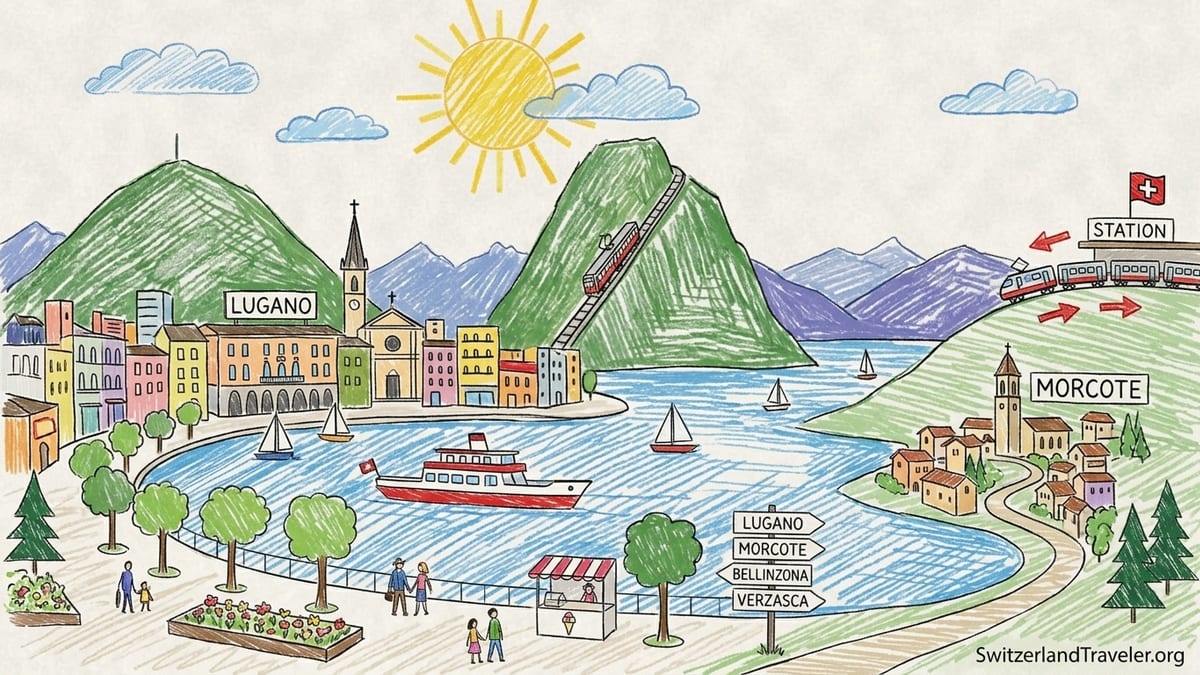
Lugano is the easiest gateway to this corner of Switzerland and a strong candidate for your main base if you want city energy with lake views. Fast trains from Zurich and Milan roll straight into Lugano’s hillside station, and from there a short funicular drops you to the compact center by the water. The feel is part financial hub, part resort: glassy bank headquarters behind the station, but also gelato stands, a long lakeside promenade and locals sunning themselves on benches at lunchtime. For many travelers, two or three nights in Lugano is the sweet spot, enough time to explore the city and slot in a couple of classic day trips.
On the ground, Lugano works well because life clusters around the lakefront. You can walk from the Parco Ciani, with its manicured lawns and lakeside cypresses, through the arcaded streets of the old town in ten minutes, stopping for a coffee on Piazza Riforma where terrace tables spill across the square. In summer, a simple lakeside lunch at a mid range grotto style restaurant might mean a plate of risotto for around 25 to 30 Swiss francs and a glass of local merlot from nearby Mendrisiotto. Late afternoon, small cruise boats leave from the main pier to reach villages like Gandria and Morcote, turning the lake itself into public transport.
If you stay overnight, Lugano rewards you in the evenings, when day trippers thin out and the waterfront path feels almost local. You might ride the funicular up Monte Brè for sunset, watching the last light catch the red roofs of Gandria opposite and the hazy outline of Italy further down the lake. Or you could walk south toward Paradiso and take the cogwheel railway up Monte San Salvatore, where a short path leads to a 360 degree lookout. These hills are not wilderness, but they are close, easy and scenic, ideal for travelers who like the idea of Alpine panoramas without technical hiking.
Lugano is also the most convenient jumping off point for Mendrisiotto wine country and for cross border hops into northern Italy. Regional trains to Mendrisio take around 15 minutes, and from there local buses fan out to villages and vineyards. The same line continues over the border to Como and onward toward Milan, which means you can realistically spend the night in Lugano, take a morning train for an espresso on Lake Como, and be back on the Lugano waterfront before dinner. That flexibility is why, if your time is limited, Lugano is usually the best place to plant yourself.
Morcote and Gandria: Picture Perfect Villages Best Seen from the Water
For pure atmosphere, the villages dotted around Lake Lugano can be more memorable than the city itself. Morcote, often labeled one of the most beautiful villages in Switzerland, clings to the hillside above the lake with a church tower and cypress lined stairway rising behind a row of arcaded houses. Gandria is even more compact, a former fishing village where narrow lanes squeeze between stone houses that seem to lean over the water. Both are easy half day trips from Lugano and are at their best when approached by boat, with the facades of ochre and terracotta houses reflected in the lake.
In practical terms, you can board a regular lake boat from Lugano’s main pier mid morning, sit on the open deck and be in Gandria in under half an hour, with the breeze and the sound of the engine as much a part of the experience as the views. Many visitors walk the Olive Grove Trail back from Gandria to Lugano, a relatively gentle lakeside path of a few kilometers with interpretive panels about olive cultivation, suitable for active travelers with decent shoes. Morcote sits farther south; boats take roughly 45 to 60 minutes depending on the route, winding past small hamlets and the forested slopes of Monte San Salvatore.
Both villages work perfectly as day trips rather than overnight bases. Accommodation is limited to a handful of small hotels and guesthouses, and while waking up to the sound of small boats knocking against the quay has its charm, you will have far more dining choice and late evening transport back in Lugano. A realistic way to fold them into your itinerary is to spend a morning in Gandria, have a lakefront lunch at one of the simple trattoria style places where grilled fish from the lake might cost 30 to 35 francs, then continue by boat to Morcote for an afternoon wander and climb to the church of Santa Maria del Sasso for the panoramic view, returning to Lugano in time for an aperitivo.
Season and timing matter. On sunny weekends in July and August, both Morcote and Gandria can feel busy by midday, particularly when tour groups arrive. Early morning or late afternoon boat rides are quieter and the low angled light makes the pastel facades glow. Spring and autumn bring a calmer mood and slightly lower prices, along with more local life: laundry hanging from balconies, church bells echoing across the water, and café owners chatting with regulars in dialect. If you enjoy photography or sketching, these shoulder seasons are especially rewarding.
Bellinzona: Castles, Fortresses and a Different Side of Ticino
While Lugano and the Maggiore lakeside towns feel almost Mediterranean, Bellinzona reveals Ticino’s strategic Alpine history. The small city sits at a natural bottleneck where several valleys converge, and its three fortified castles, connected by walls and ramparts, form a UNESCO listed complex that once controlled trade between northern Europe and Italy. A modern traveler arriving by train from Lugano in around 30 minutes steps out into a workaday town whose skyline is still dominated by the massive walls of Castelgrande rising from a rocky outcrop.
For visitors, Bellinzona is less about nightlife and more about tangible history. You can spend a day moving between the three castles, linked by paths and, in some cases, by elevator and funicular, without ever needing a car. A combined entry ticket costs roughly what you would pay for a simple main course in a mid range Swiss restaurant, and includes access to ramparts, small museums and towers with sweeping views over the town and surrounding valleys. Castelgrande offers grassy courtyards and a modern museum built into the rock, Montebello has preserved medieval walls and a more fortress like feel, while Sasso Corbaro, higher on the hillside, delivers the widest panoramas and a sense of separation from the modern town below.
In itinerary terms, Bellinzona is ideal as a day trip from Lugano or Locarno rather than an overnight stop, unless you are particularly interested in fortifications or want a quieter, more local base. A common pattern is to take a morning train to Bellinzona, explore two or three castles and have lunch under the arcades in the historic center, perhaps during the lively Saturday market when stalls sell local cheeses, dried meats and herbs. By late afternoon you can be on a train back to Lugano for dinner, or continue 30 to 40 minutes west to Locarno if you are repositioning your base toward Lake Maggiore.
That said, staying one night in Bellinzona can make sense for travelers who like slower travel and want to break up a long rail journey across Switzerland. Modestly priced business hotels near the station can be cheaper than lakefront rooms in Lugano or Ascona, especially midweek. An evening stroll through the quiet center, with the castles floodlit above and locals gathering in neighborhood bars, offers a more understated, authentic slice of Ticino life than the polished promenades by the lakes.
Locarno and Ascona: Lake Maggiore’s Transport Hub and Dolce Vita Promenade
Locarno and Ascona sit side by side on the northern shore of Lake Maggiore yet feel distinct. Locarno is the transport and events hub, with a mainline station at the edge of the center, frequent trains to Bellinzona and further, and a busy boat pier serving the lake. It is also home to the Locarno Film Festival, one of Europe’s major summer film events that each August transforms the Piazza Grande into an open air cinema and fills the town with industry professionals and cinephiles. Outside festival dates, Locarno feels like a compact lakeside city with a pleasant but workaday edge: concrete apartment blocks back from the water, but cobbled lanes climbing up to the Madonna del Sasso sanctuary and regular funicular and cable car connections into the hills.
Ascona, a short bus ride or lakeside walk away, is built around atmosphere rather than infrastructure. The wide, pedestrian friendly promenade curves along the water, lined with pastel facades, palm trees and restaurant terraces. In late afternoon, tables fill with people sharing plates of lake fish or simple pasta dishes, and you can easily linger for hours watching ferries shuttle back and forth and paddleboarders cross the small harbor. Prices here reflect the setting: expect to pay a little more for a coffee or spritz on the waterfront than in an inland bar in Locarno, but the view is part of what you are buying.
For planning, Locarno generally makes the better overnight base if you value easy onward connections and day trips by train and boat. You can stay within walking distance of the station, roll your suitcase to the platform for an early train north, and still be on the lakefront in under ten minutes. A two or three night stay gives you time to explore the old town, ride the funicular up to Orselina and the cable car onward to Cardada Cimetta for views across Maggiore, and slot in a day trip up the Verzasca Valley or out to the Brissago Islands. During the film festival, however, hotel prices rise sharply and availability tightens weeks in advance, so book early or consider basing in Ascona or even Bellinzona if your dates fall in early to mid August.
Ascona comes into its own for travelers who care more about ambiance than logistics. Many visitors sleep in Locarno and treat Ascona as an afternoon or evening outing, but if your budget stretches to a lakeside room or you are visiting in the quieter months of April, May, September or October, spending a night or two here can feel like a holiday within a holiday. Waking up to early light on the water, grabbing a coffee from a bakery one street back from the promenade and watching staff set tables for lunch has a relaxed, Riviera like charm. From a practical point of view, you still have regular buses back to Locarno station and boats connecting you to the Brissago Islands and Italian towns down the lake.
Verzasca Valley: Turquoise River, Stone Villages and a Cool Escape
North of Locarno, the Verzasca Valley offers a very different Ticino experience: an emerald river slicing through gorges of polished rock, isolated hamlets and steep, forested slopes. The most photographed spot is near the village of Lavertezzo, where a double arched stone bridge spans a set of pools and cascades whose unusually clear, green tinged water has made the valley famous on social media. On hot summer days, the rocks around the bridge fill with sunbathers and brave swimmers, and the scene can feel surprisingly lively for what is, at heart, a quiet Alpine valley.
Getting there is straightforward from Locarno. Yellow postal buses leave from near the station and climb the valley in a little under an hour, winding past the Verzasca dam and small villages with slate roofed houses. Many travelers ride as far as Lavertezzo, spend a couple of hours exploring the bridge area and perhaps following part of the riverside trail, then continue by bus up to Sonogno, the last village in the valley. Here you find a small cluster of stone houses, a simple museum, and meadows where cows graze in summer. A typical day trip might involve a picnic by the river, an ice cream or coffee in a village bar and a late afternoon bus back to Locarno in time for dinner.
It is important to respect the river. The water is cold, currents can be strong and sudden, and accidents do happen when visitors underestimate the conditions or mimic cliff jumping videos they have seen online. If you intend to swim, choose calm sections, follow local signage and be honest about your ability to handle cold, moving water. Even if you do not go in, just sitting on the warm rocks and watching the play of light on the pools can be satisfying. Sturdy footwear is helpful because wet rock can be slippery, and a light jacket is wise even on warm days since temperatures in the shaded gorge run cooler than down by the lake.
Overnight stays in Verzasca are possible in small guesthouses and simple hotels, but for most travelers the valley works better as a day trip from Locarno or even from Lugano, which is roughly 60 to 90 minutes away by train and bus combined. The buses can be busy in high summer, so starting early in the day improves your chances of a seat and helps you enjoy the quieter morning atmosphere. If you prefer to explore at your own pace and budget allows, local taxi or minivan transfers can be arranged from larger towns, though costs add up quickly compared with the reasonably priced public buses.
Brissago Islands: Botanical Gardens in the Middle of the Lake
Where Verzasca is all rugged rock and cold water, the Brissago Islands on Lake Maggiore offer a curated slice of subtropical green. This pair of small islands off the shore near Brissago host a botanical garden with hundreds of plant species from warm temperate regions around the world, arranged along winding paths, terraces and viewpoints. Because of the lake’s moderating effect and the islands’ low elevation, camellias, bamboo, eucalyptus and other non Alpine plants can grow outdoors here in a way that feels surprising in Switzerland.
Reaching the Brissago Islands is part of the pleasure. Regular boats connect Ascona and Locarno with the islands during the main visitor season, usually starting in spring and running into autumn. The ride from Ascona takes around 15 to 20 minutes, enough time to feel the town recede and the open water close in, and many travelers choose to sit on the upper deck to watch the approach. There is an island landing stage, an entrance fee for the garden roughly on par with a museum ticket in a Swiss city, and a small restaurant terrace where you can sit with a coffee or simple lunch overlooking the water before or after exploring the paths.
For most itineraries, the Brissago Islands are an easy half day excursion from Locarno or Ascona rather than a stand alone destination. You might spend your morning wandering Ascona’s lanes, take a midday boat to the islands for two or three hours, then return for a late afternoon swim in the lake or aperitivo on the promenade. The walking is gentle and the paths are well maintained, which makes this one of the more accessible nature experiences in the region for travelers who may not be up for steep hikes but still want greenery and views. Families with children often appreciate the manageable scale: there is enough to see without risking end of day fatigue and complaints.
Weather can shape the experience. On overcast days, the islands feel lush and almost tropical, with saturated greens and the scent of damp earth. On bright, hot days, the reflective water and stone terraces can make it feel warmer than the mainland, so sunscreen, a hat and water are essential. Because the islands are exposed, windy days can bring a noticeable chop to the boat ride, though services are generally reliable unless conditions are severe. Checking the forecast before you lock in a specific day for your visit is wise if your schedule allows.
Mendrisiotto: Wine Hills, Monte Generoso and Easy Cross Border Hopping
South of Lugano, the Mendrisiotto region stretches toward the Italian border with a gentler, more agricultural character than the lakefront towns. Vineyards stripe the lower slopes and small villages cluster around church towers, while the town of Mendrisio itself functions as a transport knot on the busy north south rail axis between Zurich and Milan. For visitors, the main draws are wine tasting, low mountain scenery and the chance to combine Swiss orderliness with quick, informal dips into Italy for shopping and food.
Local red wines, often based on merlot grapes, are a point of pride here. Several estates open their doors for tastings by appointment, sometimes combined with short tours of their cellars and vineyards. A typical visit might include three or four wines and a plate of local cheese and cured meats for a per person price similar to what you would pay for a mid range restaurant main course in Lugano. Some producers partner with tour operators who arrange small group excursions from Lugano or Mendrisio that bundle transport, tastings and a simple lunch, which can be convenient if you prefer not to drive or decipher rural bus timetables.
Monte Generoso, rising above the region, offers one of the broadest viewpoints in southern Ticino. A cogwheel railway runs from the lakeside village of Capolago up to near the summit, where you can step out to views taking in Lake Lugano, the surrounding mountains and, on clear days, a sweep of the Lombardy plain in Italy. For families, this is a straightforward mountain experience: no need for long hikes, but plenty of short paths, picnic spots and a summit restaurant. A realistic day from Lugano might involve a morning regional train to Capolago, the cogwheel ride up, a few hours at the top and then a late afternoon stroll through Mendrisio’s old streets or a short detour by train into Como across the border.
As a base, Mendrisiotto is less polished than Lugano but can work if you are focused on wine tourism or are traveling by car and plan to move frequently between Switzerland and Italy. Hotel prices in Mendrisio and nearby Chiasso often run lower than directly on the lake, especially outside major trade fairs and holidays. However, for first time visitors whose priority is scenery over logistics, using Lugano as your base and visiting Mendrisiotto on a long day trip or one overnight is usually more satisfying, giving you both lakeside atmosphere and time in the hills.
The Takeaway
Designing a trip to southern Switzerland is less about hunting down every viewpoint and more about choosing the right mix of bases and day trips for your style. Lugano makes sense as a main hub if you want a city feel with lake access and easy rail links to both Mendrisiotto and Italy. Locarno and Ascona suit travelers who prefer a more relaxed, lakeside rhythm and want quick access to Verzasca and the Brissago Islands. Bellinzona’s castles bring the region’s strategic history into focus, while small villages like Morcote and Gandria distill the postcard charm that first draws many people to Ticino.
Overnight stays are best concentrated in Lugano, Locarno or Ascona, with perhaps a night in Bellinzona or Mendrisiotto if you are curious about less touristed corners. Verzasca, the Brissago Islands, and the small villages along Lake Lugano all work well as day trips, offering memorable episodes without the need to constantly pack and unpack. With Switzerland’s reliable public transport, you can ride trains, boats and buses between most of these places in under an hour, which means you spend less time in transit and more time nursing a coffee in a lakeside piazza, which is, in many ways, the whole point of coming here.
FAQ
Q1. How many days do I need to see Lugano, Locarno, Ascona and Bellinzona?
Most travelers are comfortable with five to seven days. That allows two or three nights in Lugano, two or three around Locarno or Ascona, and a day trip to Bellinzona.
Q2. Is Lugano or Locarno a better base for exploring southern Ticino?
Lugano is better for quick access to Mendrisiotto and Italy, while Locarno works best if you prioritize Verzasca Valley, Ascona and the Brissago Islands. Both have good train links.
Q3. Do I need a car to visit Verzasca Valley and the Brissago Islands?
No. Regular buses from Locarno reach Verzasca villages, and lake boats connect Locarno and Ascona with the Brissago Islands. Public transport is usually the easiest option.
Q4. When is the best time of year to visit this part of Switzerland?
Late April to June and September to early October bring mild temperatures, open mountain transport and fewer crowds than peak summer, with good chances of sun.
Q5. Is swimming in the Verzasca River safe?
Conditions vary. The water is very cold and currents can be strong. Only swim where locals do, respect warning signs and avoid risky jumps from rocks or bridges.
Q6. Are Morcote and Gandria worth an overnight stay?
They are wonderfully atmospheric but small. For most visitors they work best as half day trips by boat from Lugano, with more dining and hotel options back in the city.
Q7. How expensive are meals in Lugano and Ascona?
A main course in a mid range restaurant often runs around 25 to 40 Swiss francs. Choosing lunch specials, sharing dishes or eating slightly away from the waterfront can reduce costs.
Q8. Can I easily combine this region with a trip to northern Italy?
Yes. Direct trains link Lugano and Mendrisio with Milan and Como, and lake boats connect Ascona and Locarno with Italian towns on Lake Maggiore, making cross border trips simple.
Q9. Is Bellinzona suitable for children?
Yes. The castles have open spaces, walls to walk along and towers to climb, which many children enjoy. Supervision is important near ramparts, but the atmosphere is relaxed.
Q10. Do I need to book train and boat tickets in advance?
Regular regional trains and lake boats usually do not require advance booking. It is worth reserving long distance trains and checking festival or holiday dates when services are busier.