


Rhine Falls looks simple on a postcard, but the reality on the ground is different. You arrive at Europe’s largest waterfall and suddenly face a maze of boat colors, ticket booths, viewing platforms and two different riverbanks, one of which charges entrance. This guide walks you through the real choices you will make at the falls, from the famous Rock Experience and short basin trips to the ferry crossing and Schloss Laufen admission, so you can decide quickly what is worth your time and money.
Understanding the Layout: North Bank vs South Bank
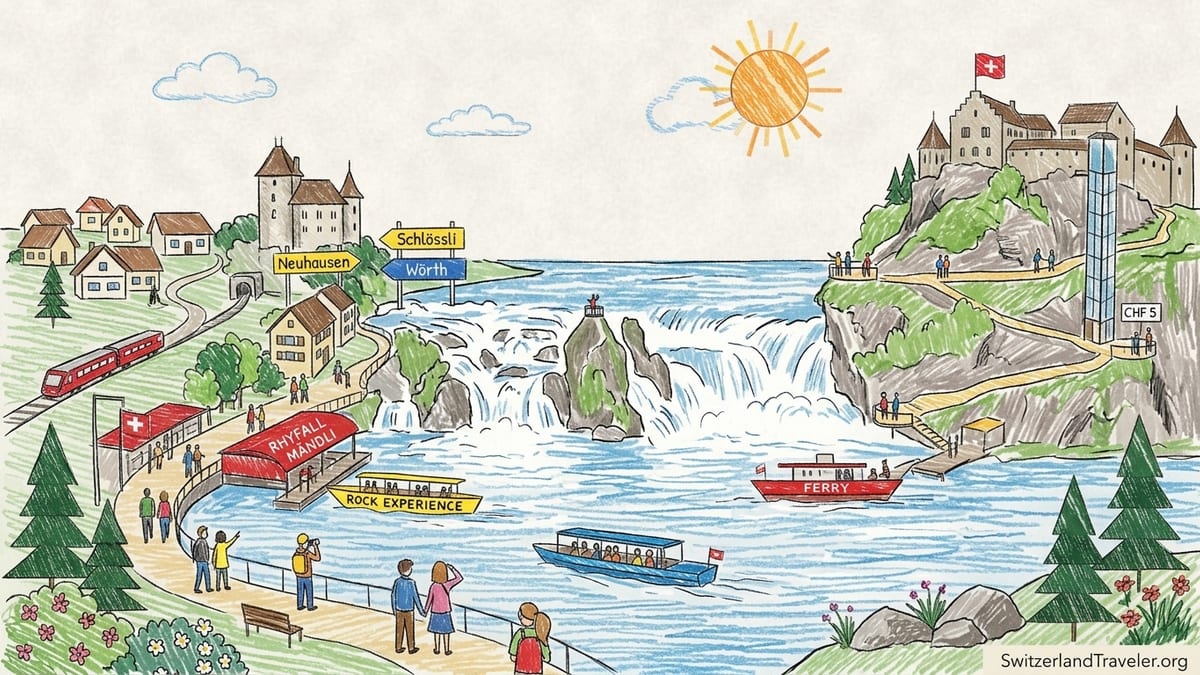
The Rhine Falls straddle two different banks, and understanding this layout first makes every later decision easier. On the north bank you have Neuhausen am Rheinfall and the historic Schlössli Wörth, with riverside paths, viewing terraces and the main boat landings. Access to the water level here is free; you simply walk down from the car parks or train station to the promenade along the Rhine Falls basin and pay only for any boat trip you decide to take.
Across the water on the south bank is Schloss Laufen, a medieval castle perched directly above the main drop of the falls. This side works more like a paid attraction: you buy a ticket that currently costs around CHF 5 for adults and includes the Historama exhibition, the panoramic lift, the Belvedere trail and several viewing platforms. Once you understand that Neuhausen side equals free river access and Schloss Laufen equals paid but very close viewpoints, planning becomes far more straightforward.
In practical terms the north bank feels like a small riverside resort. Visitors stroll between the Schlössli Wörth restaurant, snack kiosks and the Rhyfall Mändli boat ticket counters set on floating pontoons. The south bank feels more like a compact heritage site, with a visitor center, a castle courtyard and signed paths leading down toward the spray. Many travelers choose to experience both sides in one visit, using the small ferry across the basin as a scenic connector.
Because the two sides are in different municipalities, their parking, ticketing and crowd patterns also differ slightly. Neuhausen has multiple car parks, bus stops and train access points feeding into the free promenade area, while the castle side concentrates arrivals through the Schloss Laufen visitor center. Keeping this mental map in mind will help you decide where to start depending on whether you are arriving by car or train.
Getting There, Parking and Accessibility
If you are arriving by train, your choice of station effectively decides your starting bank. For the north bank promenade and boat landings, look for trains to Neuhausen Bad Bahnhof or the stop simply called Neuhausen Rheinfall. From there it is a short signed walk down to the falls and the Schlössli Wörth area. For the castle and its platforms, aim for the station Schloss Laufen am Rheinfall. The train here stops in a tunnel under the castle walls, and a path and lift connect you directly into the Schloss Laufen complex.
Drivers coming from Zurich or Winterthur typically follow the A4 motorway and then local signs to either “Neuhausen Rheinfall” for the north bank or “Dachsen / Rheinfall” for Schloss Laufen on the south. Both sides have designated car parks with machines that accept Swiss francs and often euros. As an example, many visitors doing a classic half day from Zurich choose to park at Schloss Laufen first, pay the CHF 5 castle admission to enjoy the viewing platforms, then later cross by ferry to the north bank and return to their car by train.
Accessibility is an important practical consideration. The Schloss Laufen side actively advertises step free routes, with a panoramic glass lift from near the castle down toward the main Belvedere path, which is especially useful for visitors with limited mobility or families with strollers. On the Neuhausen side, the descent from the higher level car parks and train stops involves more ramps and some stairs down to river level, although the promenade itself is relatively flat once you reach it.
Boat access is split between the two banks. The main Rhyfall Mändli welcome desk and ticket area is on the north bank by Schlössli Wörth. From here you board most Rock Experience and basin round trip boats. There is also a landing at Schloss Laufen for the ferry and some tour variants. If easy access without steep walking is a priority, arriving by train at Schloss Laufen and using the lifts and ferry can significantly reduce the amount of climbing you need to do while still letting you sample the core water experiences.
Schloss Laufen Admission and Viewpoints
Schloss Laufen is the only part of the Rhine Falls area that currently charges a separate entrance fee. The castle’s visitor ticket for adults is advertised at CHF 5 and includes the Historama exhibition, access to the Belvedere path, several viewing platforms and the panoramic elevator. Children aged roughly 6 to 15 pay a reduced rate, and groups of 15 or more can obtain slightly lower per person prices bought at the visitor center or machines.
The value of this ticket lies in how close it takes you to the falls without stepping on a boat. After entering through the castle courtyard you follow the Belvedere trail, which zigzags down through the rock to platforms perched directly beside the thundering water. At the Känzli viewing point, for example, visitors find themselves almost at eye level with the crest of the falls, close enough that camera lenses frequently catch a fine mist on wet days.
From a planning perspective, you can treat Schloss Laufen as a fixed cost add on that delivers a guaranteed close view regardless of boat schedules or river traffic. For travelers who are wary of boats or visiting in shoulder season when limited services run, the castle ticket ensures that you still enjoy an immersive waterfall experience. Many guided coach tours from Zurich bundle this admission into their excursion price and then offer a short optional basin boat ride as a supplement.
It is worth noting that the castle admission and the boat tickets are entirely separate. You cannot use the Schloss Laufen ticket to ride any of the standard boat tours, and you cannot buy boat tickets at the castle visitor center. Instead, boat tickets are sold directly at the landing stages for each operator, either on the Neuhausen side near Schlössli Wörth or at the small jetty below the castle reached via the Belvedere path and lift.
Boat Options Explained: Rock Experience, Basin Trips and Ferry
Once you reach river level, the most prominent decision is choosing among the various colored boat lines. The iconic option is the Rock Experience, often labelled as tour number 1 and marked with a yellow line on maps and timetables. This trip combines a ride through the churning basin with a landing on the dramatic rock pillar that stands in the middle of the falls. From there you climb a narrow staircase to a tiny viewing platform surrounded by water on all sides, which is about as close as you can come to the falls without swimming.
For visitors who prefer to stay on the boat, the short basin round trip usually appears as blue line number 4 or a similar designation. This 10 to 15 minute cruise circles the entire Rhine Falls basin, first approaching the main curtain of water from below, then swinging past the central rock and the castle cliffs, and finally gliding closer to the calmer outflow section downriver. It is designed as a quick way to feel the power of the water, with repeated approaches that bring the bow of the boat within a safe but very dramatic distance of the spray.
The practical workhorse of the river is the ferry crossing, traditionally marked as red line number 2. This small shuttle boat links the north bank landing near Schlössli Wörth with the jetty below Schloss Laufen on the south bank. The ride itself takes around five minutes, and in high season it runs frequent departures. Some Rock Experience tickets automatically include one ferry crossing in the price, which means you can start on one bank, ride to the rock, then cross over and continue exploring on the other side without buying a separate shuttle ticket.
In addition to these core services, there are audio guide boats and longer round trips that venture slightly further along the High Rhine. An audio tour, sometimes listed as tour number 5, typically lasts about 30 minutes and is popular with independent travelers who want live or recorded commentary in several languages on the history, geology and engineering around the falls. Longer scenic cruises are more seasonal and may continue downriver towards Rheinau or up to Schaffhausen, offering a calmer contrast to the intense close range basin rides.
Prices, Tickets and How to Combine Experiences
Pricing at the Rhine Falls is layered rather than bundled, so you will likely buy several small tickets rather than one all inclusive pass. As of the latest publicly available information, Schloss Laufen admission stands at around CHF 5 for adults, while boat trips are priced independently depending on duration and route. While exact figures can change seasonally, a realistic example would be paying a little over CHF 20 per adult for a Rock Experience ticket and a lower amount, often in the low teens, for a short basin round trip without rock landing.
Tickets for the boats are purchased directly from the operators at the landing stages. On the north bank you will see branded counters and ticket boards along the promenade by Schlössli Wörth, often with clear diagrams showing color coded lines. Payment is usually possible in Swiss francs and often in euros, either cash or card. However, it is wise to carry some cash for smaller family bookings or if you plan to buy drinks and snacks from nearby stands after your ride.
If you want to maximize experience while keeping costs sensible, combining one close range boat trip with Schloss Laufen admission often delivers the best value. For instance, a typical couple might park on the free access Neuhausen side, walk to the boat landing and purchase a Rock Experience ticket that includes a ferry crossing. They then ride to the rock, continue by ferry to the castle jetty, buy the CHF 5 Schloss Laufen ticket at the visitor center, explore the platforms and Historama, and finally take the train back from Schloss Laufen station to Neuhausen Rheinfall to return to their car.
Families with younger children or anyone prone to seasickness might choose the shorter basin round trip instead of the rock landing. Ten to fifteen minutes in the spray is often enough excitement for small kids, and you still get several dramatic approaches to the main curtain of water without the extra time required to disembark and climb the central rock. In that scenario, you could skip the ferry entirely and stay on the same bank, using only the promenade paths and castle platforms to change perspective.
Which Option Gets You Closest to the Waterfall
When travelers ask which option gets them closest to the waterfall, the honest answer is that two experiences stand out: the Rock Experience and the lower Schloss Laufen platforms. The Rock Experience physically places you in the middle of the falls on a rocky island surrounded by surging water on three sides. After the boat drops you at the tiny dock, you climb metal stairways and emerge onto a cramped viewing deck where the roar is almost overwhelming, and on windy days you may need a light waterproof layer to keep your clothes dry.
The lower platforms on the castle side offer a different but nearly as intense sensation. The Belvedere trail leads to balconies that jut out over the river just beside the main drop. Here you are only a few meters from where the Rhine tips into space, and the water thunders past at a right angle to your position. Many visitors describe this as the most photogenic spot, because you can frame the foaming water in the foreground and capture the wider basin, north bank and boats in the background without being drenched.
Among the boat only options that do not involve disembarking, the short basin round trip generally takes you closest to the white curtain of falling water. The captain will steer toward the base of the falls, lingering at a respectful distance while the bow rises and falls in the turbulent current. This is the moment when most passengers put away phones and hold onto railings, balancing the thrill of proximity with the comfort of remaining on a stable vessel.
If you are sensitive to motion or prefer dry viewpoints, you can still achieve a strong sense of closeness by timing your visit for early morning or late afternoon. At these quieter hours you may find fewer people on the Belvedere platforms and more space on the north bank terraces near water level, which lets you linger and absorb the atmosphere without jostling for a railing spot.
Audio Guide Boats and Longer Round Trips
While most visitors are satisfied with a quick Rock Experience or short basin loop, the audio guide boats and longer round trips suit travelers who want more context and a calmer pace. The audio tours, typically around 30 minutes long, follow a similar route to the shorter loops but add narrated commentary available in multiple languages through loudspeakers or headsets. You can expect explanations about the geology of the Jurassic limestone, the role of the falls in medieval trade and warfare, and how modern engineers have managed floods and energy use without dramatically changing the waterfall’s appearance.
These audio cruises tend to appeal to independent visitors who are not on a guided coach tour but still want structured information. For example, a solo traveler staying in Zurich might catch a morning train to Neuhausen, buy a ticket for an audio guided round trip from the north bank, learn about the falls during the ride, and then spend the afternoon exploring the castle platforms at their own pace with the context still fresh in mind. It is a low stress way to turn the Rhine Falls visit into a half day learning experience rather than just a photo stop.
Further afield, some operators run longer seasonal cruises that link the falls area with nearby stretches of the High Rhine, such as leisurely trips between Schaffhausen and Rhine Falls or out towards Rheinau and its historic monastery island. These sailings swap the adrenaline of the basin for open river views, vineyard covered slopes and quiet villages along the shore. They are ideal for travelers who have already done the classic close up experiences and now want a more relaxed river day with café style seating and less spray.
In practice, availability of these longer trips varies with season and river conditions, so it is wise to check schedules on arrival in Schaffhausen or Neuhausen rather than planning your entire itinerary around a specific extended cruise. Use them as a flexible extra: if the weather is fine, you can buy a last minute ticket after completing your main Rock Experience or castle visit.
Practical Tips for Choosing and Timing Your Visit
Because boat departures at the Rhine Falls follow a seasonal timetable and are sensitive to weather, timing your visit well can significantly improve your experience. In the high summer months the Rock Experience boats may leave roughly every 20 minutes, while the short basin trips run at even shorter intervals. On a busy July afternoon you might wait only a few minutes for boarding, but the platforms and boats will be more crowded. On a cool April morning services may be less frequent but there is more space to move and photograph.
If you are traveling with children, consider the length and intensity of each option. A 15 minute basin loop is often the sweet spot for school age kids, providing plenty of excitement without testing their patience. Younger children might be happier simply riding the ferry across the basin and back, combining the novelty of a boat ride with the calm of a short crossing. In all cases, lightweight waterproof jackets and secure footwear are sensible, as spray can make decks and platform steps slippery.
Budget conscious visitors should remember that the most expensive element is usually the Rock Experience or extended audio tour, not the castle admission. If you need to prioritize, it can make sense to pay for one high impact activity such as the rock landing and then use the free Neuhausen paths and paid Schloss Laufen platforms to fill the rest of your time. A realistic low to mid range budget for an independent adult traveler might be to allow enough for a return train from Zurich, one premium boat ride, the CHF 5 castle ticket and a simple meal or snack on site.
Finally, think about your preferred crowd level. Weekends in July and August can see large tour groups arriving by coach, sometimes congregating around the main Neuhausen landing area in mid morning and mid afternoon. If you value quiet, arriving early in the day, travelling midweek or visiting in the shoulder months of May, June or September can give you a much more relaxed feel without sacrificing views or services.
The Takeaway
Rhine Falls rewards visitors who understand its structure before arriving. The north bank at Neuhausen offers free access to the river promenade and most boat landings, while the south bank at Schloss Laufen charges a modest CHF 5 admission in exchange for rock hewn paths, a panoramic lift and platforms that lean directly over the roaring water. Between them, color coded boat lines deliver everything from quick ferry hops to dramatic Rock Experiences and gentle audio guided cruises.
For most travelers, an ideal half day combines at least one close range water experience with a circuit of the best viewpoints. That usually means choosing either the Rock Experience landing or the short basin round trip, adding a ferry crossing if you want to link both banks, and then spending unhurried time on the Schloss Laufen platforms and Neuhausen terraces. With this plan you see the falls from above, beside and below, all within a manageable budget and timeframe.
Whatever mix you choose, remember that Europe’s largest waterfall is as much about sound and movement as it is about photographs. Allow yourself a few quiet minutes away from the busiest platforms, whether on a bench along the north bank path or on a castle balcony after most visitors have walked on. That is when the constant thunder of the Rhine and the swirl of mist rising from the basin turn a set of boat choices and ticket prices into a lasting travel memory.
FAQ
Q1. Do I have to pay an entrance fee to see the Rhine Falls?
No. Access to the Rhine Falls from the Neuhausen north bank and the area around Schlössli Wörth is free. You only pay for optional extras such as boat trips. The south bank at Schloss Laufen charges a separate ticket, currently around CHF 5 for adults, which covers the Historama and the close range viewing platforms.
Q2. Which boat gets me closest to the waterfall?
The Rock Experience, usually marked as yellow line number 1, takes you closest. It lands on the rock in the middle of the falls, from where you climb to a small platform surrounded by water. Among boats that do not land, the short basin round trip approaches the base of the falls very closely without passengers disembarking.
Q3. What is included in the Schloss Laufen ticket?
The Schloss Laufen ticket includes access to the Historama exhibition, the Belvedere path, several rock side viewing platforms and the panoramic lift. It does not include any boat rides. You buy boat tickets separately at the landing stages on the river, either below the castle or on the Neuhausen side.
Q4. Is the ferry crossing different from the Rock Experience?
Yes. The ferry, often shown as red line number 2, is a short shuttle between the north bank near Schlössli Wörth and the Schloss Laufen jetty. It is mainly a transport link and takes about five minutes. The Rock Experience is a longer tour that brings you through the turbulent basin and lands you on the central rock before returning to shore.
Q5. Can I visit both banks of the Rhine Falls in one trip?
Yes, and many visitors do. A common plan is to start on the Neuhausen side, take a Rock Experience or basin boat, then use the ferry to cross to Schloss Laufen. After exploring the castle platforms, you can either ferry back, walk across the bridge above the falls or take a short train ride between Schloss Laufen and Neuhausen Rheinfall stations.
Q6. How long should I plan for a Rhine Falls visit?
For a simple look from one bank and a single short boat ride, allow at least two hours. If you want to visit both banks, ride the Rock Experience, spend time in the Schloss Laufen Historama and perhaps enjoy a meal by the river, planning a half day of three to five hours is more realistic.
Q7. Are the boats and platforms suitable for visitors with limited mobility?
The Schloss Laufen side offers a panoramic lift and signed step free routes that make some platforms accessible, though the very lowest balconies and the rock itself involve stairs. On the Neuhausen side, reaching the river promenade usually involves ramps and some slopes. Boat access can vary by water level and vessel type, so visitors with mobility challenges should speak directly to staff at the ticket counters on arrival.
Q8. Do I need to book Rhine Falls boat tickets in advance?
Most individual visitors do not need to book in advance. Boat tours run frequently in high season and tickets are sold on the spot at the landing stages. Group visits, school classes or organized tours sometimes reserve particular departures, but independent travelers can usually decide on the day based on weather and how busy the river looks.
Q9. What should I wear for the Rock Experience or basin boats?
Wear comfortable, non slip footwear and bring a lightweight waterproof jacket or windbreaker, especially in spring and autumn. The spray can make decks and stairs wet, and the breeze in the basin may feel cooler than on shore. Cameras and phones are fine as long as you can protect them quickly if a gust of spray blows across the bow.
Q10. Is it worth visiting Rhine Falls in bad weather or outside summer?
Yes, with adjusted expectations. On cloudy or rainy days the falls can appear even more dramatic, and crowds are much smaller. Some boat services may run less frequently or pause in very poor conditions, but the Schloss Laufen platforms and the free Neuhausen paths remain accessible. In shoulder seasons such as May, June and September you often enjoy a strong flow with more space and shorter queues.