


Eastern Switzerland has become one of Europe’s most appealing regions for inn-to-inn and hut-to-hut hiking, especially around Appenzell, the Alpstein massif and the national long-distance routes that cross them. Today you can book everything from gentle, luggage-transfer walks between Lake Constance and Appenzell to demanding Alpstein ridge treks, as well as multi-stage holidays on Switzerland’s Via Jacobi and Alpine Panorama Trail. This guide compares the main types of trips currently on offer, how difficult they are, what kind of accommodation to expect, and which options work best for different hikers and budgets.
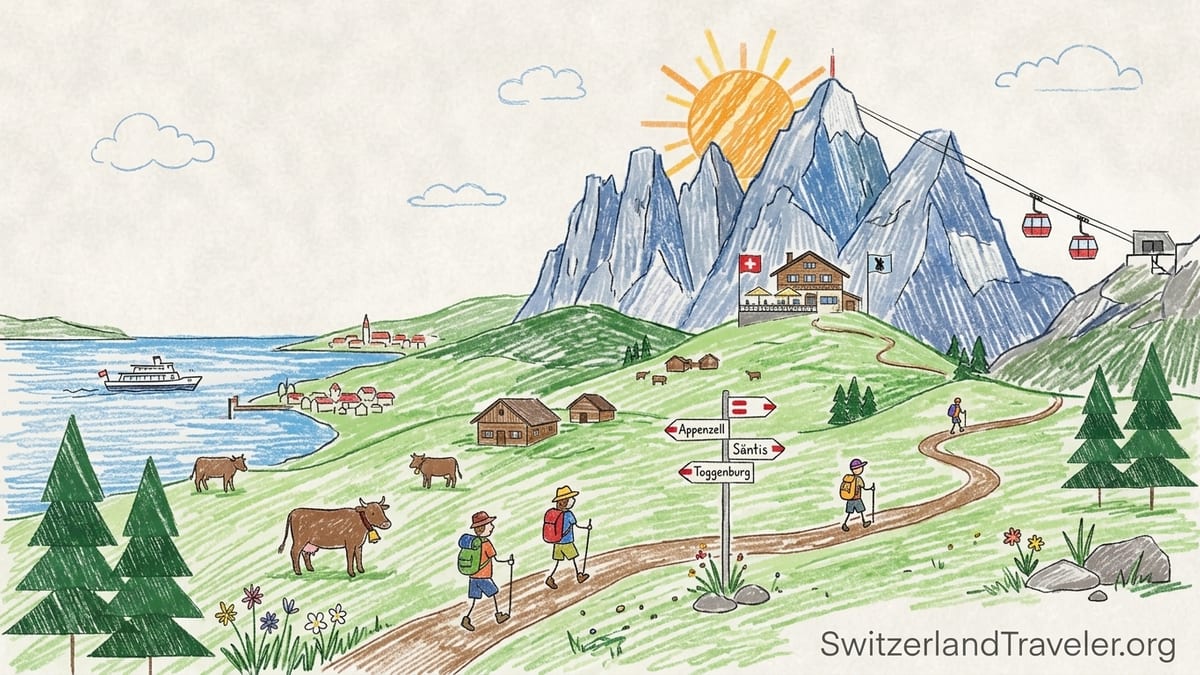
Eastern Switzerland’s Hiking Heartland: Appenzell, Alpstein and Toggenburg
For hiking holidays, Eastern Switzerland means a tight cluster of landscapes between Lake Constance, St. Gallen, Appenzell and the Toggenburg valley. At the center sits Appenzell, a small town framed by rolling dairy pastures and the jagged limestone towers of the Alpstein range. The Alpstein itself, including the peak of Säntis at just over 2,500 meters, delivers high mountain drama but is compact enough to traverse in a few days, which is why so many modern short-break packages focus here.
To the north, Lake Constance provides low-altitude walking between historic lakeside towns, while to the south and west the Toggenburg valley links these softer landscapes with panoramic balcony trails that form part of Switzerland’s Alpine Panorama Trail and Via Jacobi network. Many commercial hiking holidays now follow stages of these national routes rather than inventing completely new itineraries, which gives travelers clear waymarking and detailed SwissMobility mapping on the ground.
Several tour operators currently sell self-guided inn-to-inn trips that stitch these regions together. One widely marketed product is a Lake Constance–Appenzell–Toggenburg Alpine Panorama Trail holiday, typically starting near Rorschach on the lake, crossing through Appenzell and finishing in the Toggenburg area, with prices from about 1,099 Swiss francs per person for a week-style package including luggage transfers. Separate Via Jacobi packages that pass through St. Gallen, Appenzell and Toggenburg usually start a little lower, from around 839 francs, reflecting slightly shorter itineraries or more modest accommodation.
Regardless of which route you choose, you are walking through one of Switzerland’s best-serviced hiking regions. Trails are well marked, public transport efficiently fills in gaps between stages, and there is a dense network of mountain inns, cable cars and buses that allow you to shorten or extend days almost at will. That flexibility is a major reason Eastern Switzerland has become popular with both ambitious hikers and first-timers looking for a safe, supported introduction to Alpine walking.
Understanding the Main Route Types: Appenzell Short Breaks, Alpstein Treks, Via Jacobi and the Alpine Panorama Trail
Most bookable holidays in this area fall into four main categories: Appenzell and Alpstein short breaks, dedicated Alpstein hut-to-hut treks, Via Jacobi inn-to-inn itineraries, and Alpine Panorama Trail packages. The differences come down to altitude, terrain and how many continuous hiking days you commit to.
Appenzell and Alpstein short breaks usually focus on three to five nights based in one or two comfortable hotels or classic mountain inns, sometimes branded as “nature & wellness hiking” or “from the Alpstein to Lake Constance.” A typical example combines three nights in 4-star hotels in Weissbad, Heiden and on Lake Constance, with day hikes that range from low lakeside walks to a section of the Alpine Panorama Trail above Appenzell. These holidays use cable cars such as the ones to Kronberg or Hoher Kasten to lift you to viewpoints, then let you hike downhill or along ridges back toward the valley.
More committed Alpstein treks, sometimes sold as “Alpstein hut hops” or “Alpstein high trail” tours, string together multiple nights in rustic but atmospheric mountain inns like Berggasthaus Ebenalp, Meglisalp or Rotsteinpass. A common self-guided version runs for six days, circumnavigating the Alpstein with one night in a valley hotel at the start and the rest in huts. This style of trip is less about national routes and more about traversing the high limestone cirque, often with optional side trips to knife-edge ridges such as Schäfler.
Via Jacobi and Alpine Panorama Trail holidays are somewhat different. These follow numbered national trails on signposted paths, often between small towns and villages rather than only mountain huts. In Eastern Switzerland, Via Jacobi stages typically link places like Rorschach, St. Gallen, Herisau, Appenzell and Wattwil, while the Alpine Panorama Trail tracks a higher line between lake and valley, for example from Trogen to Appenzell and onward toward Schwägalp and Toggenburg. Commercial packages that advertise “Lake Constance–Appenzell–Toggenburg on the Alpine Panorama Trail” or “Via Jacobi through Eastern Switzerland” usually break these into 5 to 8 walking days with hotel accommodation and daily luggage transport.
Difficulty: How Demanding Are These Eastern Switzerland Routes?
Difficulty is the most important factor when choosing between these holiday types. Around Appenzell you will see everything from gentle yellow-signed paths rated T1 on the Swiss Alpine Club hiking scale to exposed blue-white alpine routes involving ladders and cables. Most commercial itineraries stay firmly in the T1 to T2 band, with some Alpstein hut treks dabbling briefly in T3 mountain trail territory on steeper passes.
Short breaks that mix Lake Constance with Appenzell usually use the easier segments of the Alpine Panorama Trail and Via Jacobi. A common section from Trogen to Appenzell, for example, is signposted as a hiking trail with no special technical difficulty, even if the day can stretch to more than 15 kilometers and several hundred meters of ascent. Families and fit but inexperienced walkers generally cope well as long as they are comfortable walking for 4 to 6 hours on undulating paths.
The Alpstein hut trips are more demanding. Stages that traverse high saddles between huts, such as between Rotsteinpass and Zwinglipasshütte or around the Säntis massif, often involve steep, sometimes airy traverses with fixed cables. While still classified mainly as hiking trails rather than full climbing routes, they require a good head for heights, surefootedness and an absence of vertigo. Tour operators selling these packages usually flag them as suitable for experienced hikers or those comfortable on red-white mountain trails, not casual walkers looking for a lakeside stroll.
Via Jacobi itineraries are generally considered moderate rather than difficult, but they do add challenge by stringing together more continuous days. Eastern Switzerland segments around St. Gallen, Appenzell and Toggenburg still involve 500 to 800 meters of ascent on some days and are not just flat pilgrimage paths. The Alpine Panorama Trail is similar in overall difficulty but often feels tougher because it deliberately holds a higher line, staying on panoramic ridges while the Via Jacobi ducks a little more often into valleys. If you are unsure which to book, a useful rule of thumb is that Via Jacobi is more accessible and cultural, while the Alpine Panorama Trail demands slightly stronger legs but rewards you with bigger views of Säntis and the Alpstein walls.
Accommodation: From Spa Hotels to Simple Mountain Inns
Across Eastern Switzerland’s hiking holidays you will encounter three main accommodation types: comfortable valley hotels, lakeside or village inns, and simple yet character-filled mountain guesthouses. How much of each you experience depends on which product you choose and how much you want to trade comfort for immersion in the mountains.
Packages that highlight Lake Constance and Appenzell tend to lean on 3 to 4-star hotels with spa facilities and multi-course dinners. It is common to see holidays advertised with nights at properties such as wellness hotels in Weissbad near Appenzell, historic hotels in Heiden above Lake Constance, and lakeside houses further north. Prices reflect this comfort: the Lake Constance–Appenzell–Toggenburg Alpine Panorama Trail itineraries that start around 1,099 francs per person usually include several nights in this category, often on a half-board basis so dinner is included.
By contrast, Alpstein hut and high trail trips involve at least two to four nights in classic mountain inns perched on pastures or ridges. These Berggasthäuser typically offer dormitory-style rooms alongside a few private doubles, shared bathrooms, and hearty set meals with local cheese and sausage. You will not find spa facilities, but the sunrise over peaks like Säntis and the sound of cowbells at dusk more than compensate. Some self-guided operators combine a comfortable valley hotel in Appenzell town at the beginning and end, with huts or basic inns in between, giving travelers both comfort and adventure in a single itinerary.
Via Jacobi and Alpine Panorama Trail hotel-to-hotel packages sit somewhere in the middle. Because they follow established national trails that drop into villages each night, most nights are spent in small guesthouses or family-run hotels in places like St. Gallen’s outskirts, Herisau, Appenzell and the Toggenburg villages. Standards are usually 2 to 3-star, though some premium versions upgrade every stop. The lower starting price of Via Jacobi holidays through this region, often from about 839 francs per person, typically reflects simpler accommodation or a slightly shorter stay compared with the more panoramic Lake Constance combinations.
Luggage Transfer, Mountain Transport and How “Self-Guided” Really Works
Most of the current bookable products in Eastern Switzerland position themselves as self-guided but supported hiking holidays, with luggage transfer as a key selling point. On a standard Lake Constance–Appenzell–Toggenburg Alpine Panorama Trail itinerary, for example, your suitcase is collected from your hotel after breakfast and delivered to the next hotel before late afternoon. You walk with only a daypack containing water, snacks and rain gear, which makes long days with 600 or 800 meters of ascent more manageable for casual hikers.
Luggage transfer coverage is slightly more complex in the high Alpstein. Some hut-based tours manage to arrange luggage delivery to most valley-accessible inns but may have one night where baggage cannot be transported by vehicle and you need to carry overnight gear in a larger pack. Operators are usually explicit about this and may provide suggested packing lists to help you keep weight down. If completely luggage-free walking is important to you, focus on hotel-to-hotel itineraries that stay below the most remote huts or accept a small compromise of one heavier day.
Mountain transport is another essential part of how these trips are structured. Many Appenzell-based short breaks integrate cable cars such as the Kronberg gondola, the cableway to Ebenalp or the lift to Hoher Kasten. A day might start with a ride up to a ridge, a high-level walk along a section of the Alpine Panorama Trail, and then a descent on foot to Appenzell or Weissbad. On Via Jacobi and Alpine Panorama Trail packages, tour dossiers often suggest optional public transport shortcuts if the weather turns bad. For example, if temperatures drop on a high stage, you might be advised to ride a PostBus over a pass section and walk only the lower half of the day.
“Self-guided” in this context means that you are not accompanied by a leader, but the route, reservations and logistics are arranged for you. Most operators now supply digital GPX tracks, offline navigation app access, or an e-guidebook in addition to printed maps. In Eastern Switzerland, where the yellow and red trail signs are already excellent, this level of support makes it realistic for confident independent travelers to complete multi-day itineraries without hiring a private guide, while still having a backup number to call if something goes wrong with a hotel or transfer.
Guided vs Independent: Which Style Suits Which Hiker?
Eastern Switzerland lends itself particularly well to independent hiking because of its dense infrastructure. Towns such as Appenzell, St. Gallen and the Toggenburg villages are linked by frequent trains and buses, waymarking is consistent, and most locals you encounter along the trails are used to helping visiting hikers with basic questions. For many people, this makes self-guided, luggage-transfer trips the ideal balance between freedom and reassurance.
Independent holidays work best for hikers who are comfortable reading maps, managing their own pace and dealing with changing weather. If you are booking a Via Jacobi package through Appenzell and Toggenburg or the Lake Constance–Appenzell–Toggenburg Alpine Panorama Trail from around 1,099 francs, you can expect clear day-by-day instructions and phone support but you are still the one making real-time decisions on whether to shorten a stage in bad weather or skip an optional summit. This appeals to travelers who prefer walking alone, as a couple or with a small group of friends rather than joining a larger guided party.
Guided trips remain a good option in two main scenarios: hut-to-hut Alpstein circuits at the upper end of difficulty and travelers who simply feel more relaxed having a professional lead the way. In Alpstein, certain traverses include exposed sections where a guide can coach less confident walkers, manage timing to avoid afternoon thunderstorms on ridgelines, and adapt the itinerary if a hut is fully booked. Guided Via Jacobi or Alpine Panorama segments are less about safety and more about interpretation: learning about Appenzell customs, Alpine farming or pilgrimage history as you walk between chapels and small towns.
Cost is also a differentiator. Guided group tours in this region typically cost more than the self-guided packages mentioned above, both because of the guide’s salary and a tendency to include more meals and airport transfers. For budget-conscious travelers, independent inn-to-inn holidays on the Via Jacobi starting around 839 francs often represent one of the most economical ways to sample Eastern Switzerland over a week, especially if you travel outside the absolute peak summer weeks.
Total Walking Days and How to Match a Trip to Your Timeframe
The number of walking days you choose has a bigger impact on your experience than many first-time visitors realize. Eastern Switzerland’s hiking products span everything from two-night weekend breaks to full two-week traverses, but most popular packages cluster in the 4 to 8 walking day range. When comparing offers, read carefully whether the advertised duration counts arrival and departure days or only actual hiking stages.
Appenzell and Alpstein short breaks tend to be at the shorter end. A classic spa-and-hiking combination around Appenzell and Lake Constance might advertise “3 nights / 2 days of hiking,” with one moderately long route high above Appenzell on the Alpine Panorama Trail and a gentler lakeside walk near Rorschach or Heiden. Slightly longer versions stretch to 4 or 5 nights and three walking days, allowing you to add a panoramic loop from cableways like Kronberg or Hoher Kasten without rushing.
Dedicated Alpstein hut circuits usually specify 4 to 6 walking days. For instance, a typical self-guided “Alpstein hut hop” might list six days with five hiking stages, each between roughly 10 and 15 kilometers, but with considerable altitude gain as you weave in and out of high valleys and passes. Rest days are rarely built into these itineraries because availability in small huts is limited, although it is sometimes possible to arrange a second night in a particularly scenic inn such as Meglisalp if you request it early.
Via Jacobi and Alpine Panorama Trail packages in Eastern Switzerland are more modular. Some operators sell a 5-day Via Jacobi holiday between Lake Constance and Appenzell with four hiking days, then suggest adding an extra three days on a follow-on section through Toggenburg if you have time. The Lake Constance–Appenzell–Toggenburg Alpine Panorama Trail itineraries that start around 1,099 francs commonly run for 7 or 8 days in total with 5 or 6 stages, giving one or two days for arrival, departure or optional side trips. If you want an extended pilgrimage-style experience, it is straightforward to combine multiple Via Jacobi modules to walk two weeks or more across a much larger section of Switzerland.
The Takeaway
Eastern Switzerland offers a rare combination of dramatic mountains, gentle pastoral landscapes and efficient infrastructure, which together make it one of the easiest places in the Alps to plan a satisfying multi-day hike. Appenzell and Alpstein short breaks deliver a concentrated taste of the region, with cable cars, spa hotels and two or three rewarding walking days for those short on time. Alpstein hut-to-hut treks raise the adventure level, putting you on steeper trails and into simple mountain inns that bring you close to the rock faces and high pastures.
For travelers drawn to the idea of a named long-distance route, Via Jacobi and the Alpine Panorama Trail provide clearly marked itineraries through Eastern Switzerland, with bookable hotel-to-hotel packages that include luggage transfer and logistical support. The Lake Constance–Appenzell–Toggenburg Alpine Panorama Trail from around 1,099 francs and Via Jacobi modules through St. Gallen, Appenzell and Toggenburg from about 839 francs are real-world examples of how these can be structured, differing mainly in altitude, views and cultural focus.
Ultimately, the best choice depends on your fitness, appetite for exposure, and how many days you can devote to hiking. If you enjoy comfortable hotels and moderate gradients, the Lake Constance and Appenzell combinations or Via Jacobi stages are ideal. If you long for rugged ridges and sunrise views from mountain huts, an Alpstein circuit or higher Alpine Panorama stages will be more rewarding. Whichever you pick, you will be walking through a compact, well-connected region where it is easy to adjust plans day by day, making Eastern Switzerland one of Europe’s most forgiving and enjoyable destinations for self-guided hiking holidays.
FAQ
Q1. How difficult are typical hiking holidays around Appenzell and Alpstein?
Most commercial trips use well-marked T1 to T2 trails suitable for fit walkers with no technical skills, especially on Lake Constance and Via Jacobi stages. Alpstein hut treks sometimes include short T3 mountain trail sections with steeper, more exposed terrain that require surefootedness and a head for heights.
Q2. What kind of accommodation can I expect on these Eastern Switzerland routes?
Lake Constance–Appenzell–Toggenburg and Via Jacobi packages usually use small hotels or guesthouses, often 2 to 4-star, with private rooms and breakfast included. Alpstein circuits add simple mountain inns and huts, where dormitories and shared bathrooms are common but the atmosphere and views are exceptional.
Q3. Do self-guided packages in this region include luggage transfer?
Yes, most current hotel-to-hotel products include daily luggage transfer so your main bag moves between accommodations while you hike with a daypack. On some Alpstein hut itineraries one remote night may fall outside the luggage network, and operators will explain clearly when you need to carry overnight gear yourself.
Q4. How many walking days should I plan for a first hiking holiday in Eastern Switzerland?
Four to six walking days works well for most visitors. Short breaks around Appenzell often feature 2 to 3 hiking days, while Lake Constance–Appenzell–Toggenburg Alpine Panorama Trail and Via Jacobi modules commonly offer 5 or 6 stages, giving you time to settle into the rhythm without committing to a full long-distance thru-hike.
Q5. Is a guide necessary for hiking the Via Jacobi or Alpine Panorama Trail near Appenzell?
For most reasonably experienced walkers a guide is not necessary. Trails are clearly marked, and self-guided packages provide maps and GPS tracks. A guided trip can be helpful if you are nervous about navigation, want local cultural insights, or are attempting more exposed Alpstein ridge stages.
Q6. When is the best time of year to hike in Appenzell, Alpstein and Toggenburg?
Late June to early October is generally the safest window for higher sections, when most snow has melted and mountain inns are open. Lower Via Jacobi and Lake Constance stages can be pleasant earlier or later in the year, but shoulder seasons may bring muddy paths, lingering snow patches and occasional cable car closures.
Q7. How do Via Jacobi and the Alpine Panorama Trail differ in this part of Switzerland?
Both are national long-distance routes, but Via Jacobi combines cultural and pilgrimage heritage with more village-to-village walking and slightly gentler lines. The Alpine Panorama Trail tends to hold higher balcony positions above the valleys, offering bigger views of Säntis and the Alpstein while demanding a bit more climbing each day.
Q8. What budgets should I expect for a self-guided hiking holiday here?
As a rough guide, current Via Jacobi packages through St. Gallen, Appenzell and Toggenburg start around 839 Swiss francs per person, typically for a week-style holiday including luggage transfer. Lake Constance–Appenzell–Toggenburg Alpine Panorama Trail itineraries with more panoramic stages and often higher hotel standards begin at about 1,099 francs.
Q9. Are these routes suitable for children or less experienced walkers?
Yes, many sections near Lake Constance and around lower Appenzell are family-friendly, with moderate distances, access to cable cars and the option to shorten days using public transport. Steeper Alpstein hut routes and exposed ridges may not be appropriate for young children or anyone uncomfortable with heights, so families often focus on easier Via Jacobi or Alpine Panorama stages.
Q10. How flexible are the itineraries if the weather turns bad?
Eastern Switzerland is highly flexible thanks to its dense bus, train and cable car network. If a storm moves in, you can usually cut a stage short, reroute onto a lower valley path or use public transport to skip a high pass. Self-guided operators typically outline these options in their route notes so you can adapt day by day.