

I arrived in Murten on a warm early-summer afternoon, stepping out of the train and straight into one of Switzerland’s oddest combinations: a fully walkable medieval town wall just ten minutes from a lakeside promenade where locals were already in swimsuits. Over the course of an afternoon and evening, walking the ramparts, wandering the cobbled arcades and ending up with my feet in Lake Murten, I learned why this small bilingual town keeps appearing in Switzerland Tourism material about the western Mittelland and the Three Lakes region. The surprise was not that Murten is pretty; it is that the intact fortifications and the easy lake access genuinely feel like two different trips layered on top of each other.
Arriving in Murten: A Small-Town Gateway to the Three Lakes
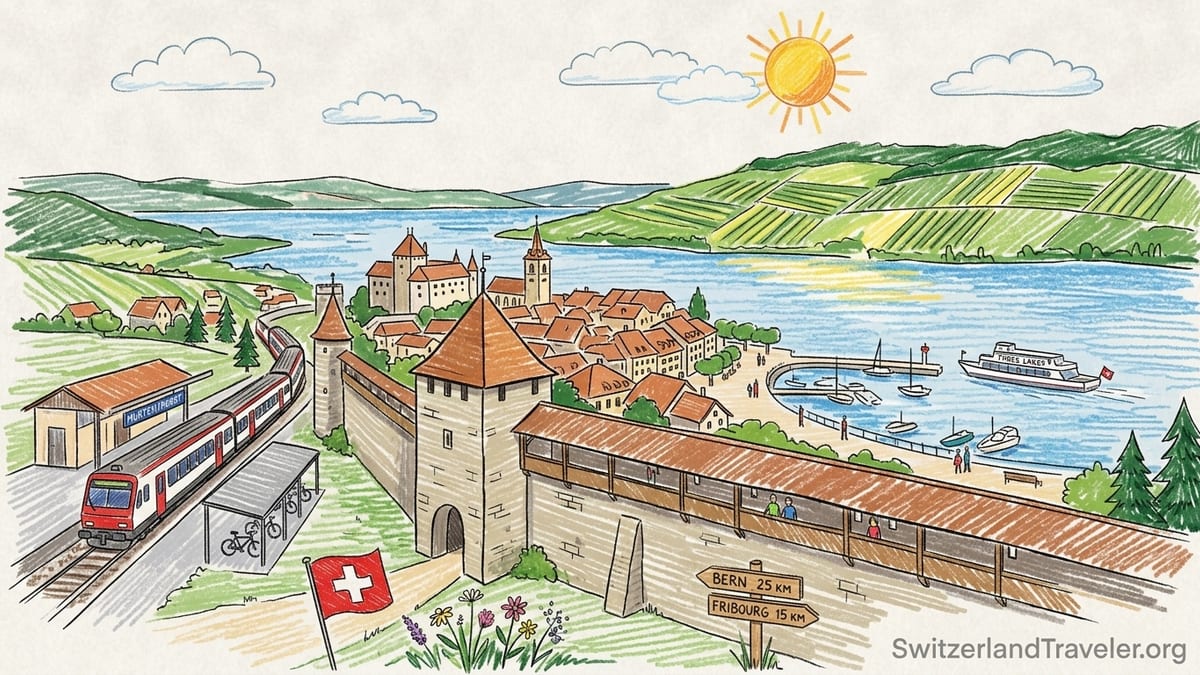
My visit started at Murten/Morat railway station, a modest stop on the line between Bern and Lausanne, with regional trains arriving roughly twice an hour in each direction during the day. The station has basic services and covered bike parking, and from here the historic core is a straightforward walk of about 8 to 10 minutes, downhill along Freiburgstrasse toward the Bern gate. The route is short enough that there is no practical reason to use local buses unless you have heavy luggage or mobility issues. Even with a small suitcase, I preferred to walk, because you feel the transition from modern residential streets into the older fabric of the town as the stone walls appear ahead.
If you are arriving by car, Murten is clearly organized for drivers skirting the old town rather than entering it. There is paid parking near the station and further lots signposted around the perimeter, including options close to the lake. Current local information shows several car parks within a five to ten minute walk of the arcaded main street, generally operating on an hourly fee structure rather than flat day rates. I noticed that spaces immediately below the ramparts filled first on a sunny weekend afternoon, while the slightly more distant lots still had availability. For most visitors, it is worth accepting a short walk for an easier parking experience and to avoid navigating narrow streets.
Because the town is compact, your first practical decision is timing. Switzerland Tourism and regional brochures often describe Murten as a classic half-day stop between Bern, Fribourg and Neuchâtel, and that expectation is accurate if you only want a quick taste of the old town and a look at the lake. I planned a longer stay from early afternoon until after sunset to see how the place evolved across the day. This schedule turned out to be ideal: the arcades and cafés were busy but manageable when I arrived, the lakefront was at its liveliest in late afternoon, and the walls and main street emptied out enough in the evening to feel almost cinematic in their quiet.
From the beginning, it was clear why national and regional tourism bodies highlight Murten among the key historic towns of the Three Lakes area. You see vineyards rising on Mont Vully across the water, hear both German and French around you, and at the same time have a preserved medieval core only a few minutes from the pier. The setting makes logistical sense: it is an easy add-on for train travelers exploring the Swiss plateau, yet feels distinctly older and more self-contained than many larger centers.
Walking the Ramparts: Murten’s Medieval Signature
The city walls are the element that most obviously sets Murten apart. Whereas many European towns have fragments of ramparts, here the upper part of the old town is still wrapped in a long, mostly continuous circuit of stone walls with a covered wooden walkway and towers. Access points are signposted; I climbed stone steps near the Bern gate and immediately found myself under a timber roof looking out through arrow slits and open sections toward the lake. Information panels placed along the ramparts explain the town’s history, including its role in late medieval conflicts, but the main impact is visual rather than interpretive.
Walking the ramparts does not take long in absolute terms. Even stopping to take photos and read panels, I spent about 30 to 40 minutes on the walls themselves. Yet that half hour was what most clearly justified the trip. From this elevated path, you see terracotta roofs, church towers and private gardens on one side and the blue of Lake Murten on the other, with Mont Vully and its patchwork of vineyards forming the distant backdrop. The combination is unusual in Switzerland: few other small towns offer a nearly complete medieval circuit with such an open lakeside panorama.
The wall walk is free, and during my weekday visit I encountered a mix of small tour groups and independent travelers. In the mid-afternoon, some sections felt briefly crowded as guided groups bunched at viewpoints. By early evening, however, the character changed; the same walkway that had felt like an attraction became more of a quiet elevated street, with just a few locals and dog walkers using it almost as a shortcut. If you dislike crowds, it is worth timing your rampart walk for later in the day or in the shoulder seasons of spring and autumn, when regional tourism data and local observation both suggest lower visitor numbers than in July and August.
From a practical standpoint, the ramparts require basic mobility. The access stairs are steep and narrow in places, and some sections of the wooden floor are slightly uneven, reflecting their age. There are low barriers and railings, but families with very young children will want to keep them close. I found that sturdy shoes made the experience more comfortable, though I saw other visitors in sandals managing without difficulty. There is no need to allocate a specific ticketed time or reserve; you simply climb up and start walking, which contributes to the pleasantly informal feel of the experience.
Arcades, Cafés and Quiet Streets: Life Inside the Old Town
Descending from the ramparts into the old town, I emerged onto the Grande-Rue, the main street that runs through the center under continuous stone arcades. The rhythm of arches, fountains and baroque townhouses is exactly the kind of scene Switzerland’s marketing material loves to show, but what struck me was how compact and human-scaled it felt. The arcades shelter a mix of cafés, restaurants and small shops rather than big brands. On a sunny afternoon, tables spilled out under the arches, with menus in both German and French and the occasional English translation for visitors.
Prices in the cafés reflected Swiss norms for a scenic historic town. A cappuccino or local pastry such as Murten’s rich Nidelkuchen typically cost in the range you might expect in other popular destinations in the country, and a light lunch with a drink easily reached several tens of Swiss francs per person depending on choices. While this will not surprise anyone familiar with Swiss prices, it is worth budgeting realistically; Murten may look like a village, but it is not a budget outlier. On the positive side, portions were generous and service generally friendly, with staff switching smoothly between German and French and often adding English when they heard my accent.
One aspect of the town that initially felt almost too polished was the level of restoration in the core streets. Facades are freshly painted, fountains neatly maintained and signage discreet. Combined with an absence of heavy traffic inside the walls, this can give Murten a slightly museum-like quality, especially in the early afternoon when day-trippers are browsing slowly under the arcades. At times I caught myself wondering how much everyday life remains in these streets compared to the tourist layer. Step a block or two away from the main axis, however, and laundry lines, schoolyards and ordinary apartment entrances quickly reassert the town’s lived reality.
What exceeded expectations in the old town was the bilingual atmosphere. Official documents note that a clear majority of residents speak German and a substantial minority French, and that bilingualism is deeply rooted. That description matches what I heard on the street. Shopkeepers greeted customers in German or French depending on cues, and conversations at neighboring café tables often switched fluidly between the two. For travelers moving between German-speaking Bern and French-speaking cities such as Neuchâtel or Lausanne, Murten offers a gentle, real-world example of Switzerland’s language transitions without the self-consciousness that sometimes surrounds linguistic identity.
From Cobblestones to Water: Lake Murten’s Promenade and Swimming
From the lower end of the old town, it takes less than ten minutes on foot to reach the lakeside promenade and harbor. The first view of Lake Murten, with boats tied up in neat rows and the hills of Mont Vully across the water, is an abrupt shift from medieval stone to open sky. Switzerland Tourism describes the lake as a popular bathing spot where water temperatures can become pleasantly warm in early summer, and this matched what I found. On my June visit, people were already swimming at the lido and along designated access points, with families spreading towels on grassy areas and teenagers daring one another to jump from small piers.
The public lakeside area here is not wild or remote; it feels like a well-managed, slightly suburban waterfront designed for both locals and visitors. There is a lido complex with facilities and a fee structure typical for Swiss lakeside pools, along with stretches of freely accessible shoreline. The promenade itself is paved and level, lined with benches, low hedges and occasional shade trees. Small kiosks and lakeside cafés offer ice cream, drinks and simple meals at prices broadly in line with what you see in the old town. It is entirely possible to spend an hour or two doing very little, simply watching sailboats glide past and listening to the alternating patterns of German and French from neighboring groups.
In terms of infrastructure, the harbor here serves as a node in the Three Lakes navigation network. Regional boat companies operate scheduled services on Lake Murten, with some itineraries linking to Lakes Neuchâtel and Biel via channels and canals. Timetables change seasonally and can be affected by water levels or maintenance, so it is important to check current schedules close to your travel date. On the day I visited, services were running on a regular daytime pattern, and you could buy tickets directly at the pier shortly before departure, with no requirement to book long in advance for standard sailings.
Swimming conditions felt relaxed yet orderly. Lifeguards were present at the main lido area, and signage made it clear where swimming was permitted and where boats took priority. The water near the shore was shallow and relatively warm compared to alpine lakes, reflecting Lake Murten’s plateau location and moderate depth. Changing cabins, showers and basic amenities were available at the paid facility, while the open grassy areas functioned more informally. For travelers who like the idea of combining a cultural town visit with a genuine swim, Murten’s waterfront delivers much more readily than many historic inland cities.
Boats, Vineyards and the Wider Three Lakes Landscape
Murten sits at the center of a wider landscape that regional tourism boards market as a trio of lakes, vineyards and historic settlements. From the harbor, boat routes circle Lake Murten and extend along connected waterways toward Neuchâtel and Biel, giving travelers an alternative to trains and roads. On my visit, I opted for a short lake cruise rather than a full Three Lakes crossing, primarily to understand how Murten appears from the water. The perspective shift is worthwhile: as the boat pulls away, the town reveals itself as a compact cluster of orange roofs topped by towers, with the castle and ramparts clearly visible above the shoreline trees.
Along the lake’s northern shore rises Mont Vully, the low hill widely covered in vineyards that supplies much of the region’s wine. Promotional material often highlights panoramic views from here across all three lakes. On this particular trip I did not hike or drive up to Mont Vully, so I can only report the view from below: long geometric bands of vines catching the afternoon light and a few scattered winery buildings. Travelers who have time to spare and a car or bicycle may well find it worthwhile to climb for the broader vista, but any description of specific viewpoints or walking routes should be based on firsthand experience. Without that, I can only confirm that from the deck of the boat and from the lakeside promenade, Mont Vully forms a graceful green backdrop rather than a sharply dramatic peak.
Boat ticket prices and combinations in this region are structured around distance and route, and discounts are often available for holders of national rail passes or regional guest cards. Because these details change regularly, especially between low and high season, it is safer to consult current timetables and price lists than to rely on any fixed figure. What does remain constant is the role of the boats as part transport, part excursion. Families used them to move between campsites and villages on different shores, while others, like me, simply completed a loop and returned to Murten for dinner, treating the cruise as a moving terrace with views of vineyards and vegetable fields in the Great Marsh.
If you are considering a broader Three Lakes itinerary, Murten works as a logical anchor point. Trains from here connect easily to Fribourg and Bern, and boats link you to Neuchâtel and to smaller lakeside communities. Cyclists, in particular, benefit from signposted routes that circle Lake Murten and continue along canals, with distance markers and dedicated paths often separating bikes from motor traffic. In several places along my walk, I saw loaded touring bikes leaning against benches as riders paused for ice cream or a swim before continuing.
Crowds, Calm and That Slightly Too-Quiet Feeling
One of the recurring questions with smaller historic destinations is whether they feel lively or overly manicured. Murten falls somewhere in the middle. On my visit, crowds were very manageable compared to Swiss hotspots such as Lucerne or Interlaken. The arcades and ramparts saw a steady flow of people in mid-afternoon, but there was no jostling and no sense of being overwhelmed. Groups tended to be small, and independent travelers could easily drop into side streets to regain solitude.
At the same time, the town can tip into a quiet that some travelers might interpret as too polished or even a little stage-like. After dinner, as the last boats docked and day-trippers boarded evening trains, the main street lost much of its bustle. A few terraces remained open, but several shops and cafés closed earlier than city visitors might expect, especially outside the peak of summer. The stone arcades, so animated in the afternoon, became echoing corridors lit by warm lamps, with only a handful of pedestrians. I found this enchanting, but those seeking nightlife or a dense bar scene would likely be disappointed.
Seasonality also shapes atmosphere. Local and national tourism sources point out that Murten’s calendar includes events such as light festivals in winter and cultural programs that draw additional visitors. Outside these periods, particularly on weekdays, the town functions primarily as a small regional center. Practical services like supermarkets and schools serve the resident population, while the number of open souvenir shops remains modest. This is not a place where you will find row upon row of identical tourist stalls. For many readers of TheTraveler.org, that will sound like a virtue. It does, however, mean that planning an overnight stay on a very quiet shoulder-season Sunday might leave you with fewer open restaurant options than you expect.
The lakeshore plays an important role in balancing this. Even when the arcades felt drowsy in late afternoon, the lido and promenade were lively with swimmers, picnicking families and cyclists looping past. Here, the polished aspect of the town revealed its advantages: the paths are well lit, access points clearly indicated and the general feeling safe and orderly well into the evening. Children rode scooters along the waterfront, and multigenerational groups lingered on benches. For a certain kind of traveler, that combination of calm and infrastructure is exactly what makes Murten appealing.
How Much Time Do You Really Need in Murten?
Going into this visit, I had read multiple guides describing Murten as a classic “half-day with option to extend” stop. After spending roughly nine hours in and around the town, my conclusion is that one afternoon and evening provide enough time to experience the main layers, but not so much that you risk boredom. In the course of a single day, I walked the ramparts, explored most of the old town streets, swam in Lake Murten, took a short boat ride and lingered over dinner under the arcades, all without rushing. I left on the late train feeling satisfied rather than pressed.
That said, the optimal length of stay depends on your broader itinerary. If you are traveling through western Switzerland by train and only have a few days, Murten works very well as a concentrated stop between larger cities. Arriving around lunchtime and leaving after sunset lets you experience the transition from day-tripping crowds to evening quiet, which is when the medieval setting feels most atmospheric. For many readers with limited time, this pattern will provide a strong sense of the place without requiring an overnight stay.
An overnight begins to make more sense if you plan to use Murten as a base for cycling or for exploring the wider Three Lakes region by boat. In that case, you might spend one full day focused on the town and lakefront, and another circling the lake by bike or venturing to nearby historic sites like Avenches or to vineyards on Mont Vully. Accommodation options in town include small hotels and guesthouses within walking distance of both the station and the lake, though availability can tighten during peak summer weeks and during special events.
Travelers who prefer slow pacing and repeated swims could also justify a romantic overnight simply to see the town at night and again in the soft light of early morning, when the cobbles are quiet and the lake often mirror-like. However, those primarily interested in urban energy, shopping or nightlife will likely find a single extended afternoon sufficient and may prefer to sleep in a larger nearby city such as Bern or Fribourg.
The Takeaway: Day Trip, Overnight or Base?
Looking back on my day in Murten, the single element that most clearly justified the trip was the combination of walking the medieval ramparts and then, within a short stroll, swimming in the lake with the town’s towers visible behind me. Many Swiss destinations offer strong old towns, and many offer beautiful lakes, but very few pack both into such a compact, easily navigable space. This unusual pairing explains why Switzerland Tourism consistently features Murten in its material about the Three Lakes and the western Mittelland and why the town continues to be recognized in broader tourism awards and campaigns.
As for how Murten works best, my assessment is nuanced. For most travelers, Murten is at its strongest as an extended day trip or afternoon-evening excursion. You can arrive by late morning or early afternoon, walk the walls, stroll the arcades, swim or sit by the lake, perhaps take a short boat trip, and then enjoy dinner as the day visitors thin out, catching a return train in the late evening. This format lets you enjoy both the town’s lively and quiet sides without committing to multiple nights.
For couples or travelers who value ambiance over activity, Murten also works well as a romantic overnight. Staying in the old town lets you wander nearly empty streets under the arcades after dark and step out early to see the lake in calm conditions before day-trippers arrive. Just be aware that nightlife is minimal; romance here is candlelight on a terrace and the sound of water rather than cocktail bars and clubs.
Murten’s role as a cycling stop is already well established in regional planning, with the 28‑kilometer loop around Lake Murten starting and ending here and numerous signposted routes feeding through town. In this context, Murten functions excellently as both a midday pause and an overnight node, with bike parking at the station, lakeside lawns for resting and easy access to food and accommodation. As a multi-day base for the entire Three Lakes region, Murten is workable but slightly less central than some might like if their plans involve repeated day trips to Neuchâtel, Biel and the Jura hills; in that scenario, combining one overnight in Murten with nights in at least one larger center offers a better balance of atmosphere and logistics.
FAQ
Q1. How do I get to Murten by public transport?
Regional trains connect Murten/Morat station with Bern and Fribourg in roughly 30 to 40 minutes, with at least two trains per hour in each direction during the day. From the station it is about an 8 to 10 minute downhill walk to the old town and another 5 to 10 minutes to the lakefront.
Q2. Is parking near Murten’s old town difficult?
Parking garages and surface lots ring the old town, with signposted spaces near the station and close to the lake. On busy summer weekends, the closest spots fill first, so it is sensible to accept a five to ten minute walk from slightly more distant lots where turnover is higher.
Q3. How long does it take to walk Murten’s medieval ramparts?
The main walkable section of the ramparts can be comfortably explored in 30 to 40 minutes, including photo stops and reading information panels. You may want to allow an extra half hour to climb up and down at different access points and to pause at viewpoints over the lake.
Q4. Is swimming in Lake Murten easy to combine with a town visit?
Yes. The lido and public shoreline are about a 10 minute walk from the old town, and facilities such as changing rooms, showers and snack kiosks make it simple to swim between sightseeing sessions. In early summer, lake temperatures are generally mild enough for comfortable bathing compared with colder alpine lakes.
Q5. Are there regular boat connections from Murten to other lakes?
Scheduled boats operate on Lake Murten and along the connecting waterways to Lakes Neuchâtel and Biel, especially from spring through autumn. Timetables vary by season, so it is important to check current schedules, but on a typical summer day you can board direct lake cruises and some longer Three Lakes routes from the Murten harbor.
Q6. Is Murten more German-speaking or French-speaking?
Murten is officially bilingual, with a clear majority of residents speaking German and a significant French-speaking minority. In practice, you will hear both languages in shops and cafés, and many people comfortably switch between the two. Visitors who speak only English generally manage well in the tourist-oriented businesses.
Q7. Does Murten get very crowded with tourists?
Murten sees steady visitor numbers in summer and during special events, but it is rarely as crowded as Switzerland’s major resort towns. Mid-afternoons in high season can feel busy along the arcades and ramparts, while mornings and evenings tend to be calm. Outside peak months, the town often feels more like a lived-in regional center than a mass tourism destination.
Q8. Is one afternoon enough to see Murten?
One afternoon and evening are sufficient to walk the ramparts, explore the old town, spend some time by the lake and have a leisurely meal. Travelers with particular interests in cycling, boating or nearby attractions may appreciate an additional day, but most first-time visitors will feel they have covered the highlights in a single extended visit.
Q9. What type of stay suits Murten best?
Murten works especially well as an extended day trip or as a romantic overnight focused on atmosphere rather than nightlife. It is also a practical stop or base for cyclists riding the loop around Lake Murten or connecting to other routes in the Three Lakes region.
Q10. Is Murten suitable for families with children?
Yes. The compact walled town, car-light streets, lakeside lawns and lido make Murten appealing to families. Parents should supervise children closely on the ramparts and near the water, but otherwise the infrastructure, clear signage and relaxed pace make the town straightforward to navigate with kids.