


I arrived in Aargau with the enthusiastic mindset of a collector. Switzerland Tourism describes the region as a dense cultural landscape of castles, monasteries, Roman sites and fortified towns, and I took that almost as a challenge. Armed with a regional castle pass and a carefully plotted map, I tried to “do” four major heritage sites in a single day. By dinner, I was sitting in a quiet square in Lenzburg wondering why one of Switzerland’s richest historical regions had started to feel strangely flat and repetitive.
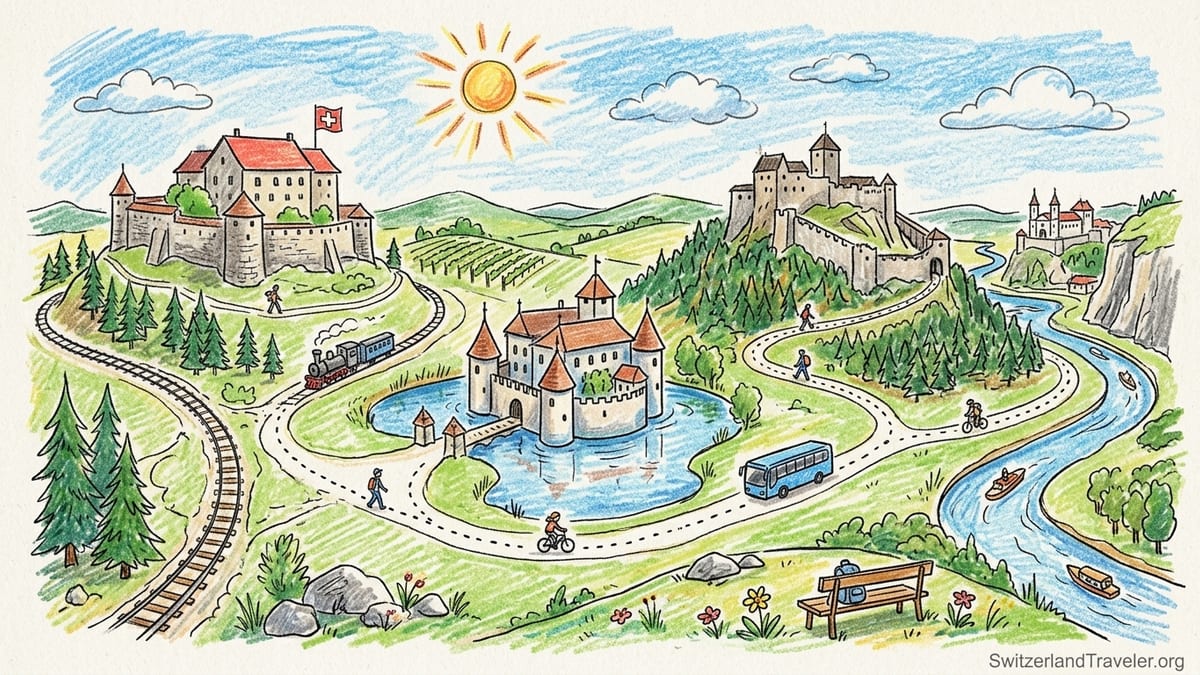
How I Built an Over-Ambitious Castle Day
My base was Aarau, the small cantonal capital with its pretty gabled old town. On an April Saturday, I set out with the idea of following the spirit of the so-called Aargau castle routes promoted by Switzerland Tourism: a mix of Lenzburg Castle, Hallwyl Castle, Habsburg Castle and the fortress at Aarburg, all in one sweeping loop by train and bus. On paper it looked efficient. The distances are short, connections are frequent and Museum Aargau’s “Schlösserpass” combination ticket can cover several sites in a day, so it felt almost wasteful not to fit in as many as possible.
I started early at Lenzburg Castle, because every brochure and tourism board blurb calls it one of Switzerland’s finest hilltop castles and it genuinely looks the part from a distance. The train from Aarau to Lenzburg takes barely 10 minutes, and the walk up from the station, though fairly steep, is under half an hour along residential streets and a wooded path. By the time the gates opened I had already logged more vertical meters than I had expected, but the views back to the Jura hills and over the town were a satisfying reward.
After Lenzburg, my plan was to hop to Hallwyl Castle on Lake Hallwil for a contrast between hilltop fortress and moated palace, then back inland toward Wildegg and finally over to the Habsburg and Aarburg area. It sounded varied when I traced it with my finger across the map. What I underestimated was how the rhythm of the day would be dictated not by the scenery but by museum interiors, timed guided tours and the pressure to “get my money’s worth” from each entrance ticket.
By mid-afternoon, instead of feeling steeped in a thousand years of Habsburg power, I mostly felt that I had wandered through a dozen similar exhibition rooms, glanced at too many coats of arms and spent too little time simply being outside in the Aare valley.
Where the Interior Ticket Was Worth Every Franc
Lenzburg Castle was where I started and, in hindsight, it is also the place where paying for a full interior visit genuinely made sense. Run as part of Museum Aargau, the complex has layered exhibitions in the keep, towers and the old bailiff’s residence that cover everything from medieval court life to early modern justice. The space is used thoughtfully. In one room, children can try on replica armor, and in another you step through a corridor of period furnishings that feel naturally arranged rather than staged for Instagram. There is enough breathing room between the thematic sections to keep it from feeling like a school project.
The entry price, which at the time of my visit was in the range of what you would expect for a major Swiss museum castle, felt fair because I stayed nearly three hours. A good chunk of that time was actually on the terrace and inner courtyard, watching families picnic and looking out over the tiled roofs of Lenzburg. The exhibitions added context to the views instead of competing with them. I learned just enough about the Habsburg period and later Bernese rule to feel oriented, without being buried in panels of dense text.
If you are going to choose one castle in Aargau where the full interior visit is worth arranging your day around, Lenzburg would be my pick. It works as an experience even if you are not a hardcore history buff. The storytelling is better, the variety of rooms larger and the sense of place stronger than at many smaller fortresses. Importantly, there are multiple outdoor pockets where you can reset your attention: a small garden corner, benches overlooking the town and paths around the ramparts.
At this point in the day, castle fatigue had not yet arrived. I walked back down toward the station feeling energized, castle pass in my pocket, convinced that I could easily handle three more heritage stops.
When Another Ticket Felt Like One Too Many
The first signs of fatigue appeared at my second castle of the day. I took a regional train and then a short bus ride into the Seetal to reach Hallwyl Castle, one of Switzerland’s best-known moated castles. Surrounded by water, with stone bridges and timbered outbuildings, it is objectively beautiful. Standing across the moat with the drawbridge and towers reflected in the water, I found myself completely satisfied before I had even entered the ticket office.
Inside, Hallwyl also belongs to Museum Aargau and has curated rooms on the noble Hallwyl family, their household economy and the life of the estate. The problem was not that the information was poor. It was that, after Lenzburg, the format felt familiar almost to the point of repetition: furnished chambers, interpretive panels about landownership and alliances, a room explaining the family’s coat of arms and connections across Europe. My attention started to slide off the displays and drift back toward the courtyard and the moat.
I ended up moving quickly through the upper floors and spending my remaining time on the bridges and in the courtyard taking in the architecture from different angles. That part was free of signage and timelines, and it was here that I remembered why I wanted to visit in the first place. The stone walls rising directly from the water, the ducks weaving under the arches, the low afternoon light on the ponds at the edge of the grounds, all of that told a more immediate story than the panels inside.
By the time I left Hallwyl, my inner critic was quietly calculating whether I should have saved the interior ticket fee and simply walked around the outside. The answer, for me on that particular day, was probably yes. If your schedule is tight or your budget modest, Hallwyl is the perfect example of a castle where the exterior and setting deliver most of what you come for. Admire it from the paths and bridges, then spend your time walking along the lakeshore instead of climbing yet another spiral staircase.
The Exact Moment Enthusiasm Dropped
After Hallwyl, I tried to stay faithful to my original plan and headed back toward the main Aare valley. My next target was the Habsburg, the ancestral seat of the Habsburg dynasty perched on a wooded ridge above the river. From the nearest train station you ride a PostBus that zigzags up through the village before depositing you below the castle. The last stretch is on foot again, a short but steady climb that I felt far more in my legs than the similar ascent at Lenzburg that morning.
Stepping through the gate at Habsburg Castle, I could sense that the site was smaller and more intimate than the morning’s attractions. There are exhibition rooms about the rise of the Habsburgs and some modest displays of archaeological finds. It is a meaningful place in European history, but the way the story is told inside felt close to what I had already read earlier in the day. Panels describing medieval power politics, glass cases of ceramics, models of the original complex. Objectively interesting, but my mind had reached saturation point.
My enthusiasm dropped sharply when I realized how I was moving through the rooms: not out of curiosity, but out of duty. I was scanning labels rather than reading them, counting how many rooms remained, checking my watch to see if I could still make a late-afternoon visit to Aarburg’s fortress above the Aare before closing time. The exhibits had blended into a kind of historical wallpaper.
The turning point came in a small courtyard at Habsburg. I stepped outside for a breath of air, looked across the vineyards and forests toward the confluence of the major Swiss rivers and understood that what I actually wanted was to walk along a ridge trail or sit in a café in nearby Brugg, not to rush back indoors for another dose of facts. It was only mid-afternoon, but I had already seen more vaulted ceilings and reconstructed rooms than I could absorb. The castle pass that had seemed like a bargain in the morning now felt like a self-imposed obligation.
How Logistics, Stairs and Timetables Feed Castle Fatigue
Part of what made that day feel heavier than expected was the constant negotiation with logistics. Each castle sits on a hill or above a river for strategic reasons. For a visitor, that translates into repeated climbs, cobbled paths and lots of staircases inside the buildings themselves. None of them are extreme in isolation, but stacking them in one day adds up. At Lenzburg alone I climbed narrow tower steps twice. At Hallwyl there were multiple wooden staircases between levels of the manor. At Habsburg it was another set of stone steps just to move between exhibitions and viewpoints.
On top of the physical effort is the mental load of timing. Museum Aargau sites and many castle museums in Switzerland still work with defined opening hours and often last-entry cut-offs in the late afternoon. Trains and buses in Aargau are frequent and generally reliable, but connections can still involve 20 or 30 minutes of waiting in small villages. I found myself cutting short a relaxed coffee in Lenzburg’s old town because missing a half-hourly bus would have meant shrinking my time at Hallwyl. Later, I speed-walked through a residential area to reach a bus up to Habsburg, eyes on the clock rather than on the countryside.
Financially, trying to maximize a multi-site pass can warp your decisions. Knowing that each additional castle only added a modest supplement to the pass, I felt compelled to use it as often as possible. Instead of asking, “Do I actually want another interior visit today?” I was asking, “Wouldn’t it be wasteful not to go inside when I am already here?” That is how you end up spending an hour in a museum you are no longer emotionally present for, simply because you have already paid the fee.
By the time I considered slotting in a final dash to Aarburg’s fortress, with its long staircase above the Aare and limited visiting hours, the day had stopped feeling like a journey through living history and had morphed into a spreadsheet exercise. All of this fed a sense of castle fatigue that was not about the quality of the sites themselves, but about the way I had chosen to consume them.
Why Four Castles Turn Into One Blurred Memory
In hindsight, the most surprising part of that weekend was how quickly distinct places blurred into a single generic memory. Lenzburg’s hilltop silhouette, Hallwyl’s reflections in the moat, Habsburg’s ancestral aura and the idea of Aarburg’s clifftop fortress above the river should all have felt different. Yet, a few days later, I found myself mixing up which audio guide had talked about which noble family, and where exactly I had seen a particular model of a medieval kitchen.
Part of this is inherent in how castle museums across Europe present their material. You tend to get similar topics: warfare, daily life in the Middle Ages, changes under later rulers, sometimes a room about criminal justice or witch trials. When you experience these themes back-to-back in a single day, your brain starts to protect itself by generalizing. The careful curatorial distinctions that museum teams work hard to create are lost simply because the visitor has reached their interpretive limit.
Another culprit is the lack of contrast in some itineraries. Aargau actually offers a lot of variety within short distances: river confluences nicknamed Switzerland’s “water castle,” vineyards in the Jura foothills, spa towns along the Limmat and Aare, Roman sites in Windisch and Brugg. On my overstuffed day, I passed many of these places in transit but rarely stopped to experience them. The castles dominated everything, so the landscape in between became just a corridor. Without changes in texture, light and activities, it is easy for a trip to feel flatter than the brochure promises.
Most importantly, trying to “collect” castles encourages a tick-box mentality. You count sites, not moments. When I look back, the strongest memories from that weekend are not tied to how many exhibits I saw. They are of smaller details: a quiet bench under a tree below Lenzburg, the smell of damp stone at Hallwyl’s moat, the silhouette of Habsburg at sunset from a distance. The lesson, which I only truly understood afterward, is that heritage in a region like Aargau is better appreciated in three deep experiences than in eight superficial ones.
The Second-Trip Plan: One Castle, One Town, One Nature Break
If I were to plan that weekend again, I would keep the heritage focus but cut the castle count drastically. My revised itinerary for a single day in Aargau would start with one major castle interior visit, continue with a lighter stop in a historic town and end with a riverside or spa break that has nothing to do with museum labels.
For the main castle, I would still choose Lenzburg. I would allow a full morning there, without checking the clock for onward buses. That would mean time for the exhibitions, plus a simple picnic in the courtyard and a stroll around the outer paths to enjoy the views. Instead of rushing down to the station immediately, I would spend an hour in Lenzburg’s compact old town, perhaps at a café near the church, letting the stories from the castle settle a bit.
The second stop would be a historic town that does not demand an entrance ticket or structured visit. Aarau works well for this with its painted gables and small pedestrian core, as do Brugg or Baden, both with layers of history and easy rail connections. An hour or two of unscripted wandering, with the option of stepping into a church or town museum only if the mood strikes, gives you the feeling of heritage without the pressure of another curated route.
To finish, I would build in a nature or wellness experience. That could mean walking along the Aare near Brugg, following a section of the regional Aargauer Weg hiking route through the Jura Park to a castle ruin, or spending late afternoon at a thermal spa in Baden, where the Roman history is literally under your feet but the focus is on hot water and relaxation. Crucially, this third element should not involve timed entries or dense information panels. It should reset your senses so that the castle you saw in the morning stands out in memory rather than getting lost in a blur.
The Takeaway
Aargau’s dense concentration of castles, monasteries and fortified towns is both its strength and its trap. It invites you to approach the region like a catalogue, confident that with a rail pass and a few smart connections you can fit a whole dynasty’s worth of sites into one tidy weekend. My attempt to do exactly that left me tired, over-informed and oddly underwhelmed, not because the individual places were weak, but because I tried to experience too many of them in the same way and in too little time.
The day I tried to string together four heritage sites across the canton taught me more about my own limits than about medieval politics. Somewhere between the second and third castle, enthusiasm tipped into obligation. Ticket costs started to feel like quotas to fill, stairs became something to endure rather than routes to viewpoints and yet another sequence of period rooms blurred into the one before. The landscape outside the bus window, which should have been a key part of any Swiss trip, receded into the background.
On a second trip, I would plan with subtraction, not addition. One richly explored castle interior, one unhurried town wander and one nature or spa interlude are enough to let Aargau’s layered history breathe. Instead of hunting for the next tower on the horizon, I would choose a single vantage point and give it time. In a region where heritage is everywhere, the real discipline is not in collecting sites, but in deciding which ones to skip so that the few you do see can stay vivid long after you leave.
FAQ
Q1. Is it realistic to visit four castles in one day in Aargau?
It is physically and logistically possible to string together several castles in one day using trains, buses and walking, but the experience often feels rushed and repetitive. After two interior visits most travelers will find their attention and enthusiasm waning, which reduces the value of additional stops.
Q2. Which single castle interior in Aargau is most worth the ticket price?
If you only choose one full interior visit, Lenzburg Castle is a strong candidate. It combines extensive exhibitions, a varied architectural layout and good outdoor spaces, so you can easily spend several hours there without feeling museum fatigue.
Q3. Are there castles in Aargau that are better appreciated from the outside only?
Some sites, such as moated castles like Hallwyl or hilltop ruins in the Jura Park, offer much of their appeal through exterior views and surroundings. In these cases, walking around the grounds, bridges and nearby paths can be more rewarding than another detailed tour of interior rooms, especially on a tight schedule.
Q4. How do ticket costs influence the feeling of castle fatigue?
Multi-site passes and combination tickets can create a subtle pressure to “use” every possible inclusion, even when your energy is fading. This can lead you to visit additional interiors out of obligation rather than genuine interest, which accelerates the sense of fatigue and blurs individual memories.
Q5. What is the main physical challenge of a castle-heavy day in Aargau?
The repeated climbs add up. Most castles sit on hills or ridges and have multiple levels connected by staircases. When you combine several steep walks from stations or bus stops with interior towers and ramparts, the cumulative effect can be tiring even for reasonably fit visitors.
Q6. Can public transport handle a castle-focused itinerary, or is a car better?
Public transport in Aargau is generally reliable, with frequent trains and PostBus connections to many heritage sites. A car can shorten some transfers, but it does not solve issues of limited opening hours or the mental fatigue of too many similar visits. The key is editing your plan, not simply changing your mode of transport.
Q7. How much time should I budget for one major castle visit?
For a substantial site like Lenzburg or Hallwyl, allowing at least two to three hours works well. This lets you explore exhibitions, climb to views, take photos and pause in the courtyard or café without constantly watching the clock or racing to the next attraction.
Q8. What is a good non-museum activity to pair with a castle in Aargau?
Balancing heritage with nature or wellness helps prevent overload. Options include a riverside walk along the Aare near Brugg, a short hike in the Jura Park to a castle ruin, or a soak at a thermal spa in Baden. These experiences add variety without more dense information.
Q9. How can I avoid repetitive exhibits when I like history?
Focus on variety rather than quantity. Choose one castle for a deep dive into medieval life, then shift to a town museum, an archaeological site or simply a historically rich old town for the rest of the day. Rotating the type of experience keeps the history feeling fresh.
Q10. If I only have one day in Aargau, what balanced itinerary would you recommend?
A practical plan is to spend a relaxed morning at Lenzburg Castle, enjoy lunch and a stroll in Lenzburg or Aarau’s old town, then finish with a riverside walk or spa visit in the afternoon. This mix gives you one major heritage anchor, one lighter urban stop and one nature or wellness element without turning the day into a checklist.