

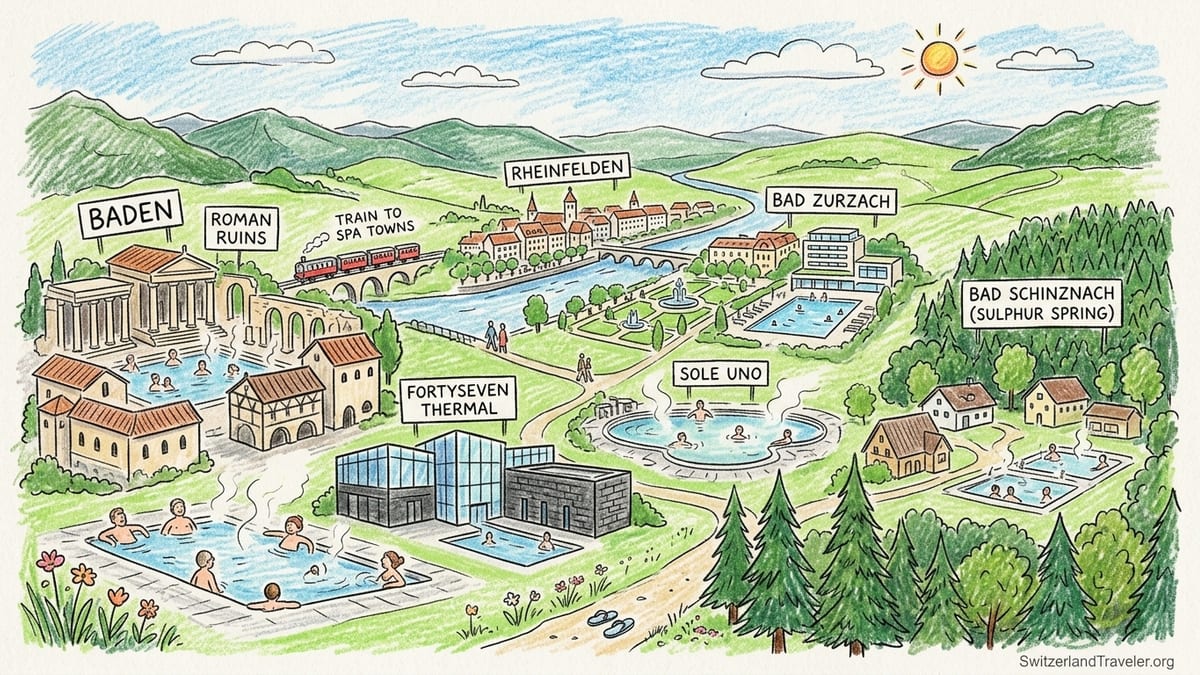
In northern Switzerland’s Mittelland, between Zurich and Basel, thermal water has shaped towns, trade routes and health tourism since Roman times. Today Baden, Bad Zurzach, Bad Schinznach and Rheinfelden form a compact spa region in Aargau and the northern Mittelland where steaming pools, riverside promenades and contemporary wellness architecture are all part of a very real travel product. Each town offers its own blend of history, atmosphere and facilities, from sulphurous springs once known to the Romans to modern brine pools with spa rituals and saunas. This guide compares the four destinations to help you choose the right Swiss thermal experience for a day trip or an overnight wellness break.
Thermal Aargau and the Northern Mittelland: A Historic Spa Landscape
The Aargau–Solothurn region sits above a geological fault line where deep rock layers push mineral-rich water toward the surface. Romans quickly discovered these springs and established baths and way stations along key north–south routes. The most famous cluster grew up at Baden on the Limmat River, where excavation has revealed extensive Roman bathing structures and the remains of temples and villas. Later, medieval pilgrims, Habsburg nobles and nineteenth‑century grand tourists soaked in the same waters, turning Baden into a byword for bathing culture in the German-speaking world.
Further downstream along the Rhine, Bad Zurzach and Rheinfelden evolved as spa towns with riverfront promenades, Kurpark gardens and hotels built to serve guests who stayed for weeks of cures. Inland, near the border between the folded Jura and the Mittelland, sulphurous springs around today’s Bad Schinznach created a quieter, more rural spa cluster. Switzerland Tourism now highlights Baden, Bad Zurzach and Bad Schinznach as flagship wellness destinations for Aargau and neighboring Solothurn, with Rheinfelden increasingly marketed alongside them thanks to its strong brine-based spa product.
For modern travelers, what once were medical cures have become short wellness breaks and weekend escapes. Yet the historic layering is still tangible. In Baden you step out of a design-led thermal complex and almost immediately pass medieval inns that once welcomed bathers. In Rheinfelden and Bad Zurzach, the Kurpark lawns and colonnades around the baths recall a time when promenading between treatments was part of the experience. Understanding these roots helps explain why thermal bathing here feels more like an entire place-based culture than a single isolated spa visit.
All four destinations work well as day trips from Zurich, Basel or the wider Mittelland, with travel times often under an hour by train and bus. At the same time, each town has enough depth in its spa offering, walking paths and dining to justify at least one overnight stay if you want to slow down and really live the spa rhythm.
Baden: Roman Hot Springs and Contemporary Design
Baden’s springs are among the hottest in Switzerland, with water emerging at around 47 degrees Celsius. That temperature inspired the name of the town’s new flagship thermal complex, Fortyseven, which opened in 2021 and anchors the redeveloped riverfront bath quarter. The architecture is contemporary, with angular volumes clad in dark stone and expansive river-facing glass. Yet the roots are unmistakably historic: this same bend in the Limmat hosted Roman baths, medieval bathhouses and the grand hotels of the nineteenth century.
Inside, Fortyseven leans toward a tranquil, spa-like atmosphere rather than a water park. You find several indoor and outdoor pools with different temperatures, quiet zones with loungers, and areas dedicated to thermal rituals such as Kneipp-style foot basins and experience showers. The outdoor pools stretch toward the river, so in cooler months you float in warm water while watching mist rise from the Limmat and steam drift from surrounding rooftops. A separate sauna world, accessed with an upgraded ticket, follows continental European sauna culture: nude in the sauna cabins, with towels and robes for moving between rooms and relaxation spaces.
Baden balances couples-oriented wellness with reasonable family suitability. Children are welcome in most pools, and families often visit for a half day, combining bathing with a walk along the river or up into the old town for ice cream or dinner. However, the mood is generally calm rather than boisterous, and the sauna area is reserved for adults. Current online price lists indicate that basic admission for adults to the thermal baths is in the range of a few dozen Swiss francs for a timed slot, with higher combined tickets that include saunas. It is important to check the latest prices and possible dynamic tariffs on the official booking platform and to reserve peak weekend and holiday times in advance.
Public transport access is straightforward, which helps Baden excel as a day trip destination. Fast trains from Zurich or Basel reach Baden in around 15 to 30 minutes depending on the route, and from Baden station it is an easy walk or short bus ride down to the spa quarter. Travelers without a car can leave a city hotel after breakfast, enjoy several hours of bathing and still return in time for an evening engagement. For a more immersive stay, Baden’s compact old town and the riverside path make pleasant surroundings for an overnight spa break focused on design, culture and gastronomy as much as on the water.
Bad Zurzach: Rhine-Side Resort Feel and Open-Air Pools
Bad Zurzach sits directly on the Rhine, upriver from Basel and opposite Germany. Thermal water is pumped from underground and fed to an extensive complex of outdoor and indoor pools, including a 25‑meter open-air pool that attracts both lap swimmers and wellness guests. The atmosphere has more of a resort feel than Baden: the spa complex is surrounded by hotel buildings and apartment houses with balconies, and the adjacent Kurpark with its lawns, trees and fountains extends the sense of space beyond the pools themselves.
The bathing offer in Bad Zurzach includes several thermal pools at different temperatures, bubble loungers, neck showers, a lazy river and at least one brine pool where you can float more easily than in normal water. In cooler seasons, steam rises from the open‑air basins, and evening visits under floodlights are particularly atmospheric. A substantial sauna area, including a newer “bohrturm” themed sauna landscape, caters to sauna enthusiasts with multiple cabins, infusions and quiet rooms. As is typical in Switzerland, the sauna section is textile-free, while the main pools require standard swimwear.
This is one of the more family-friendly options in the region, provided children are comfortable in warm water and with longer stays. Families often base themselves in one of the on-site or nearby hotels, which sometimes sell packages that include unlimited or extended access to the thermal baths and saunas during the stay. One local hotel, for example, bundles room rates with unrestricted use of the entire bathing and sauna world plus the fitness center from the afternoon of arrival until late afternoon on departure day. For many travelers this shifts Bad Zurzach from a simple day excursion to a mini-resort experience.
From Zurich, trains to Bad Zurzach involve at least one change and arrive at a station within walking distance of the baths, making it realistic for a day visit. The journey from Basel is a bit longer but still manageable. For drivers, the spa town is directly accessible from regional roads along the Rhine. Current admission charges for the public thermal baths and sauna areas fall broadly in line with other major Swiss spas, with higher prices for full-day access and combined sauna tickets. Specific amounts can change seasonally and may be affected by special offers or package deals, so it is worth consulting the official price overview before traveling and considering online reservations during popular winter weekends.
Bad Schinznach: Sulphur Springs in a Green River Valley
Bad Schinznach lies in a quieter valley along the Aare River, framed by forested hills at the transition between the Jura and the Mittelland. Here the focus is on sulphurous thermal water, described by the operators as the strongest sulphur spring in Switzerland. The spring has been known since at least the mid‑seventeenth century, when hot, strong‑smelling water suddenly broke through the ground and soon attracted bathers. Today that heritage continues through two neighboring facilities: Aquarena Fun, which is more family- and activity-oriented, and Thermi Spa, which caters to guests seeking calm and classic wellness.
Aquarena Fun combines indoor and outdoor pools, warm‑water play areas, slides and features that appeal to children and teenagers. The sulphurous water is managed so that the characteristic smell is noticeable but not overpowering, and there are zones where families can simply enjoy warm bathing without intense wellness rituals. Thermi Spa, by contrast, aims for a quieter, more exclusive feel, with a focus on relaxation pools, panoramic rest areas and a wellness and beauty program. The overall atmosphere in Bad Schinznach is more rural and intimate than in Baden or Bad Zurzach, with the baths surrounded by trees, lawns and a small hotel and clinic complex rather than a full-scale town.
Wellness orientation is strong here. The official information highlights thermal bathing, spa treatments, massages and beauty services, especially at Thermi Spa. Sauna facilities are available, following standard nude sauna culture in designated zones with towel and robe use outside the cabins. Public price lists show a structure of separate tickets for Aquarena Fun and Thermi Spa, plus combined options. Entry for intensive wellness areas is typically restricted to adults, and online ticketing is used to manage capacity. Operators note that tickets are sold from age 18 upward for certain zones, which effectively positions much of the spa side as adults-only.
Bad Schinznach is reachable by train on the line between Brugg and Aarau, with a small local station from which it is a short walk to the thermal complex. This makes the site realistic as a car-free day trip, especially if you combine a few hours of bathing with a walk along the Aare or a meal at the on-site restaurants. For many travelers, though, Bad Schinznach becomes most attractive as a tranquil overnight retreat, especially when paired with accommodation at the adjoining hotel or at a nearby country inn. Compared to the more urban feel of Baden or Rheinfelden, you are closer to fields, riverbanks and forest paths.
Rheinfelden and Sole Uno: Brine Water and a Compact Spa Town
Rheinfelden, just upstream from Basel, is a small medieval town set directly on the Rhine, with one half in Switzerland and the other across the river in Germany. On the Swiss side, the Parkresort complex houses the Sole Uno wellness world, a substantial spa centered on brine water. The brine concept connects Rheinfelden to its industrial past, when saltworks and saline infrastructure shaped the local economy. Today, the same salty water underpins a contemporary bathing and sauna product marketed to both locals and destination spa visitors.
Sole Uno’s pools include a large indoor brine pool with massage jets and gentle currents, an outdoor pool that steams in winter under colored lighting, and a special floating pool where the salt concentration allows bathers to drift with minimal effort. There are also hot‑and‑cold pools, a Kneipp path and experiences such as brine inhalation rooms. The sauna area, a clearly separated textile-free zone, offers several cabins at different temperatures, a steam bath and regular sauna infusions. Indoors the mood is subdued and softly lit; outside, especially on cool evenings, the view of steam rising against the backdrop of tall trees and hotel buildings gives a strong sense of being in a spa park rather than an amusement facility.
House rules and FAQs published by the operator make the framework for a visit transparent. In the bathing area, only standard swimwear is permitted, and long garments that extend below the knee or elbow are not allowed. Children under 4 are not admitted at all, and those aged 4 to 13 may enter only when accompanied by an adult. The sauna zone is strictly for guests 14 and over and must be used without clothing, in line with continental sauna norms. Towel use is mandatory to cover benches in saunas, and in the humid steam bath, surfaces must be rinsed before and after use. Senior discounts begin from age 64 for women and 65 for men, and last admission is generally 2 hours before closing, with bathing and sauna operations ending about 30 minutes before official closing time.
Current price overviews for Sole Uno show timed admissions of several hours and full-day options, with different rates for weekdays and weekends or public holidays. There are supplements or combined tickets that include both bath and sauna areas. Because prices have been adjusted more than once in recent years, and local media occasionally report on price debates, it is essential to verify the latest amounts on the official price page or at the entrance. For visitors from Basel, Rheinfelden is extremely easy to reach by regional train in under 20 minutes, and from the station it is a short signed walk through the Parkresort to the spa. Zurich travelers usually change trains once and can still arrive within about an hour, which makes Sole Uno especially attractive as a day trip from either city.
As a town, Rheinfelden rewards an overnight stay. After a long spa session you can stroll the car‑free old streets, walk the river promenade or cross the pedestrian bridge to the German side for a different perspective on the Rhine. Several hotels are integrated into or closely tied to the Parkresort, so you can go from your room to the brine pools in a few minutes in your robe. The combination of cohesive spa infrastructure, riverside setting and easy train access makes Rheinfelden one of the most complete spa-town experiences in the area.
Practicalities: Swimwear, Saunas, Robes and Reservations
Across all four destinations, swimwear and sauna rules follow a similar pattern that can surprise visitors who know only Anglo‑Saxon pool culture. In the main thermal pools in Baden, Bad Zurzach, Bad Schinznach and Rheinfelden, standard swimsuits, bikinis or swim shorts are required. Surf-style long shorts and streetwear are often discouraged or explicitly banned, with some facilities specifying that garments should not cover knees or elbows. In the dedicated sauna and steam areas, by contrast, nudity is the norm. Guests remove swimwear for hygiene reasons and sit or lie on large towels inside the cabins. Between saunas you wear a towel or bathrobe, and in relaxation rooms it is common to be wrapped in a robe.
For travelers who do not own spa gear or prefer to travel light, all four destinations offer some form of towel and robe rental, typically at the reception desk or a dedicated shop in the entrance zone. Rental fees are usually a handful of Swiss francs per item, often with a deposit system or a charge added to a wristband that you settle when leaving. Because price lists change periodically and sometimes bundle rentals into package tickets, you should check the current details on the operator’s information sheet or ask at the desk. Bringing flip-flops or non‑slip bathing shoes is strongly recommended, and some facilities may sell inexpensive pairs if you arrive without them.
Reservation practices also matter. Baden’s Fortyseven and Bad Schinznach’s wellness areas increasingly rely on online tickets and timed entry, especially at weekends and during winter, to control crowding. Bad Zurzach and Rheinfelden’s Sole Uno, while still allowing walk‑in visits on many days, strongly encourage advance reservations during peak periods and for massages or beauty treatments. Where time limits apply, your bathing period usually starts when you pass the turnstile, not when you buy the ticket, and surcharges can be due if you overstay your booked slot.
Age rules are another practical point. Sole Uno in Rheinfelden does not admit children under 4 at all and excludes anyone under 14 from the sauna section. Bad Schinznach’s Thermi Spa restricts certain tickets to adults 18 and over, positioning that area as a child‑free quiet zone. Baden and Bad Zurzach are more family‑oriented in their main pools, but their sauna worlds are still adult territories. Families should always confirm current age restrictions and ask whether specific pools or times are recommended for children, and consider visiting earlier in the day when the atmosphere tends to be calmer and less crowded.
Comparing Atmosphere and Best Uses: Family Days or Couples’ Escapes
Each of the four spa destinations has a distinct atmosphere that influences whether it shines more as a family outing, a romantic escape or a quiet solo wellness retreat. Baden feels urban and cultural. Its bath quarter is integrated into a small city with theaters, museums and a lively old town. This makes it ideal if you want to pair a half‑day of bathing with an exhibition, a concert or dinner in a local restaurant. Couples and solo travelers who enjoy design and architecture are especially drawn to the contemporary lines of Fortyseven against the historic backdrop of Roman ruins and old bathhouses.
Bad Zurzach, with its resort-like complex of hotels, balconies and sprawling outdoor pools, leans toward longer stays and multi‑generational travel. Grandparents, parents and children can all find their pace, whether doing gentle exercise in the lap pool, soaking in warm outdoor basins or taking a sauna session. It is the closest in feel to a classic Central European Kurort, and the grassy Kurpark invites slow walks between dips. As a day trip it works well if you are based in the Zurich region and want extensive outdoor pools, but its full potential emerges when you check into a spa hotel for two or three nights.
Bad Schinznach’s green valley setting and sulphurous springs make it more intimate and nature‑oriented. Aquarena Fun gives families a place to play in warm water, while Thermi Spa caters to adults seeking silence, spa rituals and treatments. Travelers who prefer birdsong and riverside walks to town squares and shopping streets often favor Schinznach, particularly in shoulder season when foliage is colorful but temperatures are cool enough to appreciate the hot pools. It works both as a tranquil day excursion and as a one‑ or two‑night hideaway when combined with a stay at the adjoining hotel.
Rheinfelden with Sole Uno, finally, sits somewhere between an urban and a resort feel. The Parkresort complex is self‑contained with hotels and spa all in one park-like area, yet a short walk takes you into a handsome medieval old town with cafes, shops and river views. The brine‑based bathing product, the strict but clear house rules and the strong sauna program make it especially attractive to couples and adult groups who value wellness rituals. Children are welcome within limits, but the absence of slides or loud attractions means the general mood remains relaxed. For many Basel locals, it is the go‑to spa for an evening or weekend wind‑down.
Choosing the Right Trip: Day Visits, Overnights and Transport
From a logistics perspective, all four destinations are well served by Switzerland’s public transport network. Baden sits directly on mainline rail routes, with frequent fast trains from Zurich, Basel and Bern, which is ideal if you are weaving a spa session into a broader itinerary. Bad Zurzach and Bad Schinznach lie on regional lines with hourly or better services; connections from major cities are smooth, though often with a change. Rheinfelden’s proximity to Basel means that it functions almost like an extended city spa, with regional trains shuttling visitors back and forth throughout the day and into the evening.
If you are short on time and want a straightforward day trip, Baden and Rheinfelden are the strongest choices. Both can be reached from Zurich or Basel in roughly an hour or less, and the walk from the station to the baths is simple. You could, for example, attend meetings in Zurich in the morning, catch a mid‑afternoon train to Baden, soak for three hours as darkness falls over the Limmat, then return on an evening train. Likewise, based in Basel, you can leave after lunch, be in a brine pool at Sole Uno before mid‑afternoon and be back in the city by late evening.
For overnight wellness breaks, Bad Zurzach and Rheinfelden offer the most cohesive packages, with multiple hotels either integrated into or clustered around the spas and often cooperating on room‑and‑spa deals. It is common to find offers that include extended or unlimited spa access, breakfast and sometimes dinner. Baden and Bad Schinznach also have attractive hotels with spa packages, but the surrounding urban or rural context respectively means you are likely to spend more time exploring outside the baths as well, whether that is wandering Baden’s cobbled alleys or walking along the Aare near Schinznach.
Driving can be convenient, especially if you are combining more than one spa in a single trip or bringing bulky gear, but it is not essential. Parking is available at all four destinations, usually in paid garages or lots signposted near the spa complexes. However, because these are popular weekend escape spots for Swiss residents, car parks can fill quickly at peak times. For international visitors who are not used to Swiss driving and parking rules, trains and local buses are often a less stressful alternative, with the added benefit that you can relax completely after sauna sessions without considering driving responsibilities.
The Takeaway
Seen together, Baden, Bad Zurzach, Bad Schinznach and Rheinfelden form a dense, varied spa landscape in the northern Swiss Mittelland, all within a relatively small geographic area yet offering strikingly different moods. Baden stands out for its combination of Roman‑era roots and confident contemporary architecture, positioning it as the region’s most evocative historical spa experience. Bad Zurzach delivers a classic Rhine‑side resort ambiance with broad lawns, extensive outdoor pools and hotel packages that encourage guests to stay for several days. Bad Schinznach, anchored in sulphurous springs known since early modern times, offers a greener, more rural interpretation of Swiss wellness, split between family fun and adult serenity.
Rheinfelden’s Sole Uno ties brine water to a compact spa town that feels both like an extension of metropolitan Basel and a standalone destination in its own right. Clear house rules, a strong sauna program and atmospheric indoor and outdoor brine pools make it a benchmark for modern thermal design in the region. Across the four, sauna culture follows the Central European pattern of textile‑free cabins, while main pools remain swimwear-only. Towel and robe rentals, online reservations, and published age and admission rules make visits relatively straightforward for international guests willing to read the fine print.
Putting it all together, the best historical spa experience belongs to Baden, where Roman excavations and centuries of bathing tradition frame a stylish new complex. The best modern thermal experience, focusing on brine rituals and a comprehensive wellness offering, is Rheinfelden’s Sole Uno. For a pure day trip from Zurich or Basel, Baden and Rheinfelden share top billing thanks to quick rail links and compact walking routes from the station. And for an overnight spa town stay, Bad Zurzach edges ahead with its Rhine‑side setting, integrated hotels and generous outdoor pools that invite you to slow down for more than just a single afternoon in the water.
FAQ
Q1. Do I need to wear a swimsuit in Swiss thermal baths in Aargau?
In all four destinations, standard swimwear is required in the main thermal pools, while sauna and steam areas are textile‑free and used without swimsuits.
Q2. Can I rent towels and bathrobes at these spas?
Yes. Baden, Bad Zurzach, Bad Schinznach and Rheinfelden’s Sole Uno all offer towel and bathrobe rental for a fee, which is added to your entry wristband or paid at reception.
Q3. Are children allowed in the thermal baths and saunas?
Children are welcome in the main pools in Baden, Bad Zurzach and Bad Schinznach, though age limits vary. In Rheinfelden, children under 4 are not admitted, and under‑14s are excluded from the sauna area.
Q4. How much does admission cost for a visit?
Adult admission for several hours of bathing typically costs a few dozen Swiss francs, with higher prices for full‑day or combined bath‑and‑sauna tickets. Exact amounts change and should be checked on each spa’s current price list.
Q5. Do I need to make a reservation in advance?
Reservations are strongly recommended at peak times. Baden and Bad Schinznach use timed online tickets, and Bad Zurzach and Rheinfelden can become busy on winter weekends and holidays.
Q6. Which spa is best for families with children?
Bad Zurzach and Bad Schinznach’s Aquarena Fun are particularly suitable for families, thanks to larger outdoor pools and play features, while still offering quieter zones for relaxation.
Q7. Which destination is best for couples seeking a quiet wellness escape?
Baden’s Fortyseven, Bad Schinznach’s Thermi Spa and Rheinfelden’s Sole Uno are all excellent for couples who want calm atmospheres, strong sauna offerings and spa treatments.
Q8. How easy is it to reach these spas by public transport?
Baden and Rheinfelden are on main rail routes and are very easy to reach from Zurich or Basel. Bad Zurzach and Bad Schinznach are served by regional trains with good connections from major cities.
Q9. Are there hotels directly connected to the thermal baths?
Yes. Bad Zurzach and Rheinfelden have hotels integrated into or adjacent to their spa complexes, often offering packages that include extended spa access. Bad Schinznach also has an on‑site hotel.
Q10. Can I rely on thermal baths for medical treatment?
The spas present their water and facilities as supporting wellness and relaxation. For any medical treatment or health claims, you should consult a healthcare professional and rely only on information officially provided by the operators.