


Lucerne has a problem most cities would love to have: two world class mountains competing for your attention just across the lake. Mount Pilatus and Mount Rigi are both easy day trips with dramatic views, historic cogwheel trains and classic Lake Lucerne boat rides. If you only have one spare day, choosing between them becomes a real decision that affects your budget, your timetable and the kind of alpine experience you remember.
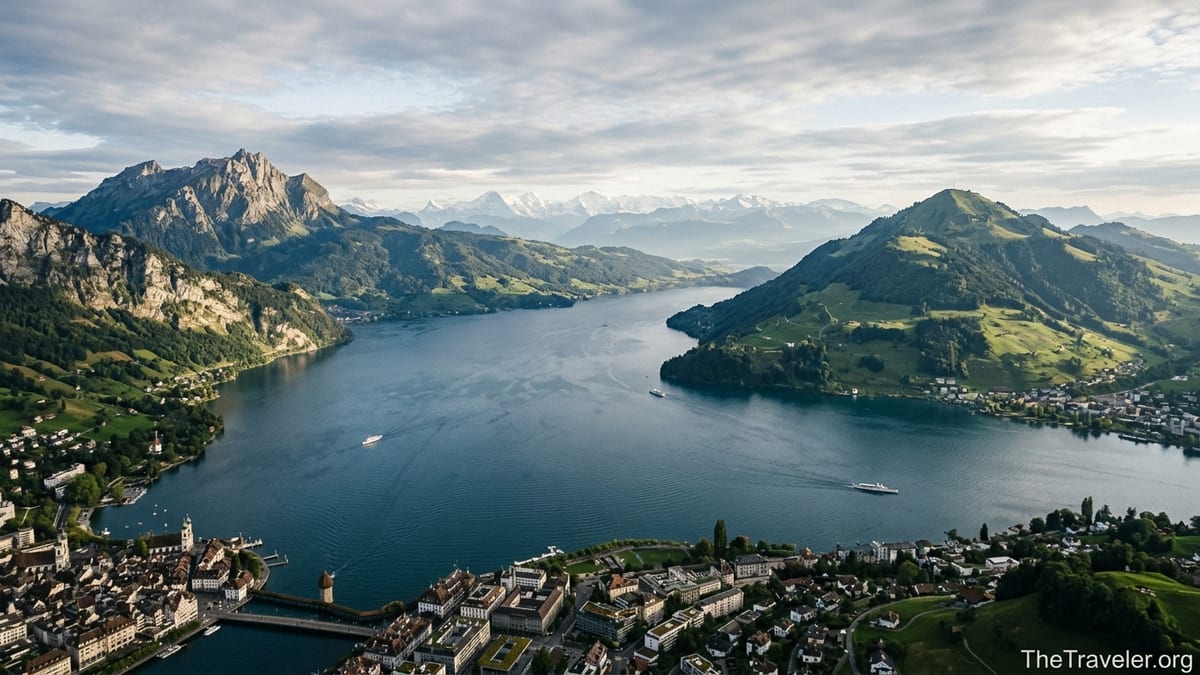
Overview: Two Classic Lucerne Mountain Excursions
Mount Pilatus rises directly above Lucerne, with its jagged limestone ridge forming the city’s signature skyline. From the lakeside promenade or the Chapel Bridge you see its rocky antennas and steep flanks catching the evening light. Pilatus feels dramatic and a little intimidating, with narrow ridges, cliff drops and a fortress like summit complex. It is also home to the world’s steepest cogwheel railway from Alpnachstad, and the long gondola and cable car chain from the suburb of Kriens.
Mount Rigi, often called the Queen of the Mountains, is more rounded and green. It stands slightly farther away, between several arms of Lake Lucerne, with broad grassy slopes, farmhouses and walking paths radiating from the top. Its cogwheel trains from Vitznau and Arth Goldau were among the first of their kind in Europe, and today Rigi is known as a classic easy hiking and picnic mountain, very popular with Swiss families and retirees.
Both mountains can be combined with scenic boat trips on Lake Lucerne and both offer varied ticket combinations. In recent timetables, typical full return tickets for Pilatus via cogwheel or cable car are around 80 to 85 Swiss francs per adult, while a Mount Rigi day pass covering the main cogwheel lines and cable cars is priced around the high 70s to low 80s. Actual prices change seasonally and with promotions, but in practice you will usually pay slightly more for Pilatus than for Rigi.
For most travelers, the choice comes down to priorities: spectacular rocky drama versus gentler green meadows, a famous steep cogwheel ride versus a more relaxed historic train, and whether you prefer a bigger, more commercial attraction or a quieter, more local style outing. The details below break down how the two compare in real situations you are likely to face when planning from Lucerne.
Mountain Scenery and Views
Pilatus offers some of the boldest scenery in Central Switzerland. The upper cogwheel line from Alpnachstad climbs through forests and tunnels before emerging onto raw rock walls and dizzying drops. At the top, short paths link several viewpoints such as Esel and Oberhaupt, where you look down over Lucerne, the full spread of Lake Lucerne and on clear days a sea of Alps stretching from the Bernese Oberland to the distant Tödi region. The rock peaks feel close and harsh, and clouds can wrap around the summit in fast moving banks, giving Pilatus a moody, high mountain atmosphere even though it is relatively low compared with big alpine giants.
Rigi’s appeal is subtler but equally rewarding. From Rigi Kulm, the highest point, you stand on a wide, grassy dome with a 360 degree panorama. Instead of looming rock walls, you see gentle pastures, scattered farmhouses and long arms of water. To one side lie Lake Lucerne and Lucerne itself; to another, Lake Zug and Lake Lauerz; on a clear day even the distant Jura hills form a blue line. It feels more spacious and less vertigo inducing than Pilatus, and the fact that you can wander along broad ridges for kilometers without significant drops makes the scenery feel open and peaceful.
If you crave dramatic rock formations, vertiginous paths and the feeling of being high on a ridge, Pilatus has the edge. Travelers who have hiked in the Dolomites or the Canadian Rockies often find Pilatus more familiar in atmosphere. If you are drawn to softer, pastoral landscapes where you can watch cows grazing near the tracks and see multiple lakes from one hilltop, Rigi will probably match your mental picture of a “Swiss postcard” more closely.
Weather matters on both mountains, but especially on Pilatus. Its summit often sits in or above clouds, and a day that is bright in Lucerne can be socked in at the top. With Rigi’s broader ridges and multiple levels, you sometimes still find views from intermediate stations like Rigi Kaltbad or Staffel even if the very summit is hidden. When skies are only partly clear, Rigi may deliver more consistent views over the lakes.
Cable Cars, Cogwheel Trains and Classic Round Trips
From Lucerne, Pilatus is famous for the “Golden Round Trip” in summer. A typical combination works like this in practice: you take a morning boat from Lucerne to Alpnachstad, ride the steep cogwheel train up to Pilatus Kulm, then descend on the cable car and gondola route toward Kriens, finishing with a short trolleybus ride back into the city. This round trip neatly strings together boat, historic train, aerial cable car and city bus in one loop, and many travelers buy it as a single packaged ticket from the local boat company or at Lucerne station.
The Pilatus cogwheel railway from Alpnachstad to Pilatus Kulm is a highlight in its own right, with a maximum gradient of close to 48 percent and tight tunnels cut through solid rock. In peak months the trains are frequent, but there can be lines of tour groups at the lower station. On the Kriens side, modern gondolas link Kriens to Fräkmüntegg, where a large intermediate station hosts a ropes park and other activities, followed by a cable car stretching up to the summit. Some visitors choose to go up and down entirely by gondola from Kriens, skipping the boat.
Rigi offers more flexible train and cable car combinations. A classic “Queen of the Mountains” round trip often starts with a boat from Lucerne to Vitznau, followed by the historic cogwheel ride up to Rigi Kulm, a walk or short train ride down to Rigi Kaltbad, and then the large cable car down to Weggis, where another boat returns you to Lucerne. Another common pattern is to travel by regular train from Lucerne to Arth Goldau, connect to the cogwheel train up to Rigi Kulm, then descend by a different cogwheel line to Vitznau and finish with a lake steamer back to the city.
The Rigi network feels like a web. You can change your mind partway through the day, for example riding only halfway up to Kaltbad if weather looks poor, or staying on the summit longer and taking a later train down to a different valley. Timetables of cogwheel trains and cable cars are integrated with boat schedules, and locals often use these services for regular outings, so the experience is a bit less like a single packaged attraction and more like using everyday mountain transport that happens to pass through a world class viewpoint.
Lake Lucerne Views and Boat Combinations
From both Pilatus and Rigi, Lake Lucerne is the star. Pilatus towers directly above the main Lucerne basin, so from its terraces you look almost straight down onto the Chapel Bridge, the city center and incoming ferries docking at Bahnhofquai. The view here is very vertical: the lake appears as a deep blue disk framed by cliffs and by the ridge of Bürgenstock across the water. When you arrive via the Golden Round Trip, the boat section across the lake is relatively long, taking about an hour from Lucerne to Alpnachstad, and feels like a mini cruise past rural shores and smaller villages before you even start climbing.
Rigi’s relationship with the lake is different. Because Rigi stands between several arms of Lake Lucerne and neighboring lakes, you see water from multiple directions rather than just one basin. From Rigi Kulm, you can trace the winding fjord like arms of Lake Lucerne, then swing your view to Lake Zug on the opposite side. When you ride the boat from Lucerne to Vitznau or Weggis you travel closer to the mountain’s base, looking up at green slopes and scattered chalets, and you often see the cogwheel trains inching across the hillside high above.
In practice, boat combinations are slightly more varied for Rigi. Apart from the main routes to Vitznau and Weggis, there are seasonal cruises along the Küssnacht arm of the lake and to other landing stages that sit beneath the Rigi massif. Travelers on a tight schedule sometimes choose a short lake cruise that simply gives them views of both mountains from the water without going up either one, but if you are already committing to the cost of a mountain railway, it usually makes sense to integrate at least one boat leg into the journey.
If you are obsessed with boats and want the longest possible time on the water, the Golden Round Trip to Pilatus gives you a substantial crossing along the route toward the southern end of the lake. If you prefer more, shorter legs and the ability to hop off in lakeside villages such as Weggis for a coffee break, the Rigi round trips and day tickets tend to be more flexible and easier to adapt on the fly.
Hiking, Outdoor Activities and Overall Atmosphere
Rigi is the better hiking and strolling mountain for most visitors. Its summit plateau and side ridges are laced with wide, well signposted paths that rarely feel exposed. A popular example is the gentle walk between Rigi Kaltbad and Rigi Scheidegg, which follows the line of a former railway and offers constant lake views while staying practically level. Families push strollers along the main promenade around Kaltbad, and many visitors simply walk a short section between stations, then hop back on the next train using a day pass.
The atmosphere on Rigi is calm and village like. Around Rigi Kaltbad, you find a small car free resort hamlet with a mineral bath complex, a playground and a handful of restaurants and hotels. People often plan a full day that mixes short hikes with long coffee breaks on sunny terraces. Because the mountain is crisscrossed with several cogwheel lines and cable cars, you can start or end walks at many points, which is ideal if you are not sure how far younger children or older relatives will want to go.
Pilatus offers some short hiking options, but the terrain is steeper and more rugged. At the top there are a few well known loop paths and stairways to minor peaks such as Esel, which can be done in about 30 to 45 minutes at an easy pace, but sections of railing and narrow rock ledges may bother travelers who dislike heights. Longer hikes down to intermediate stations are possible, yet the steep elevation gain and rocky ground make them more suitable for fit hikers used to mountain paths.
In exchange, Pilatus leans into adventure style attractions. At Fräkmüntegg, the intermediate cable car station above Kriens, there is a large ropes course in the trees and a summer toboggan run that appeals to teenagers and active adults. On the summit itself, the experience centers more on dramatic viewpoints, quick ridge walks and the feeling of standing on a craggy rooftop overlooking Lucerne rather than on slow, easy meanders through pastureland.
Families, Accessibility and Winter Access
For families with younger children, Rigi is generally the easier mountain. The cogwheel trains are less steep than Pilatus, and the broad grassy slopes around stations like Rigi Kaltbad and First let kids run around without the anxiety of nearby cliffs. Many Swiss families use Rigi as a weekend picnic spot: they ride up from Goldau or Vitznau with backpacks full of food, walk for an hour or two on gently rolling paths and then grill at one of the official barbecue sites in summer. In winter, Rigi usually offers a low key mix of sledding hills, simple ski lifts and winter walking trails that do not require advanced skills.
Accessibility is also better on Rigi for visitors who prefer short walks or use mobility aids. The main cogwheel trains and the cable car from Weggis to Rigi Kaltbad are designed with low floor access or ramps, and the area around Kaltbad is mostly flat. Several restaurants and viewing areas near the top stations can be reached without tackling long staircases. Pilatus stations have lifts and facilities too, but once you step outside, the natural terrain around the summit buildings quickly becomes steeper and more stair heavy.
In winter, the difference can be decisive. Rigi generally runs its main cogwheel services year round, though individual lines and cable cars may operate on reduced schedules or shut during bad weather. For many visitors based in Lucerne during the colder months, a train from Lucerne to Arth Goldau and then up to Rigi Kulm is the straightforward choice for a snowy panorama and a walk along groomed winter trails. By contrast, Pilatus has a more seasonal operation pattern, with the cogwheel railway running only in the warmer months and the gondola route from Kriens forming the main winter access. Strong winds, heavy snow or technical work can also affect summit openings.
If your trip to Lucerne falls in late autumn or early spring, when weather can be unsettled and alpine infrastructure is switching between seasons, it is wise to check which lines are running on your exact dates before committing to either mountain. In practice, Rigi’s more regular year round train connection from Arth Goldau tends to make it the safer bet for visitors who want flexibility and do not mind building their mountain day spontaneously depending on how the clouds look that morning.
Ticket Costs, Passes and Value for Money
Ticket prices on both mountains change over time, but recent examples give a useful sense of relative cost. A standard Pilatus return trip by cogwheel train or cable car, without a lake boat leg, typically falls in the range of roughly 80 to 85 Swiss francs per adult. Holders of national rail discount cards such as the Half Fare Card, some international rail passes and Swiss Travel Pass products usually pay about half of the base amount. Combined “Golden Round Trip” tickets that include the Lake Lucerne boat, the cogwheel railway up and the cable car and gondola down tend to be higher, often sitting in the low to mid 100s per person once you factor in full price transport.
On Rigi, a full day pass that covers the main cogwheel lines between Vitznau, Arth Goldau and Rigi Kulm plus key cable cars such as Weggis to Rigi Kaltbad normally costs slightly under the Pilatus equivalent. As of recent pricing, public rates for a day pass have been set in the high 70s to low 80s in Swiss francs for adults, with half prices for many national and international pass holders, and free travel for young children when they accompany a paying adult with the relevant family card. Individual point to point tickets, such as just Vitznau to Rigi Kulm return, are cheaper but still substantial, so many travelers choose the day ticket in order to ride different lines without worrying about each segment.
Lake Lucerne boat fares are extra unless you purchase one of the official round trip packages marketed by the lake navigation company or the mountain railways. A single second class boat journey from Lucerne to Vitznau or Alpnachstad for an adult often lands in the 25 to 35 franc range at public rates, depending on the length of route and any supplements for historic paddle steamers. Rail passes may discount or fully cover the boat section, which can make the combined cost of a Rigi or Pilatus round trip significantly more attractive.
From a pure cost benefit perspective, Rigi often delivers better value for travelers who want a long, leisurely day in the mountains. With a single day ticket you can ride multiple trains, mix in cable cars and hop on and off at different stations to explore. On Pilatus, most visitors make one ascent and one descent along a fixed route, and any repeated rides are more tightly tied to buying extra tickets. That said, if experiencing the world’s steepest cogwheel railway and the iconic Golden Round Trip have been on your wish list for years, the premium for Pilatus can feel like money well spent for that one standout day.
Which Excursion Is Better From Lucerne?
When deciding between Pilatus and Rigi from a Lucerne base, think about what your specific trip looks like. If you have just one full day in Lucerne and you want a single, memorable headline excursion, Pilatus tends to impress first time visitors more strongly. The combination of long lake crossing, dramatic cogwheel climb and cliffy summit with Lucerne right below is hard to forget. Couples on a short city break or travelers ticking off a classic Swiss itinerary often leave feeling that Pilatus delivered exactly the high mountain drama they had imagined.
However, if you value flexibility, quieter paths and a softer, more local feel, Rigi often comes out ahead. For example, a family staying three nights in Lucerne might spend one day on Rigi using a day ticket, ride up from Arth Goldau, walk an easy section of ridge, have lunch at Rigi Kaltbad while the kids use the playground, then descend to Weggis for an afternoon swim in the lake before taking a late boat back to the city. That kind of do it your own way chain of small experiences is easier on Rigi’s network than on Pilatus’s more linear system.
Season also matters. In high summer, Pilatus can be very busy with tour groups, especially midday, and the summit terraces fill quickly. Rigi also receives crowds on sunny weekends, but the presence of multiple stations and longer walking routes disperses people more evenly. In shoulder seasons or winter, Rigi’s year round train from Arth Goldau gives it a reliability advantage, while Pilatus’s cogwheel line is limited to the warm months and the summit may close during poor weather periods.
If forced to name a “better” excursion from Lucerne for most independent travelers, especially those watching their budget and wanting a full day of varied experiences rather than a single iconic attraction, Rigi is often the smarter overall choice. On the other hand, travelers who prioritize dramatic rock scenery, the uniqueness of the steep cogwheel railway and a neatly packaged round trip that requires minimal planning will likely be happier dedicating their one Lucerne mountain day to Pilatus.
The Takeaway
Mount Pilatus and Mount Rigi are not rivals so much as complementary characters in Lucerne’s landscape. Pilatus is the rugged, theatrical neighbor that dominates the skyline and excels at big moments: the crunch of steel teeth on steep rack rails, the first step out onto a windswept terrace high above the city and the long sweep of a gondola gliding over forest and pasture back toward town. It is the right choice when you crave drama and do not mind paying a little extra for a tightly curated, greatest hits day out.
Rigi is gentler and more generous with its time. Its appeal lies in broad horizons, the ability to wander for as long or as little as you like, and the pleasure of stitching together boats, trains and cable cars in whatever pattern suits the day. Costs are marginally lower, the on mountain experience is more flexible and the whole outing feels less like entering a single attraction and more like sliding into the everyday mountain life of central Switzerland.
From Lucerne, either excursion will deliver the alpine memories most visitors hope for: cowbells drifting up from the slopes, church spires reflected in the lake and late sunlight catching snow peaks on the horizon. If your schedule and budget allow, seeing both on different days shows two very different faces of the same region. If you must choose, pick Pilatus for drama and a polished, iconic loop, and Rigi for space, calm and value. Whichever you select, start early from Lucerne, watch the clouds before you commit and let the lake, the trains and the mountains do the rest.
FAQ
Q1. Which is better if I only have one full day in Lucerne, Pilatus or Rigi?
If you want the most dramatic single experience and do not mind a higher price, Pilatus is usually better for a one day Lucerne visit. If you prefer a calmer day with more freedom to walk, linger and change plans as you go, Rigi is often the more satisfying all around choice.
Q2. How long does a typical Pilatus or Rigi excursion take from Lucerne?
A classic Pilatus Golden Round Trip with boat, cogwheel railway and cable car usually takes six to eight hours including time at the top. A flexible Rigi day with boat and multiple train rides can also fill six to eight hours, though you can shorten it to four or five hours by skipping some legs or starting by train instead of boat.
Q3. Which mountain is cheaper to visit from Lucerne?
In recent price lists, standard adult return or day tickets on Rigi are usually slightly cheaper than comparable Pilatus tickets. Exact costs depend on whether you add boat journeys and whether you hold passes such as a Swiss Travel Pass or Half Fare Card, which often halve the mountain railway fares.
Q4. Can I visit Pilatus or Rigi in winter?
Yes, but operations differ. Rigi’s main cogwheel trains from Arth Goldau generally run year round and offer access to winter walking trails and simple sledding. Pilatus’s cogwheel railway operates only in the warmer months, while the gondolas from Kriens provide the main winter access and may be affected by weather or maintenance on certain dates.
Q5. Which mountain has easier hiking for beginners and families?
Rigi is better for beginners and families, with wide, mostly gentle paths between stations such as Rigi Kulm, Rigi Staffel and Rigi Kaltbad. You can walk as far as you like and then catch a train or cable car, which makes it easy to adapt the day to children or less fit relatives.
Q6. Are the Lake Lucerne boat rides included in mountain tickets?
Sometimes. Special round trip offers, such as Golden Round Trip style packages or “Queen of the Mountains” tickets, often bundle boat, cogwheel train and cable car into a single fare. If you buy a simple mountain train ticket only, the boats are usually extra unless you hold a rail or travel pass that includes lake navigation.
Q7. Is Pilatus suitable for travelers afraid of heights?
It depends on the individual. The cogwheel train itself feels solid and enclosed, but some of the summit paths at Pilatus are narrow with drops on one side, and the cable car from Fräkmüntegg to the top hangs over steep slopes. Travelers who are very sensitive to heights often feel more comfortable on Rigi’s broader ridges and lower angle paths.
Q8. Do I need to book tickets in advance for Pilatus or Rigi?
Advance booking is highly recommended for Pilatus in peak summer, especially for combined boat and railway packages and for weekends. For Rigi, many visitors simply buy day passes on the day at Lucerne station, boat piers or valley stations, although reserving ahead can be helpful on busy public holidays or if you want a very specific boat departure.
Q9. Can I visit both mountains in one day from Lucerne?
Technically it is possible but not advisable for most travelers. Doing both in one day leads to a rushed schedule with much of the time spent in transit or in queues. It is better to choose one mountain and enjoy it fully, or plan two separate days in the region so each excursion has enough breathing room.
Q10. Which mountain gives better photo opportunities of Lucerne itself?
Pilatus looks directly down on Lucerne and its main lake basin, so it gives more dramatic, close up aerial style views of the city, Chapel Bridge and surrounding hills. Rigi’s views are broader and more distant, showing Lucerne as part of a wider panorama of multiple lakes and lowlands.