


Snow capped peaks, mirror still lakes and smooth Swiss transport make Central Switzerland one of Europe’s easiest places to reach serious alpine scenery in a single day. From Lucerne, you can be standing on a jagged glacier, riding an open top cable car or watching the sunset over Lake Lucerne in less than two hours. The challenge for most visitors is not how to get into the mountains, but which excursion to choose when time and budget are limited. This guide compares the main mountain trips from Lucerne Mount Pilatus, Mount Rigi, Titlis, Stanserhorn and Stoos so you can decide what to prioritize and what to save for next time.
How the main Central Switzerland peaks compare at a glance
From Lucerne, the most popular mountain excursions are Mount Pilatus, Mount Rigi, Titlis, Stanserhorn and Stoos with Fronalpstock. All are reachable as a day trip by public transport, but they differ in price, travel time, altitude and overall feel. Pilatus and Rigi are closest to Lucerne and combine lake boat rides with classic cogwheel railways. Titlis, near Engelberg, reaches over 3,000 meters and offers guaranteed snow and glacier experiences most of the year. Stanserhorn and Stoos are lower but deliver spectacular lake and ridge views with more unusual transport options and fewer crowds.
In practice, most visitors coming for one to three days in Lucerne choose one or two mountains. If you want the highest and most dramatic option, Titlis usually wins. For a classic lake and cogwheel day without extreme altitude, Pilatus and Rigi are the prime choices. Travelers who value quieter trails and novel cable cars often add Stanserhorn or Stoos. Prices change regularly, but as a rough guide in 2026 expect full fare return tickets to the summits to fall somewhere between around 60 and 120 Swiss francs per adult, with savings for holders of a Swiss Travel Pass, Half Fare Card or regional passes.
Because ticket structures are complex and promotions change, it is safest to treat specific prices as approximate and check current figures when you book. However, the relative differences are fairly stable. Titlis is typically the most expensive individual excursion. Pilatus often comes next, especially if you choose the full Golden Round Trip that includes boat and cogwheel segments. Rigi, Stanserhorn and Stoos are generally slightly cheaper and can become very good value if you already hold a Swiss Travel Pass or a local visitor card that provides discounts.
For time pressed travelers, journey time matters almost as much as price. In broad terms, Lucerne to the valley stations for Pilatus, Rigi, Stanserhorn and Stoos takes about 20 to 40 minutes, while reaching Engelberg for Titlis takes around 45 to 60 minutes by train before you even board the mountain lifts. That longer journey can be well worth it, but it does mean Titlis is better suited to a full day than a half day.
Mount Pilatus: Golden Round Trip and steep cogwheel drama
Mount Pilatus is Lucerne’s signature peak, with its jagged limestone ridge dominating the skyline above the old town. The classic way to visit is the so called Golden Round Trip, which usually combines a boat ride from Lucerne across Lake Lucerne to Alpnachstad, the steep Pilatus cogwheel railway from lake level to Pilatus Kulm and then the gondola and aerial cableway down to Kriens, finishing with a short bus ride back to Lucerne. On busy summer days, families and tour groups cluster on the promenade in front of the Lucerne train station ready to board the lake boats for this route.
The cogwheel railway from Alpnachstad is billed as one of the steepest in the world, with gradients of up to about 48 percent. Even seasoned rail travelers are surprised at how sharply the cars climb through forests and rock faces. The ride from lake to summit takes roughly 30 minutes. The gondola and aerial cableway on the Kriens side feel quite different, with an easy glide over trees and meadows followed by a short final leg in large panoramic cabins. The whole Golden Round Trip from Lucerne usually requires at least four to five hours, and many visitors choose to spend longer to sit on the terrace at Pilatus Kulm, walk one of the short summit paths or have lunch at one of the hotels or self service restaurants.
Ticket products vary, but a typical Golden Round Trip in high season often costs in the region of 90 to 120 Swiss francs per adult at full fare, depending on route and promotions. A Silver Round Trip that uses trains instead of the lake boat can be noticeably cheaper. Holders of the Swiss Half Fare Card usually pay roughly half of the basic transportation component, though special combined offers such as Mountain and Rail passes may have their own conditions. It is common for travelers to buy Pilatus tickets on the day at Lucerne, especially outside peak summer weekends, but in fine weather during school holidays the boats and cogwheel trains can be busy enough that advance purchase or early departure makes the day smoother.
In terms of views, Pilatus looks in several directions at once. On clear days you see Lake Lucerne from multiple angles, the distant Bernese Alps and, in the other direction, the rolling Swiss plateau. For nervous visitors, the paths that loop around the summit include some tunnels and handrails, but they are short and manageable. Pilatus makes sense to prioritize if you want one high but not extreme mountain close to Lucerne, enjoy interesting transport combinations and do not need a full glacier experience. It can be a little exposed and crowded in midsummer, so travelers seeking quiet hiking might prefer Rigi or Stoos instead.
Mount Rigi: Queen of the Mountains and relaxed lake panoramas
Mount Rigi promotes itself as the Queen of the Mountains and is famous for soft, rounded ridgelines rather than jagged rock. It stands at just under 1,800 meters, much lower than Titlis or Jungfraujoch, but this makes it ideal in shoulder seasons and for visitors sensitive to altitude. From Lucerne you normally reach Rigi either by boat to Vitznau or Weggis on Lake Lucerne then by cogwheel train or cable car, or by direct train from Lucerne to Arth Goldau followed by the cogwheel track up to Rigi Kulm.
One popular example is to take a morning boat from Lucerne to Vitznau, ride the historic red cogwheel train to Rigi Kulm, walk along the ridge or down to Rigi Kaltbad and then descend by cable car to Weggis for a return boat or bus. Another option is to keep things simpler and travel only by train via Arth Goldau, which is usually faster and less weather dependent than the boat. From Lucerne to Vitznau by boat takes around 60 to 75 minutes, the cogwheel ride up to Rigi Kulm about 30 to 40 minutes, and the Weggis cable car a further 10 minutes. Using the main rail route via Arth Goldau, you can be on the summit roughly 90 minutes after leaving Lucerne if connections line up.
Rigi ticketing is relatively flexible. There are day passes for unlimited travel on Rigi’s cogwheel trains and cable cars, along with cheaper one way and return tickets. As of mid 2026, public full fare day passes for Mount Rigi commonly fall around the 80 to 90 Swiss franc range for adults, though seasonal promotions and evening offers can lower the price significantly. Travellers with a Swiss Travel Pass, Swiss Half Fare Card or certain regional passes usually receive 50 percent discounts or, in some cases, complete coverage on the Rigi mountain railways. For example, visitors staying in Lucerne sometimes combine a regular boat ticket with discounted mountain rail tickets bought on the spot at the pier or station.
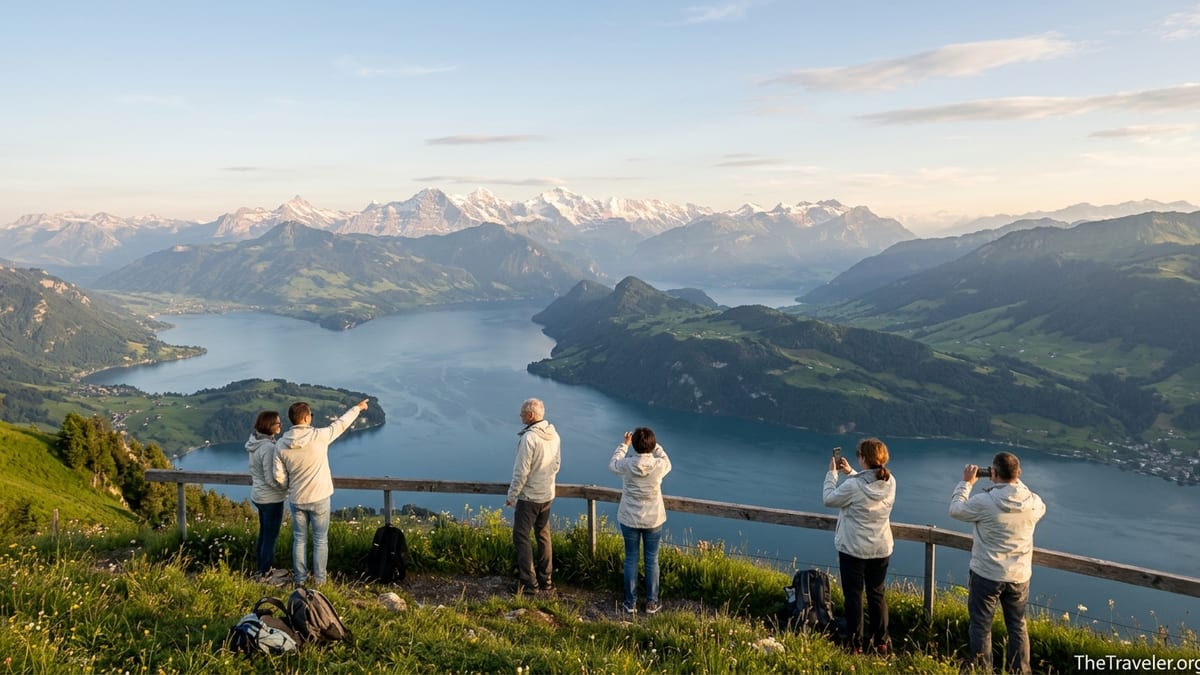
Rigi is particularly known for sunrise and sunset views, with broad panoramas over Lake Lucerne, Lake Zug and the surrounding plateau. On clear evenings in summer and early autumn, locals ride up late in the day with picnic blankets or book dinner at a mountain restaurant. The hiking is gentler than on Pilatus or Titlis, with well marked trails and plenty of intermediate stations so you can shorten or extend walks as needed. If you only have one mountain day and want a relaxed, varied experience with big lake views, Rigi is often the easiest all round recommendation, especially for families and visitors who prefer mild to moderate exertion.
Titlis: high alpine snow and glacier experiences from Engelberg
Titlis is Central Switzerland’s high alpine heavyweight. Reaching over 3,000 meters, it offers year round snow, a glacier cave and dramatic views into the high Alps. The excursion starts from Engelberg, a resort village at about 1,000 meters altitude that you reach by train in roughly 45 minutes to one hour from Lucerne. Once in Engelberg, you walk or take a shuttle to the Titlis valley station, then board the Titlis Xpress gondolas to Trübsee and Stand before changing to the revolving Rotair cable car for the final leg to the summit.
The full ascent from Engelberg to the Titlis summit typically takes about 30 to 40 minutes, depending on queues and how long you spend at intermediate stops such as Trübsee, which has a lake and family activities in summer. Many travelers time their day so they enjoy a leisurely morning in Engelberg, ride up to Titlis late morning, spend two or three hours at the top exploring the cliff walk, glacier cave and viewing platforms, then stop at Trübsee or another mid station on the way down for short walks or lake side cafes. Because of the altitude, the air feels noticeably thinner, and even short stair climbs can be tiring for some visitors.
Ticket categories on Titlis vary by season, but the basic Engelberg to Titlis return cableway ticket for adults is usually in the upper price range among Central Switzerland excursions. Recent public tariffs place it roughly around 90 to 110 Swiss francs at full fare, with discounts for Swiss Half Fare Card holders and occasional reductions through local visitor cards from surrounding regions. Some hotel packages in Engelberg and certain tour operators bundle Titlis transport with meals or additional activities, which can be cost effective if you plan to ski or stay several days.
Titlis is the logical priority for travelers who want maximum alpine drama and are willing to pay for it. Even in summer, you usually find snow at the top, and the weather can change quickly, so warm layers and proper footwear matter more than on Rigi or Stanserhorn. On cloudy days, it is worth checking webcams before committing, because if the summit is deep in cloud you may get very limited views, although some visitors still enjoy the novelty of the glacier cave and cliff walk regardless. As a rule of thumb, plan Titlis as a full day excursion from Lucerne and allow time to rest, hydrate and adjust to the altitude, especially if you are not used to high mountains.
Stanserhorn CabriO: open top cable car and quieter summit
Stanserhorn, south of Lucerne and near the town of Stans, is a lower but very scenic peak reached by a combination of vintage funicular and the CabriO, a double deck cable car with an open air upper deck. From Lucerne, direct trains to Stans take around 20 minutes. The valley station is a short walk from the station. You ascend first on a restored early 20th century funicular through meadows and trees, then transfer to the modern CabriO cable car, where many visitors choose to ride on the rooftop terrace to feel the breeze and enjoy unobstructed views.
The ride to the 1,850 meter summit takes only about 20 to 25 minutes from Stans, making Stanserhorn one of the quickest ascents from Lucerne. Once on top, you find a revolving style restaurant, a large terrace and easy loop trails with views over Lake Lucerne, Bürgenstock and the surrounding valleys. Conditions feel more mellow than at Titlis, with no glacier or year round snow, but many travelers find the overall experience unusually memorable because of the open air cable car and the contrast between old and new transport technology.
Ticket prices for Stanserhorn change by season, but the round trip from Stans typically costs somewhat less than Pilatus or Titlis and more in line with Rigi. Holders of the Swiss Travel Pass and Half Fare Card often receive substantial discounts, and there are occasional evening or late afternoon specials. Stanserhorn usually operates from roughly late spring through autumn rather than year round, so it is important to check operating dates if you are traveling early or late in the season. Because it is lower and more open, Stanserhorn makes a particularly attractive option in May, June and September when the high alpine peaks may still be snowbound or experiencing unstable weather.
Stanserhorn is worth prioritizing if you have already visited Pilatus or Rigi on previous trips or if you enjoy novel cable cars and want a shorter, less demanding day. It pairs easily with a half day in Lucerne or a visit to nearby lakeside villages. Many travelers describe it as a solid second or third excursion once you have tried one of the big name peaks, but for some it becomes a favorite precisely because it feels less commercial and crowded.
Stoos and Fronalpstock: steep funicular and ridge top lake views
The traffic free village of Stoos and the nearby peak of Fronalpstock offer one of Central Switzerland’s most impressive lake panoramas, looking straight down on a series of fjord like arms of Lake Lucerne. To reach Stoos from Lucerne, you usually take a train toward Schwyz, get off at the Stoosbahn stop or Schwyz, then change to a bus or walk a short distance to the valley station of the Stoos funicular. This funicular is known for its very steep gradient and barrel shaped cabins that keep floors level as they climb.
From the funicular top station in Stoos, you either hike or take chairlifts up to Fronalpstock, where a ridge trail runs along the top of the cliffs. On clear days, the view ranks among the best in the region, with multiple lakes and mountain chains visible at once. The hiking here can be gentle if you stick to the main paths near the lifts, but serious hikers can continue along more challenging ridge routes. Because there is no glacier or large summit infrastructure, the atmosphere is quieter than Pilatus or Titlis and feels more like a mountain village than a major tourist resort.
In terms of cost, Stoos and Fronalpstock are usually a little cheaper than the highest profile peaks. A common pattern is to buy a combined day ticket that covers the funicular between the valley and Stoos plus the chairlifts to Fronalpstock. Exact prices vary, but full fare adult tickets often sit comfortably below the Titlis or Pilatus level, particularly outside peak season. As with other mountains, Swiss Travel Pass and Half Fare Card holders often receive reductions on at least part of the route. Travel time from Lucerne to the Stoos funicular valley station is commonly around 45 to 60 minutes depending on connections.
Stoos is a strong choice to prioritize if you value panoramic lake views and hiking over cable car novelty. It is especially appealing in summer and early autumn, when the meadows around the village are green and the ridge paths are dry. Families with older children who enjoy walking often prefer Stoos to the higher, more engineered environments of Titlis or Pilatus. On the other hand, if you are looking for snow play and glacier attractions, Titlis is the better match.
Practical comparison: prices, passes, timing and weather
Although exact ticket prices change, some patterns help you compare costs. As a rough hierarchy, Titlis is usually the most expensive excursion from Lucerne when bought as a standalone lift ticket from Engelberg. Pilatus, especially with the Golden Round Trip including boat and cogwheel, often comes next. Rigi day passes, Stanserhorn tickets and Stoos plus Fronalpstock combinations typically sit slightly lower. The presence of lake boats increases costs, so if you want to save money you can often choose rail based approaches rather than boat routes for Rigi and Pilatus.
Swiss passes make a big difference. The Swiss Travel Pass usually fully covers standard boats on Lake Lucerne and may fully or partially cover certain mountain railways, particularly on Rigi. The Swiss Half Fare Card generally halves the basic transport component on many lines, including Pilatus, Titlis and Stanserhorn, although special combined offers sometimes have exceptions. Regional visitor cards, such as those issued by hotels in Engelberg or in the Nidwalden region around Stanserhorn, sometimes include 10 to 50 percent discounts on local mountain excursions during specified months. This means the most cost effective mountain for you may depend less on the base price and more on which pass you already own.
Travel time from Lucerne central station to the valley station or first lift is usually around 20 to 40 minutes for Pilatus (Kriens), Rigi (Arth Goldau or Weggis), Stanserhorn (Stans) and Stoos, but closer to 45 to 60 minutes for Engelberg and Titlis. Add another 30 to 40 minutes on lifts and you quickly see why Titlis is best as a full day trip, whereas Pilatus or Rigi can fit into a long half day. When you plan your itinerary, also allow for time waiting in queues, especially on weekends and during summer holidays. Starting early often improves both the crowding and the clarity of the views.
Weather and altitude are critical. Titlis, at over 3,000 meters, often has snow and ice even when Lucerne is warm, and temperatures can be close to freezing even in high summer. Pilatus and Rigi, being lower, usually feel like a cool spring or autumn day when Lucerne is in midsummer. Stanserhorn and Stoos sit lower still and often have comfortable hiking weather earlier in the year. Cloud layers can sit between valley and summit, so checking mountain webcams the morning of your trip can save you from riding into a whiteout. If one peak looks cloud covered, another nearby mountain may be above or below the clouds and offer much better views.
Which mountain to prioritize for different travelers
If you are in Lucerne for a single full day and want one flagship experience, the choice often narrows to Titlis, Pilatus or Rigi. Pick Titlis if your priority is snow, glaciers and high alpine scenery, and if you are comfortable with the higher price and longer journey. Choose Pilatus if you want classic Swiss engineering in the form of a very steep cogwheel railway, combined with a lake boat and dramatic rocky summit views. Opt for Rigi if you prefer gentler hiking, wide lake panoramas, flexible routes and a slightly softer, more family friendly feel.
For a two or three day stay, many travelers pair a high mountain like Titlis with a lower, more relaxed peak such as Rigi or Stanserhorn. One typical pattern is to visit Rigi on your arrival or departure day, since the cogwheel railway from Arth Goldau connects conveniently with long distance trains, then spend a full day on Titlis once you are settled in Lucerne or Engelberg. Another is to start with Pilatus, which is closest to Lucerne, and then decide based on weather whether to add Titlis, Stoos or Stanserhorn on subsequent days.
Budget conscious travelers with a Swiss Travel Pass might prioritize Rigi and Stanserhorn or Stoos, where pass coverage and discounts can make the overall cost significantly lower than Titlis. Families with young children often find Rigi and Pilatus more manageable than Titlis because of the lower altitude and more varied intermediate stops. Travelers sensitive to crowds may prefer Stoos or Stanserhorn, especially if they can visit on weekdays outside the peak of July and August.
If you are visiting in winter, the picture changes slightly. Titlis and Rigi remain attractive, with dedicated winter hiking trails, sledging routes and, in Titlis’s case, major ski infrastructure. Pilatus may have more limited winter operations, and Stanserhorn typically closes for the coldest months. Stoos, on the other hand, functions as a small ski resort and winter sports area, making it a pleasant alternative if you want a quieter snow day within reach of Lucerne.
The Takeaway
Central Switzerland offers an unusually dense collection of accessible mountain excursions, and Lucerne is the perfect base from which to sample them. Titlis brings you to high alpine glaciers and snow in a single day by train and cable car. Pilatus wraps a steep cogwheel railway and a lake cruise into one classic loop. Rigi spreads itself across a graceful ridge with softer hiking and broad lake views. Stanserhorn adds a memorable open top cable car and quieter summit trails, while Stoos and Fronalpstock provide some of the region’s finest lake panoramas from a traffic free village.
Because prices, timetables and discounts evolve frequently, it is wise to use current online planners and official ticket information as you finalize your plans. Yet you can confidently use the broad comparisons in this guide to match mountains to your interests. Start by deciding whether your top priority is glacier snow, iconic engineering, relaxed hiking, crowd free viewpoints or value for money. Then choose the one or two peaks that best fit your time, budget and appetite for altitude. With that decision made, Central Switzerland’s trains, boats and cable cars will do the rest, carrying you smoothly from Lucerne’s lakeside promenades into the high mountain air.
FAQ
Q1. If I have time for only one mountain from Lucerne, which should I choose?
If you want dramatic snow and glacier views and can spend a full day, Titlis is often the strongest single choice. If you prefer a slightly shorter, more varied day with lake boat, cogwheel railway and rocky summit, Pilatus is ideal. For gentler hiking and broad lake panoramas at a somewhat lower cost, many travelers choose Rigi.
Q2. How far in advance do I need to buy tickets for Pilatus, Rigi or Titlis?
For most independent travelers, buying tickets one or two days in advance or even on the day is sufficient, especially outside peak July and August weekends. Tours sold through agencies and certain promotional offers may require earlier booking. If weather is uncertain, many visitors wait until the morning of travel and purchase at Lucerne station or the boat piers so they can choose the clearest mountain.
Q3. Are these mountain excursions included in the Swiss Travel Pass?
The Swiss Travel Pass usually covers standard trains, buses and boats to the valley stations and often offers free or discounted travel on certain mountain railways, especially on Rigi. For Pilatus, Titlis, Stanserhorn and Stoos, the pass typically provides a 50 percent discount on the mountain transport rather than full coverage. Exact conditions change, so it is important to check current inclusion tables before you travel.
Q4. Which mountain is best for travelers sensitive to altitude?
Rigi, Stanserhorn and Stoos have summits under about 2,000 meters and are usually comfortable for most visitors, with conditions similar to a cool hilltop. Pilatus sits higher but is still below the extreme altitudes of the high Alps. Titlis, above 3,000 meters, can cause mild shortness of breath or headache in some people, so those very sensitive to altitude may prefer to stay with the lower peaks.
Q5. What should I wear for a summer visit to Titlis, Pilatus or Rigi?
Even in July and August, you should bring layers. For Titlis, plan on a warm jacket, long trousers, closed shoes with good grip, a hat and gloves, as summit temperatures can be close to freezing. For Pilatus and Rigi, a light jacket or fleece, long trousers or sturdy shorts and comfortable walking shoes are usually enough, but a windproof layer and sun protection are still important.
Q6. Can I combine more than one mountain in a single day?
It is technically possible but rarely pleasant to combine full excursions such as Pilatus and Rigi or Titlis and Stanserhorn in one day. Transport, queues and time on the summit all add up. Most travelers find that one major mountain plus some time in Lucerne’s old town or on the lake makes for a better balanced day. Shorter, lower excursions like Stanserhorn or Stoos can sometimes be combined with an afternoon in Lucerne without feeling rushed.
Q7. Which mountain offers the best value if I am on a tight budget?
Rigi often provides excellent value, especially for holders of the Swiss Travel Pass, because many rail segments are fully or heavily discounted. Stoos and Stanserhorn can also work out cheaper than Titlis or a full Pilatus Golden Round Trip, particularly if you skip lake boats and travel only by train and cable car. Checking what your existing passes cover before choosing an excursion is the easiest way to maximize value.
Q8. How family friendly are these excursions for young children?
Rigi and Pilatus are very family friendly, with short walking paths, playgrounds at some intermediate stations and plenty of facilities. Stoos and Stanserhorn also suit families who enjoy walking, though parents need to supervise closely near exposed viewpoints. Titlis is exciting for children because of the snow and glacier attractions, but the altitude, colder temperatures and sometimes crowded cable cars mean it is better for school age children than for very young toddlers.
Q9. What happens if the weather turns bad after I have bought a mountain ticket?
Most standard mountain tickets are valid for a specific day and are not refundable if the weather changes, although some operators offer partial goodwill gestures or allow date changes in certain cases. Travel insurance may cover cancellations in extreme conditions, but usually not ordinary cloud or rain. Many visitors manage this risk by checking forecasts and webcams, buying tickets late and staying flexible between several possible mountain choices.
Q10. Do I need any special experience or equipment for these excursions?
For the normal sightseeing routes on Pilatus, Rigi, Titlis, Stanserhorn and Stoos, you do not need mountaineering experience or technical equipment. The cable cars, cogwheel trains and marked walking paths are designed for ordinary visitors. Good footwear, weather appropriate clothing and basic fitness are usually sufficient. Only if you plan more demanding hikes beyond the main marked routes would you need additional skills, gear or possibly a local guide.