


I have used all three of Ticino’s main Italian-speaking lakeside towns as a base on different trips: Lugano on a spring long weekend built around lake walks and restaurant-hopping, Locarno for an April trip focused on the valleys and the Centovalli railway, and Ascona for a slower, late-summer stay that revolved around the lakeside promenade and romantic evenings by the water. What follows is drawn from those visits; where I supplement my experience with more recent price checks or schedule updates, I indicate that the information is researched rather than lived.
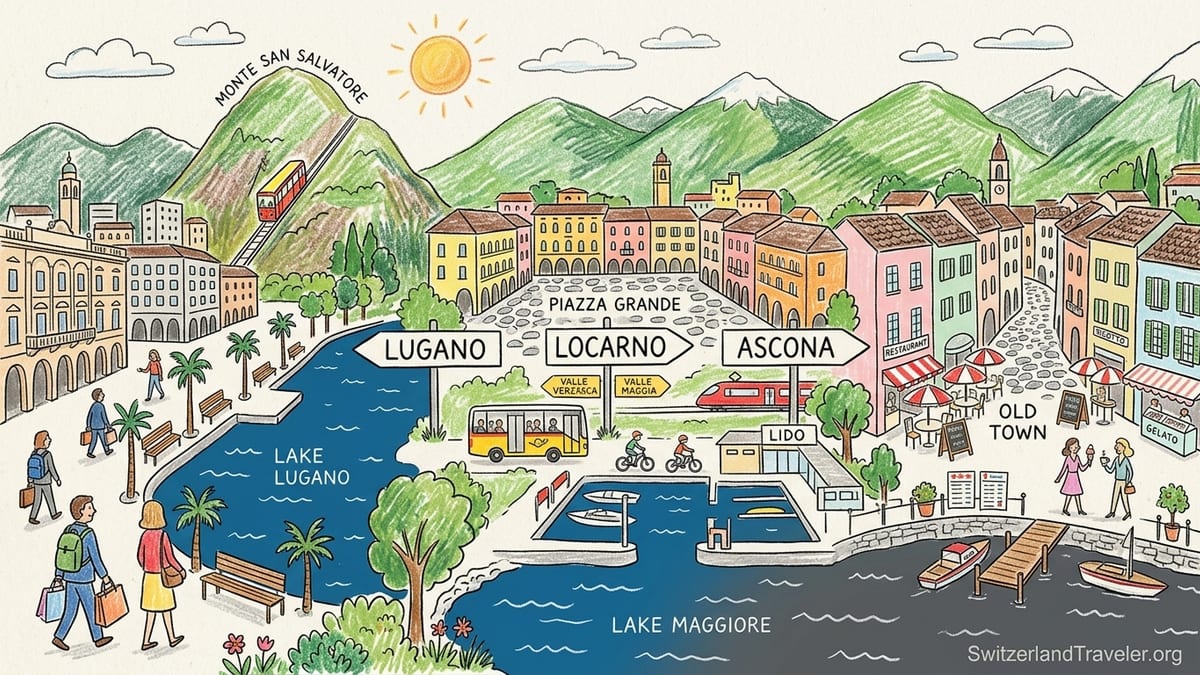
Lugano, Locarno and Ascona at a Glance
Walking out of Lugano station on my first trip, I took the steep little funicular down into town and was dropped almost directly into a compact, busy city of arcaded streets and polished boutiques, with the lake opening up at the end of Via Nassa. It felt immediately more urban than I expected, closer in spirit to a small Italian city than to a quiet lakeside resort. Office workers streamed toward the station in the evening, and by the time I reached the palm-lined promenade near the Best Western Bellevue au Lac the atmosphere was part commuting hub, part holiday town.
Locarno was a different first impression altogether. Arriving by train from Zurich, I stepped out into a smaller station area and walked ten minutes to Piazza Grande, the broad, cobbled square that anchors the town. The arcades were low-rise and colorful, the pace slower, the lake visible but not yet dominant. It felt like a place where people live and work, but the scale was more relaxed than Lugano. By the time I wandered down to the lakefront path and watched kids cycling toward the Lido, the setting felt more like a medium-size resort town than a city.
Ascona, which I reached by bus from Locarno on a later trip, greeted me not with a square but with the water itself. The narrow streets of the old town funneled straight out onto the promenade, a short curve of pastel facades and restaurant terraces almost touching the lake. It was quieter in terms of traffic, but the tourism focus was unmistakable: menu boards in three languages, gelato counters every few steps, and boat timetables pinned up by the pier. The overall feel was intimate and overtly holiday-oriented, especially in the evening when the promenade turned into one long waterfront aperitivo.
From these first impressions, my personal rule of thumb became clear. Lugano is the city base with a strong lakefront and serious shopping. Locarno is the practical hub that combines a real-town feel with easy access to valleys and regional transport. Ascona is the postcard-perfect resort where you step from your hotel straight onto the lakefront. None is objectively “best,” but each suits a different style of trip.
Hotel Prices and Where Your Money Goes
During my most recent Lugano stay, I paid a noticeably higher nightly rate than I did in either Locarno or Ascona. On that trip I stayed in a mid-range hotel a short walk uphill from the lake, and when I checked more recent pricing across several booking sites for 3 and 4 star properties, Lugano still came out as the most expensive of the three on average, with typical summer weekend rates around the equivalent of 300 to 350 US dollars for a standard double in a central 3 star and higher for 4 star properties. This price pattern comes from research, but it matched what I felt in my own budget when I compared receipts later.
In Locarno, my base was a simple but modern hotel a few minutes from Piazza Grande. Rooms were clean and compact, with a small balcony and breakfast included. When I cross-checked current prices for similar properties near the square and along the Muralto lakefront, Locarno tended to run somewhat lower than Lugano, with more 3 star options falling in the mid-200 US dollar range on typical spring or autumn dates and only the big-name lakefront properties pushing much higher. This aligns with how my Locarno bill compared with Lugano’s: I noticed that my three-night total there looked closer to what two nights cost me by Lake Lugano.
Ascona was more nuanced. On my late-summer visit I stayed a block back from the promenade in a family-run hotel with a shaded garden. The nightly rate undercut comparable Lugano options, but when I recently checked current prices for true waterfront hotels on Ascona’s promenade, they were among the highest in the region, especially for rooms facing the lake. In practice, I found that Ascona offers a split personality for budgets: step back a few streets and you can still find mid-range rates comparable to Locarno, but if you want that balcony directly over the water, you are often paying close to or above Lugano levels.
Across all three towns, something important for the budget is that hotels in Ticino issue the Ticino Ticket, which, according to current tourism information, gives free use of regional public transport within the canton and discounts on some cable cars and boats. That benefit influenced my own choices. In Lugano I felt more comfortable booking the nicer lake-adjacent hotel once I remembered that almost all my bus and local train rides would effectively be pre-paid. In Locarno and Ascona, where I took multiple buses into Verzasca and Maggia, the ticket saved me a noticeable amount compared with buying individual tickets every time.
Lakefront Atmosphere and Nightlife
The most vivid memory of Lugano for me is an evening walk along the waterfront, beginning near the historic International au Lac hotel and continuing past the neatly kept gardens and benches that line the bay. The lake there feels a little contained, framed by the curve of the shore and overlooked by Monte San Salvatore and Monte Brè. Joggers passed in both directions, couples sat on the low walls with take-away gelato, and a small group of teenagers practiced skateboard tricks near the trees. The promenade felt well-used by locals, not simply an attraction for visitors.
Nightlife in Lugano struck me as relatively urban. On my last visit, cocktail bars tucked under the arcades near Piazza della Riforma were busy after 9 pm, and a handful of places stayed open well past midnight on Friday and Saturday. Dinner reservations at popular restaurants near the lake were useful, but not always essential outside peak summer. I found choices running from sleek wine bars to older-style grotti on the hillsides above town, and the crowd skewed mixed: local professionals, Italian weekenders and international visitors.
Locarno’s lakeside felt noticeably calmer in the evening. One of my favorite routines there was to wander from Piazza Grande down the short slope to the waterfront just before sunset. The path runs past the Lido complex and the departure points for Lake Maggiore boats. On a clear April night I remember locals in light jackets sitting on the steps by the water, watching the last boats come in while the lights along the Maggia delta slowly switched on. There were bars and gelato kiosks open, but the energy level stayed lower than in Lugano, especially outside the Locarno Film Festival period.
Ascona’s lakeside atmosphere in the evening was the most overtly romantic of the three. I still remember a particular night there when the water was almost completely still, restaurant tables were pushed almost right against the promenade railings, and the façades behind me glowed in warm pastel colors. Street musicians played gently amplified jazz near the central square. From my seat on the terrace with a glass of Merlot from Ticino, I could hear cutlery and quiet conversation more than traffic. Nightlife here was centered on long dinners and slow walks; if you are looking for dance clubs or a bar crawl, Ascona is the least suited of the three. If your idea of going out is a second round of dessert and a lakeside stroll, it is ideal.
Eating and Drinking: Grotti, Pizzerias and Aperitivo
On my Lugano stay, food and drink were a significant part of the budget. Sitting down at a mid-range restaurant near the lake, I was rarely out for less than the equivalent of 60 to 80 US dollars per person with a starter, main and a glass or two of wine. Recent guides to Lugano pricing confirm that a dinner for two in a mid-range restaurant often comes out around 120 to 160 euros. I found that trattoria-style spots just off the main lakefront sometimes offered slightly better value than the most prominent addresses along the water, while traditional grotti up on the slopes above Paradiso or toward Gandria were where I paid the most reasonable bills for hearty plates of polenta and braised meat.
Price levels in Locarno felt marginally gentler to me, particularly for lunch. Near Piazza Grande I lunched on simple plates of pasta or risotto for around the equivalent of 25 to 30 US dollars including a non-alcoholic drink and espresso. Down by the lake, cafés around the Lido and boat pier served lighter fare at similar prices. For dinner, the numbers drifted closer to Lugano, but I still sensed a small discount when I compared receipts afterward. The town has no shortage of pizzerias and gelaterias that welcome families, and in the off-season I had no trouble finding a table without a reservation.
Ascona was where I most clearly felt the trade-off between setting and price. Aperitivo on the promenade, complete with complimentary snacks, came with lakefront markups that were obvious when I compared them to second-row bars tucked farther back in the alleys. At the same time, I had one of my most memorable meals in Ticino at a restaurant just off the lakeside, where the chef leaned into local products: lake fish, chestnut flour pasta and Merlot from nearby vineyards. The bill at the end of that evening was high, but the whole experience, from the golden light on the water outside to the quiet walk back along the promenade, made it feel justifiable as a splurge night.
In all three towns, I learned to keep a couple of cost-control tactics in mind. Grabbing takeaway panini or focaccia for lunch and reserving sit-down meals for dinner kept budgets manageable, as did using hotel breakfasts fully. And in each place I found that the most atmospheric cafés were not always the ones directly on the water; often a bar or bakery one or two streets back provided better value without much sacrifice in charm.
Public Transport, Valleys and Mountain Access
One of the reasons I returned to Ticino more than once is how easy it is to get around without a car, and how much the Ticino Ticket stretches your transport budget. On my Lugano trips, I relied on frequent regional trains and buses to get to nearby viewpoints. The funicular up Monte San Salvatore and the separate line to Monte Brè offered quick ascents to panoramic terraces, where signed trails let me hike down toward Carona or Gandria. Regional trains from Lugano connected me north through the Gotthard Base Tunnel to Zurich and south toward Milan, and the combination of lake boats and buses made short day trips around Lake Lugano feasible without driving.
Locarno, however, is where I felt most connected to Ticino’s classic valleys. On my April trip I used it as a base for Valle Verzasca and Valle Maggia. From the bus stops near the station and along the lakefront, yellow PostBus services headed up the river valleys at regular intervals, stopping in villages like Lavertezzo with its photogenic stone bridge and Sonogno at the top of Verzasca. Current regional maps still show Locarno as the hub for these valley buses. I liked that I could finish a hike along the Verzasca river, catch a bus back to town using the Ticino Ticket, and be back on Piazza Grande within an hour of leaving the trailhead.
Ascona shared many of these advantages, though with a subtly different orientation. On my Ascona stay, buses linked the town back to Locarno in under fifteen minutes, connecting me to the same valley network when I wanted it. At the same time, boats from Ascona’s small harbor took me along Lake Maggiore toward the Brissago Islands or up the lake toward other Swiss and Italian shore points, giving that side of Ticino its own character. Ticino tourism material explicitly groups Ascona and Locarno with Lake Maggiore and the Verzasca and Maggia valleys, and on the ground that is exactly how it felt. Days alternated easily between valley hikes and lake excursions.
For rail-based excursions, Locarno again stood out. The Centovalli railway, which I boarded near the main station, wound its way through a string of small villages and gorges en route to Domodossola in Italy. The journey itself felt like an attraction, with the train creeping across narrow bridges and stopping at quiet platforms surrounded by chestnut forests. Lugano, by contrast, excelled at through-connections on the north-south axis. It was the easiest base for long-distance travel elsewhere in Switzerland or to Milan and Malpensa airport, but a slightly less efficient starting point for repeated day trips into Verzasca or Maggia compared with Locarno or Ascona.
How Touristy Each Town Felt
Over the course of my stays, Lugano consistently felt like the least tourist-dependent of the three, especially on weekdays. Offices, banks and a university presence brought in a steady flow of commuters. In the side streets above the lake, I passed people heading to supermarkets, small hardware stores and language schools that had nothing to do with tourism. Of course there are souvenir shops and luxury goods boutiques along Via Nassa, but the city identity felt broader than just serving visitors. As a traveler, that made my days feel more immersed in everyday life, though it also meant that some restaurants leaned toward business diners and could be a little formal.
Locarno struck a balance. Around Piazza Grande, tourism was obvious: hotel signs clustered around the square, café terraces filled with visitors, and during one visit I saw banners going up for the Locarno Film Festival, which transforms the town for a period in August. Yet walk a few blocks inland or along the residential streets toward Orselina or Muralto, and you quickly encountered quieter neighborhoods and local bakeries. On shoulder-season evenings, the ratio of locals to tourists in the bars felt roughly even to me.
Ascona, particularly along the waterfront, was the most clearly tourist-oriented of the trio. I heard far more German, Italian and English on the promenade than I did local dialect, and many businesses seemed calibrated to seasonal visitors: art galleries, design shops, lakefront hotels and restaurants with trilingual menus displayed prominently. On a sunny late-summer Saturday afternoon, the promenade felt almost like a gentle parade of holidaymakers: couples with cameras, families with strollers, cyclists pushing their bikes through the crowds. Yet even there, climbing a few minutes uphill into the narrow lanes behind the promenade or up toward Monte Verità, I found older houses and gardens that felt lived-in and quiet.
Personally, I appreciated this mix. When I wanted something closer to everyday Ticino life, I gravitated to Lugano or to the less central streets of Locarno. When I wanted a consciously holiday-focused atmosphere, Ascona delivered it in concentrated form, especially in the evenings and on sunny weekends. None of the three felt overwhelmed to the degree of some Mediterranean resorts, but the gradient from city to resort was very clear.
Which Base I Preferred for Different Types of Trips
For a first-ever Ticino trip, especially for someone arriving by train from elsewhere in Switzerland, I found Locarno to be the most forgiving base. The scale is manageable, the combination of Piazza Grande, lakeside paths and quick bus links to Verzasca and Maggia gives a classic Ticino experience in a compact package, and prices for mid-range hotels are a touch easier on the wallet than central Lugano or prime-lakefront Ascona. From my Locarno base I managed, in four days, to take a valley hike, a lake boat ride, a Centovalli rail excursion and unhurried walks through both Locarno and neighboring Ascona.
For a romantic getaway, my clear personal favorite was Ascona. The memory that settles this is one particular evening watching the light fade over Lake Maggiore from a restaurant terrace right on the promenade. The setting felt intimate without being isolated, the traffic almost non-existent, and the ability to stroll the curve of the waterfront after dinner, with reflections of the façades trembling in the water, was hard to beat. If your priorities are slow mornings in a lakeside café, afternoons on boats or short valley excursions, and long dinners by the water, Ascona has an atmosphere that amplifies all of that.
For a public-transport trip focused on exploring Ticino more widely, including multiple valleys, my vote goes to Locarno again, with Lugano a strong alternative if your onward travel is north or south. From Locarno, valley buses and the Centovalli train feel like natural extensions of the town; in a single stay I used them repeatedly without feeling that I was spending half my day getting to and from trailheads. Lugano, with its fast intercity connections, worked best for me on a trip where I wanted to combine Ticino with other Swiss cities and a side hop into Italy.
For access to nature, particularly hiking in river valleys and lower alpine landscapes, I found the Ascona–Locarno side superior overall, again reflecting how Ticino tourism itself groups Locarno and Ascona with Lake Maggiore and the Verzasca and Maggia valleys. My most memorable nature days began on a bus from either Locarno or Ascona and ended with tired legs and an easy ride back down-valley. Lugano’s mountains, like Monte San Salvatore and Monte Brè, offered wonderful panoramas and some satisfying half-day hikes, but when I think of full days in wild-feeling scenery, it is the Verzasca and Maggia valleys that come to mind first.
The Takeaway
After using all three towns as bases, I no longer ask which of Lugano, Locarno or Ascona is “best.” Instead, I match them to the shape of the trip I want. If I am in the mood for a more urban environment that still revolves around a lake, with strong onward rail connections and a sense of everyday life carrying on around me, I pick Lugano and accept that my hotel and restaurant bills will likely be higher.
If I want a neatly packaged Ticino experience with quick access to the valleys, a central square for evening people-watching, and a balance between locals and visitors, I head back to Locarno. It gives me lake, mountains, film-festival glamour if I time it right, and buses that will deliver me to trailheads along Verzasca and Maggia without stress.
When my priority is a romantic lakeside setting and an unhurried pace, I choose Ascona. It may be small and more overtly tourist-oriented, and its true waterfront hotels can be expensive, but for sunset walks along the promenade and quiet dinners almost at the water’s edge, it has, for me, the most concentrated charm.
Whichever you choose, the real advantage of Ticino is that distances are short. On each stay I was able to visit the other two towns as easy day trips by bus or boat. In practice, that meant I never really had to give any of them up. I simply picked one as home base, knowing that the others, and the valleys that knit them together, were never more than an hour or so away.
FAQ
Q1. Which town is cheapest as a base, Lugano, Locarno or Ascona?
From my experience combined with recent price checks, Locarno usually offers the most mid-range hotel options at slightly lower rates than Lugano, while Ascona can be similar to Locarno if you stay a street or two back from the waterfront but often matches or exceeds Lugano prices for prime lakefront rooms.
Q2. Which base works best without a car?
All three work well without a car thanks to the Ticino Ticket and dense public transport, but I personally found Locarno best for repeated excursions into Verzasca and Maggia, while Lugano is strongest for long-distance rail connections and Ascona is ideal if you mainly want lake boats and the occasional valley bus.
Q3. Is Lugano too urban for a relaxing lakeside holiday?
Lugano feels more like a small city than a pure resort, especially around the station and shopping streets, but the lakeside promenade, parks and nearby mountains still gave me plenty of relaxed moments, particularly in the evenings when commuter traffic eased off.
Q4. Is Ascona worth the higher lakefront prices?
For me, yes, on a romantic trip or special occasion, because the compact promenade, quiet traffic and direct relationship with Lake Maggiore created some of my favorite evenings in Ticino, but for a budget-focused trip I would stay slightly off the waterfront or in nearby Locarno instead.
Q5. How many days should I stay in each town?
On my trips, a long weekend of three nights felt about right for Lugano and Ascona individually, while four or five nights in Locarno allowed enough time for at least two valley excursions plus a ride on the Centovalli railway and a day shared with Ascona.
Q6. Which base is best for hiking and nature?
For varied hiking and river scenery, I preferred staying in Locarno or Ascona, since buses into Valle Verzasca and Valle Maggia start nearby, while Lugano was better suited to shorter hikes combined with cable car rides up Monte San Salvatore or Monte Brè.
Q7. Where will I find the best nightlife?
Of the three, Lugano offered the liveliest nightlife on my visits, with cocktail bars and some late-opening spots downtown, Locarno felt social but quieter outside festival periods, and Ascona’s evenings were focused mainly on lakeside dinners and relaxed drinks rather than clubs.
Q8. Can I easily visit the other towns as day trips?
Yes, that was one of the main advantages of the region for me; frequent buses and boats link Locarno and Ascona in well under half an hour, and regional trains run regularly between Lugano and Locarno, making it straightforward to sample all three from a single base.
Q9. Which base is better for a first-time visitor to Ticino?
From my own first-timer perspective, Locarno felt like the best introduction, since it combines a walkable old town and lakeside with simple access to the classic valleys and an easy side visit to Ascona, while still letting you day-trip to Lugano.
Q10. What is the main downside of each town as a base?
In my experience, Lugano’s main downside is cost and a slightly more businesslike feel, Locarno can feel a bit subdued at night outside festival season, and Ascona, while beautiful, can be expensive and quite tourist-oriented along the waterfront, especially in peak summer.