


The Jungfrau Region and St. Moritz are two of the most coveted addresses in the Swiss Alps, but they deliver very different versions of the mountain dream. One is classic Bernese Oberland postcard country, with car‑free cliff villages and close‑up views of the Eiger, Mönch and Jungfrau. The other is a high Engadin valley of frozen lakes, larch forests and a resort that helped invent winter tourism. Choosing between them is less about which is “better” and more about which fits your style, season and budget. This guide looks at scenery, hiking, skiing, luxury hotels, scenic rail access, seasonal differences and costs, with concrete examples to help you decide.
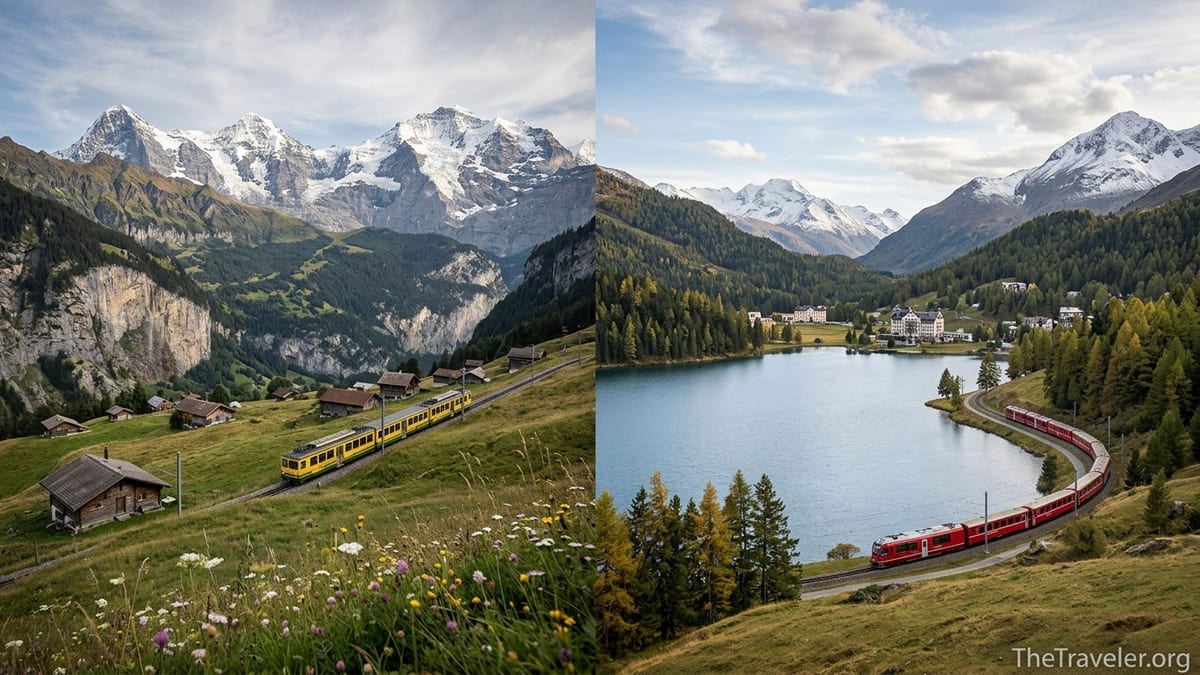
Bernese Oberland vs Engadin: Scenery and Atmosphere
The Jungfrau Region sits in the Bernese Oberland south of Interlaken and includes Grindelwald, Lauterbrunnen, Wengen and Mürren. Sheer limestone walls, hanging valleys and close‑up glacier views define the landscape. Stepping off the train in Lauterbrunnen, you are in a U‑shaped valley hemmed in by 300‑meter cliffs and dozens of waterfalls. Ride the Wengernalp Railway from Lauterbrunnen to Wengen and up to Kleine Scheidegg and the Eiger North Face feels almost within reach, a dramatic setting that many first‑time visitors picture when they imagine Switzerland.
St. Moritz lies in the Upper Engadin of southeastern Switzerland at about 1,800 meters, opened out along a broad, high valley. Here the drama is more horizontal than vertical. You look across a chain of lakes, including Lake St. Moritz and Lake Silvaplana, framed by rounded 3,000‑meter peaks and golden larch forests in autumn. The Engadin light has been praised by painters and photographers for more than a century, and on a clear February afternoon you can see why as sunlight bounces off frozen lakes and dry powder.
Atmosphere differs just as strongly. Jungfrau villages like Wengen and Mürren are compact, traditional and mostly car free, with chalet architecture and a slower rhythm. Grindelwald is busier but still feels like a mountain village with cows in nearby meadows in summer. By contrast, St. Moritz has two main parts: the higher Dorf area of luxury hotels and boutiques, and St. Moritz Bad by the lake, connected by a funicular and local buses. It feels more like a small Alpine town with designer shops and galleries alongside traditional Engadin houses.
In practical terms, this means the Jungfrau Region envelops you in wild, vertical scenery the moment you step out of your hotel, whereas St. Moritz offers wide panoramas and more of an international resort vibe. Travelers seeking romantic, enclosed mountain drama typically lean toward Jungfrau; those dreaming of open high‑valley vistas and a glamorous lakefront scene often gravitate to St. Moritz.
Hiking and Summer Activities: Close‑Up Peaks vs High Valley Trails
In summer, both regions are hiker’s paradises, but the style of hiking differs. In the Jungfrau Region, some of the most popular routes are balcony trails with constant views of the big three peaks. For example, the Männlichen to Kleine Scheidegg hike is an easy two‑hour walk suitable for families that begins with a gondola ride from Wengen or Grindelwald and then follows a wide path with broad views of the Eiger, Mönch and Jungfrau the entire way. Another favorite is from First above Grindelwald to Bachalpsee, a roughly one‑hour‑each‑way alpine lake hike that starts from the First gondola and is often combined with adventure activities like the First Cliff Walk and zip line.
In St. Moritz and the wider Engadin, hiking tends to mix panoramic balcony trails with high‑alpine routes above a chain of lakes. From the Corviglia area, reached by funicular from St. Moritz Dorf, hikers can follow well graded paths along the Piz Nair and Trais Fluors area with long views toward the Bernina massif. Around Pontresina, classic walks lead into the Roseg Valley with its glacier views and horse‑drawn carriages, or up toward the Morteratsch Glacier along a path with educational panels explaining its retreat. These routes feel more spacious and less steep‑walled than Jungfrau’s, ideal for travelers who enjoy big skies and long perspectives.
Both regions offer non‑hiking summer activities, but again with different flavors. In the Jungfrau Region, families often combine short walks with mountain attractions like the indoor ice palace on the Jungfraujoch or the revolving restaurant at Schilthorn’s Piz Gloria, which gained fame as a James Bond filming location. Paragliding over Interlaken or Grindelwald, trotti‑bike descents from First and boat cruises on Lakes Thun and Brienz round out itineraries. In St. Moritz, summer focuses on sailing and windsurfing on the Engadin lakes, mountain biking on signposted trails from Corviglia and Corvatsch, and a surprisingly lively cultural calendar with open‑air concerts and art exhibitions.
If your ideal day is a fairly short hike followed by a mountain restaurant terrace with peak‑face views and then a stroll through a small traditional village, Jungfrau is likely the better match. If you prefer longer, varied hikes that alternate between forests, lakes and high‑alpine viewpoints, paired with evenings in a resort town with upscale dining, St. Moritz may suit you more.
Skiing and Winter Sports: Classic Terrain vs High, Snow‑Sure Slopes
For skiers, the Jungfrau Region is anchored by the Jungfrau Ski Region areas of Grindelwald First, Grindelwald Wengen and Mürren Schilthorn. Skiers based in Wengen ride the Wengernalp Railway up to Kleine Scheidegg and ski under the Eiger, including long intermediate runs down toward Grindelwald and Wengen. The famous Lauberhorn World Cup downhill course is here, and confident skiers can follow a variant of the race route. Across the valley, the Mürren Schilthorn area offers steeper terrain, including the Direttissima run, one of the steepest pistes in the region, and sweeping views from Schilthorn’s 2,970‑meter summit.
Snow reliability in the Jungfrau Region is generally good in midwinter, but many slopes start around 1,000 to 1,500 meters, and warmer spells can affect valley runs. The upside is that you ski through trees and traditional hamlets, finishing runs in car‑free villages like Wengen or Mürren. Lift passes in winter are typically somewhat less expensive than those in St. Moritz, and there is a wide selection of modest three‑star hotels and chalet apartments in places like Lauterbrunnen and Grindelwald, which helps keep costs manageable for families or longer stays.
St. Moritz’s ski offering centers on Corviglia, Corvatsch and Diavolezza. Corviglia rises directly above St. Moritz, reached by funicular from the Dorf area and a cable car from St. Moritz Bad, and offers a broad network of intermediate‑friendly pistes with excellent sun exposure. Corvatsch, accessed via Surlej, is higher and colder, with its top station at 3,303 meters and a long black run known as the Hahnensee route that drops toward St. Moritz Bad with wide views of the lakes. Diavolezza, reached by cable car along the Bernina line, is a compact high‑alpine area favored for its glacier scenery and off‑piste options.
Because key Engadin ski areas rise well above 2,500 meters, snow conditions are typically reliable from December into April, and the dry continental climate often brings powder that regular visitors insist feels different from the wetter snow of the north side of the Alps. Non‑ski winter activities are also a major draw here: cross‑country skiers can use more than 200 kilometers of prepared tracks along the valley, and in February the frozen Lake St. Moritz hosts events such as horse racing on snow.
For advanced skiers who prioritize high, cold slopes and long sunny pistes, St. Moritz clearly leads. For intermediate skiers looking for classic Swiss scenery, tree‑lined runs and villages that feel like storybook postcards, the Jungfrau Region has the edge. Beginners will generally find good ski schools and nursery slopes in both areas, with family‑oriented zones such as the Cristins area near Corvatsch on one side and gentle gradients around Kleine Scheidegg and Männlichen on the other.
Luxury, Hotels and Overall Cost
St. Moritz has a global reputation for five‑star hospitality, and that is reflected in both its hotel stock and prices. On a typical winter weekend, flagship properties such as Badrutt’s Palace, Kulm Hotel or Suvretta House can easily command nightly rates in the high hundreds of Swiss francs or more for double rooms, even before adding half‑board or spa treatments. High‑end restaurants, designer boutiques and private concierge services make the resort particularly attractive for travelers used to destinations like Courchevel, Aspen or Gstaad.
The Jungfrau Region has its share of upscale addresses, including long‑established hotels in Wengen and Grindelwald with spas and gourmet dining. However, the overall mix leans more toward midrange and upper‑midrange. In summer, visitors can often find good three‑star double rooms in villages like Lauterbrunnen or Grindelwald at prices that, while still high by global standards, are meaningfully lower than prime St. Moritz. Apartment rentals and chalet stays are common, which benefits families and small groups trying to manage food and accommodation costs over a week.
Day‑to‑day expenses follow similar lines. A basic meal at a self‑service mountain restaurant in either region might cost around the same, but St. Moritz offers far more opportunities to spend on fine dining, in‑resort shopping and nightlife. Drinks in hotel bars, spa treatments and ski school for children tend to be priced at the top end of the Swiss spectrum. The Jungfrau Region still requires a solid budget, but its more village‑based character encourages simple evenings, such as dining at a family‑run restaurant in Wengen or cooking in an apartment after a day on the slopes.
In terms of tickets and passes, travelers in both regions often use some combination of national products such as the Swiss Travel Pass and regional passes like the Jungfrau Travel Pass or local Engadin mountain rail tickets. A Swiss Travel Pass for several days provides easy rail access to both areas and discounts on many mountain lifts, but the exact savings depend heavily on your itinerary. Price differences between Jungfrau and St. Moritz for regional lift passes tend to be modest compared to what you will spend on lodging, food and activities, so accommodation choice is usually the key deciding factor for budget.
Scenic Rail Access and Getting Around
Reaching the Jungfrau Region from major Swiss gateways is straightforward and scenic. From Zurich Airport, travelers typically take mainline trains via Bern to Interlaken Ost, then transfer to narrow‑gauge mountain trains run by local rail companies. The Wengernalp Railway climbs from Lauterbrunnen or Grindelwald to Wengen and Kleine Scheidegg, while the Jungfrau Railway continues through tunnels in the Eiger to Jungfraujoch, one of the highest railway stations in Europe. The Eiger Express gondola, operating from Grindelwald Terminal, now provides a fast connection to Eigergletscher station, reducing travel time to the high‑alpine viewpoint.
In St. Moritz, rail access is all about the Engadin and Bernina lines. From Zurich, trains usually run via Chur along the Rhine valley before branching southeast to the Albula tunnel and emerging into the Upper Engadin. The approach features spirals and viaducts that form part of a UNESCO‑listed railway landscape. St. Moritz is also one end of the Glacier Express, the panoramic train that runs across the Alps to Zermatt, and sits on the route of the Bernina line toward Italy, famed for its high pass at Ospizio Bernina and lake views at Lago Bianco.
Once in the Jungfrau Region, most visitors get around almost entirely by rail, cable car and on foot. Interlaken acts as a hub, but many travelers stay higher up in Wengen or Mürren, which are car free and linked to the valley by cogwheel trains, cable cars and funiculars. This creates a sense of immersion, though it also means building in connection times, especially in winter when early‑morning trains to the slopes can be busy. In practice, a family based in Wengen can reach the Kleine Scheidegg ski area in roughly 30 minutes by cog railway, while a day trip from Grindelwald to Schilthorn involves changing from train to cable car at Lauterbrunnen and Mürren.
St. Moritz has a denser local bus system, plus the St. Moritz–Corviglia funicular and lifts to Corvatsch and Diavolezza. Many luxury hotels include complimentary shuttle services to lifts and train stations, and local transport passes are sometimes included with overnight stays in summer seasons, giving free or discounted rides on mountain lifts. The compact nature of the valley means that within about 20 to 30 minutes you can move between lakeside promenades, ski bases and trailheads, provided you are comfortable using buses and the occasional short train hop.
From a rail enthusiast’s perspective, St. Moritz holds an advantage thanks to its role on both the Glacier Express and Bernina routes. From a convenience and iconic‑experience standpoint, the Jungfrau Region wins with its direct access to the Jungfraujoch and classic cog railways starting right from village centers.
Summer vs Winter: When Each Region Shines
In summer, the Jungfrau Region is at its greenest and most photogenic. Meadows above Wengen and Mürren are filled with wildflowers, cows graze around rustic huts and waterfalls thunder into the Lauterbrunnen valley. Cable cars and mountain railways operate on extended schedules, making it easy to combine multiple viewpoints in a single day, such as taking the train from Wengen to Kleine Scheidegg in the morning, continuing to Jungfraujoch midday and descending toward Grindelwald in the afternoon. Evening light on the north face of the Eiger from terraces in Grindelwald can be a highlight of a July or August trip.
St. Moritz’s summer appeal is different but no less compelling. The Engadin climate is famously dry and sunny, so even in high summer, temperatures remain comfortable for hiking and biking at altitude, while lakes provide a cooling counterpoint below. Mornings might start with a walk along Lake St. Moritz or a paddle on Lake Sils, followed by an excursion to Corvatsch for views of glaciers and 3,000‑meter peaks. The long, flat valley floor invites road cycling and Nordic walking, and the resort’s summer social calendar features events from sailing regattas to classic car gatherings.
In winter, the Jungfrau Region feels like a collection of snowbound villages clinging to mountainsides. Wengen and Mürren set up festive decorations, and access is via mountain railways and cable cars rather than cars. Non‑skiers can still enjoy winter walking paths, sled runs such as those from Männlichen or Pfingstegg, and excursions to Jungfraujoch or Schilthorn, which offer indoor attractions like viewing platforms, restaurants and ice sculptures. However, early and late season conditions can vary in lower areas, and some valley hiking paths may be icy or closed.
St. Moritz comes into its own in deep winter. The lakes freeze, becoming venues for walking, cross‑country skiing and occasional special events. Hotels run elaborate winter programs with spa rituals, afternoon teas and après‑ski on sun terraces. Because of the altitude, snow‑sure slopes remain open later into spring, making March and often April excellent months for skiing and sunbathing at mountain restaurants. For travelers whose priority is consistent snow, high‑altitude skiing and the full resort atmosphere of winter sports culture, St. Moritz has a clear edge.
Which Region Suits Which Traveler Type
First‑time visitors to the Swiss Alps who have long imagined steep valleys, cogwheel trains and chalets under towering peaks often find that the Jungfrau Region matches their mental picture perfectly. Couples seeking romance appreciate car‑free Wengen and Mürren, where evenings are quiet and nights are dark enough for star‑gazing. Families like the variety of easy hikes and non‑hiking attractions, from Trümmelbach Falls in Lauterbrunnen to the mountain playgrounds near Männlichen and First. Budget‑conscious travelers, while still facing high Swiss prices, can more easily find modest hotels or apartments within walking distance of stations.
St. Moritz suits travelers who value refined comforts as much as scenery. Repeat visitors to Switzerland who have already experienced places like Interlaken or Zermatt often choose the Engadin for its distinctive landscape and sophisticated atmosphere. It is a strong choice for luxury‑oriented couples, groups of friends who enjoy gourmet dining and spa time, and serious skiers seeking long, snow‑sure pistes. The presence of major scenic trains like the Glacier Express and Bernina line also makes St. Moritz a useful anchor point for more complex rail itineraries across Switzerland and into northern Italy.
Active travelers who prioritize multi‑day hiking circuits or extensive cross‑country skiing networks may find the Engadin’s high plateau and branching side valleys more versatile. On the other hand, those who want shorter, dramatic walks with frequent mountain‑rail connections back down to villages often prefer the Jungfrau Region’s denser lift network and closer proximity between valley and peaks.
If your ideal Alpine holiday is about feeling cocooned in mountain scenery with a strong sense of place and traditional village life, Jungfrau is usually the better fit. If you see the Alps as a backdrop to a broader experience of fine hotels, restaurants, winter events and iconic rail journeys across different regions, St. Moritz in the Engadin is likely to deliver more of what you are looking for.
The Takeaway
Comparing the Jungfrau Region and St. Moritz is less like judging competitors and more like deciding between two distinct interpretations of the Swiss Alps. Jungfrau offers instant immersion in classic Bernese Oberland scenery, from the vertical drama of Lauterbrunnen’s cliffs to the close‑up views of the Eiger from Kleine Scheidegg and the high‑alpine spectacle of Jungfraujoch. Villages are small, often car free and deeply rooted in mountain traditions, making this region particularly rewarding for first‑time visitors, families and travelers who value scenery and authenticity over nightlife and designer shopping.
St. Moritz, set in the high Engadin valley, wraps its guests in a different kind of Alpine experience, one defined by broad horizons, frozen lakes and a refined resort culture that has attracted international guests for more than a century. High, sunny ski slopes, extensive cross‑country networks, and marquee scenic trains connecting to Zermatt and Italy give it special appeal for winter sports enthusiasts and rail travelers, while its luxury hotels and restaurants cater to those for whom the journey is as much about comfort as it is about landscape.
If your priority is iconic mountain imagery, easy access to hiking and an intimate village feel, start with the Jungfrau Region. If you dream of high‑altitude skiing, long valley panoramas and polished hospitality, St. Moritz and the Engadin may be your better match. Many seasoned travelers eventually visit both, perhaps linking them on different trips by panoramic train, but for a first decision, understanding their contrasting characters will help you choose the Alpine experience that feels most like your own.
FAQ
Q1. Is the Jungfrau Region or St. Moritz better for a first trip to the Swiss Alps?
For most first‑time visitors, the Jungfrau Region feels closer to the classic Swiss Alps image, with dramatic valleys, cogwheel trains and car‑free villages. St. Moritz is excellent too, but its resort atmosphere and broader horizon may appeal more to travelers who have already seen other parts of the Alps.
Q2. Which area is more budget friendly, Jungfrau Region or St. Moritz?
Both are expensive by global standards, but the Jungfrau Region generally offers more midrange hotels and apartments, especially in villages like Lauterbrunnen and Grindelwald. St. Moritz is known for luxury hotels and high‑end dining, so overall costs there tend to be higher, particularly in peak winter season.
Q3. Where will I find better hiking, Jungfrau or St. Moritz?
Hiking is excellent in both, but different in style. Jungfrau focuses on balcony trails under steep peaks and shorter routes linked by mountain trains and lifts. St. Moritz and the Engadin offer more open, high‑valley and lakeside routes, often suited to longer day hikes. Your choice should match whether you prefer enclosed, dramatic scenery or wide panoramas.
Q4. Which region is better for skiing and snow reliability?
For high, snow‑sure slopes and long sunny runs, St. Moritz usually has the edge because many pistes on Corviglia, Corvatsch and Diavolezza are well above 2,500 meters. The Jungfrau Region offers wonderfully scenic skiing under the Eiger and around Schilthorn, but some runs start lower, so early and late season conditions can be more variable in warmer winters.
Q5. How do travel times from Zurich compare for Jungfrau and St. Moritz?
Travel times from Zurich to either region are broadly similar. Reaching Interlaken for the Jungfrau Region usually takes around 2 hours by mainline train, plus additional time on mountain railways to reach villages like Wengen or Mürren. Getting to St. Moritz by rail via Chur and the Albula line typically takes around 3 and a half hours, depending on connections.
Q6. Which area is better if I do not ski?
Non‑skiers are well catered for in both, but the Jungfrau Region may have a slight advantage thanks to excursions such as Jungfraujoch, Schilthorn and Schynige Platte, plus easy valley walks and waterfalls. St. Moritz, however, offers lake promenades, winter walking paths, spa culture and events on the frozen lake, so it also works well for non‑skiers who enjoy a resort atmosphere.
Q7. Is one region better for families with children?
Families often find the Jungfrau Region very convenient, with short scenic walks, playgrounds near lift stations and varied non‑ski activities. Car‑free villages like Wengen and Mürren feel safe and manageable. St. Moritz also has family‑friendly facilities and ski schools, but its luxury focus and higher price point can be challenging for larger family budgets.
Q8. Which area offers better scenic train experiences?
Both offer outstanding rail journeys. Jungfrau stands out for its iconic cogwheel railways to Kleine Scheidegg and Jungfraujoch, and steep valley climbs from Lauterbrunnen and Grindelwald. St. Moritz, however, is the terminus for the Glacier Express and sits on the Bernina line toward Italy, making it a prime base for panoramic long‑distance train journeys.
Q9. How do summer experiences differ between Jungfrau and St. Moritz?
In summer, the Jungfrau Region is all about green meadows, waterfalls and balcony hikes under towering rock faces, with frequent use of trains and cable cars to move between viewpoints. St. Moritz offers dry, sunny weather, lake activities such as sailing and paddleboarding, and high‑valley hikes and bike rides through the Engadin. Both are excellent, but the landscapes and atmospheres feel distinct.
Q10. If I have a week, is it realistic to visit both regions on one trip?
It is possible but demanding. With only seven days, splitting time between Jungfrau and St. Moritz means you will lose at least one full day to transfers and risk feeling rushed. Many travelers prefer to base themselves in one region and explore it thoroughly, then plan a second trip to experience the other, perhaps connected by a panoramic train like the Glacier Express on a future visit.