

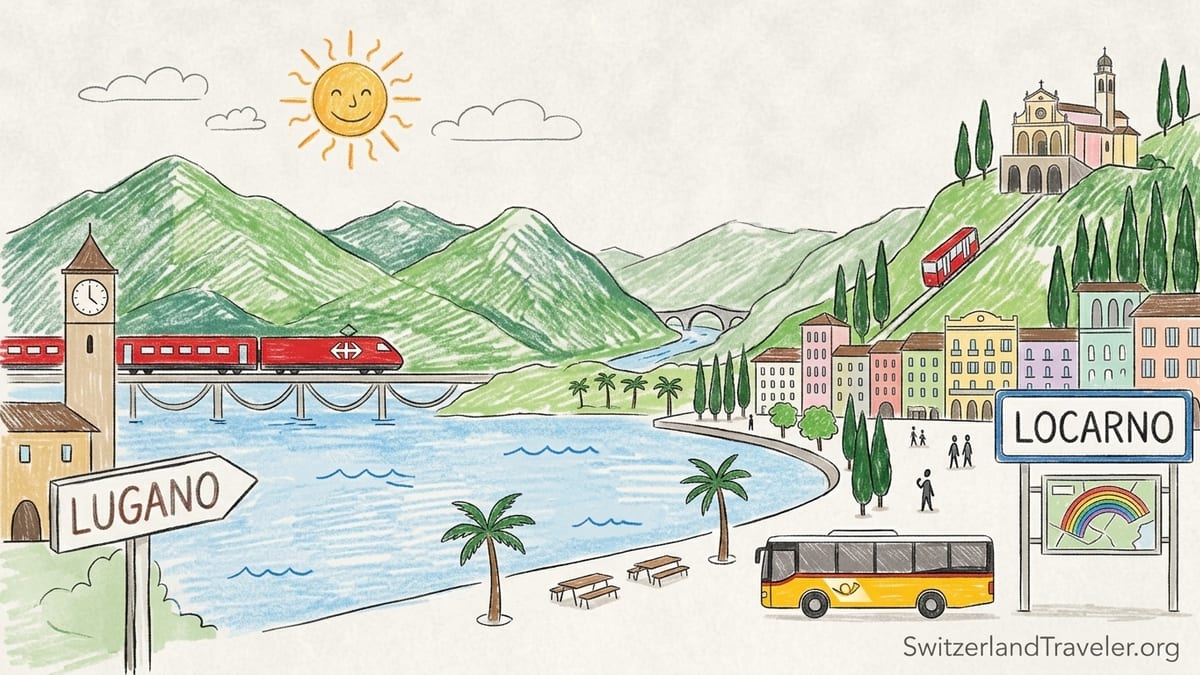
I arrived in Ticino expecting a sleepy Italian borderland with a Swiss price tag. What I found instead was a region that felt at once Mediterranean and meticulously Swiss, where palm trees frame snowy peaks and trains glide into stations with to-the-minute precision while everyone chats in musical Italian. Over ten days based in Lugano and Locarno, with side trips to Ascona, Bellinzona, Valle Verzasca, Valle Maggia and several mountain viewpoints, I kept bumping into my own wrong assumptions, spending money where I did not need to and discovering places I wish I had given more time. This is a practical, ground-level account of what actually surprised me most about Italian-speaking Switzerland, and how I would do it differently next time.
First Impressions: “Am I Really Still in Switzerland?”
My very first surprise came the moment I stepped out of the train in Lugano. Moments earlier I had been in the German-speaking part of Switzerland, where announcements flipped crisply between German, French and English. In Lugano, the loudspeakers switched to Italian first, with a softer Swiss-accented German following behind. Yet the station itself felt quintessentially Swiss: spotless platforms, clear signage with the familiar red SBB logo and a digital board quietly ticking through precisely timed InterRegio and EuroCity departures for Zurich, Basel and Milan.
I had lazily imagined Ticino as a cul-de-sac at the southern edge of the country. The reality, visible right on the departure board, is that Lugano, Locarno and Bellinzona are tightly woven into the national rail network. Direct InterRegio trains link Bellinzona north through the Gotthard corridor, and EuroCity trains connect Milan with Lugano and Locarno according to the national timetable. On a later day I rode one of these early-morning EuroCity services from Milan Centrale that pulls into Lugano before continuing on to Locarno, a reminder that this “Italian” corner of Switzerland is in fact a major north–south gateway.
Stepping outside the station was my second jolt. The air felt softer, almost humid after the dry alpine breeze I had left behind. Cypress trees lined the slopes, and down below a slice of deep-blue Lake Lugano flashed between pastel facades. Cafés had outdoor terraces already busy with people sipping espresso at nine in the morning. It felt like I had taken a train straight into northern Italy, yet the bus stops displayed the familiar blue and white “Arcobaleno” zoning maps, and the ticket machines offered extensions perfectly integrated with my Swiss Half Fare Card. It was my first real glimpse of how thoroughly Swiss Ticino remains beneath its Mediterranean skin.
Getting Around Ticino: Trains, Funiculars, Boats and a Few Missteps
I had underestimated how much I would rely on Ticino’s web of public transport, and how much planning mistakes could cost. My first big lesson came within minutes of arrival in Lugano. Instead of dragging my suitcase down the road into town, I followed signs for the funicular directly inside the station. Locals call it the “Sassellina,” a short but steep line that links the SBB platforms with Piazza Cioccaro in the old center. The official city information lists a fare of about 1.30 Swiss francs per ride, with departures running continuously throughout the day rather than to a sparse rural timetable. I stepped into the red car, the doors closed, and less than two minutes later I was in the heart of Lugano without having wrestled a single hill.
This tiny ride became the first of many small efficiencies that made Ticino feel deeply Swiss. In Locarno I made similar use of the historic Funicolare Locarno–Madonna del Sasso, which climbs from near the rail station up to Orselina. The operator’s most recent tariff table shows a return fare of 8 francs for adults and 4 francs for children for the Locarno–Orselina stretch, with services typically running every 30 minutes during the day and a reduced schedule in the shoulder months. I used it one afternoon to avoid the punishing climb to the sanctuary and to connect with the cable car toward Cardada, grateful that my Ticino Ticket from the hotel knocked a modest percentage off the published price.
Where I went wrong at first was with regional train and bus tickets. On my second day I bought individual point-to-point tickets for a short hop between Lugano and Bellinzona, not realizing that a zone-based Arcobaleno day pass would have covered both that route and later rides in the same zones for just a bit more. I only understood the error when I later checked the SBB app and saw that the day pass would have saved me several francs once I factored in my afternoon detour to a lakeside village. For routes like Lugano to Locarno or Bellinzona to Locarno, it is worth checking the current Arcobaleno pricing and comparing single fares against a day ticket, especially if you plan to add buses or funiculars.
The lakes brought their own learning curve. On Lake Maggiore, the regional boat services connect Locarno with Ascona, the Brissago Islands and Italian ports. While planning, I had imagined this as a cheap local ferry. On arrival at the pier I learned that regular tourist day passes and single trips on Lake Maggiore are priced more like short cruises than basic public transport, reflecting the scenic nature of the route and cross-border operations. A day pass that included travel to the Brissago Islands cost me noticeably more than I had budgeted, although it did allow flexible hop-on, hop-off sailing between Locarno, Ascona and the islands all day. Next time, I would build those lake-boat prices into my core budget rather than treating them as incidental extras.
Choosing a Base: Lugano vs Locarno and Why I Moved
For my first four nights I based myself in Lugano, assuming it would be the best all-purpose hub. This was only half right. Lugano felt immediately cosmopolitan, with business travelers pulling wheeled suitcases past fashion boutiques and the LAC arts center drawing people in the evenings. The lakeside promenade between Parco Ciani and Paradiso was my morning ritual, watching joggers weave between palm trees while ferries slid out toward Morcote. The city’s position on the main rail axis made day trips to Bellinzona and even back across the Alps straightforward.
Yet by day three I realized that most of the places I was most excited about Bellinzona’s castles, Valle Verzasca, Valle Maggia and Lake Maggiore were better reached from Locarno. Trains linking Lugano and Locarno involve at least one change, most often in Giubiasco or Cadenazzo, and while the ride is not long, repeating it several times eats into your days. I ended up shifting my base for the second half of the trip, catching a mid-morning InterRegio to Bellinzona and then continuing to Locarno on a regional service, which I booked via the SBB platform like any other domestic connection.
Locarno surprised me by feeling more resort-like and at the same time more compact. The station opens almost directly onto the lakefront, with a short walk bringing you to Piazza Grande and the old lanes climbing toward the Madonna del Sasso funicular. Within minutes of checking into my small hotel near the piazza, the receptionist handed me the Ticino Ticket, a regional card that provides free travel on many local buses and trains across Ticino and discounts on selected mountain railways and attractions. I had read about it in passing but had not factored it into my budgeting. In practice, that slim card saved me money daily, covering my bus up Valle Verzasca, local trains as far as Bellinzona and sizable reductions on some mountain lifts.
In hindsight, if my main focus were lakes and valleys, I would base in Locarno or Ascona from the start and spend perhaps only a night or two in Lugano, spaced around a day on Monte San Salvatore or Monte Brè. Lugano still matters as a transport hub and has a lively urban vibe, but the northern lakes and hiking valleys pull you naturally toward Locarno as your home base.
Mountain Viewpoints: Funiculars, Cable Cars and Time I Wish I Had
I had seen countless photographs of Ticino’s lake-and-peak panoramas before traveling, yet standing on them in person was still a shock. The first viewpoint I visited was Monte San Salvatore above Lugano. From the suburb of Paradiso, the Monte San Salvatore funicular climbs in two sections through chestnut woods to a summit with a small church and sweeping views, and it is one of several funiculars serving the Lugano area. A standard adult return ticket purchased through the operator’s current channel was around 34 francs at the time of my visit, with holders of the Ticino Ticket paying less. I arrived mid-morning, joining a car filled with local families and a few hikers carrying poles and daypacks.
What I had not anticipated was how long I would want to linger at the top. I had planned a quick up-and-down before hopping a train north, but the terrace views over the lake, the short loop paths and the quiet corners around the church easily absorbed several hours. On another day I repeated the mistake in Locarno by riding the funicular up to Orselina and then continuing by cable car to Cardada and chairlift to Cimetta. Cardada’s pricing, as listed in recent public tariffs, bundles the different segments into combination tickets that, while not cheap, make it easy to ride all the way to the upper station without separate purchases. The result is a stunning perspective over both Lake Maggiore and the chain of Alps to the north.
My most frustrating blunder was underestimating shoulder-season schedules. In late autumn, some mountain lifts shorten their operating hours or close for annual maintenance, especially in November. I learned this the hard way when I showed up for an afternoon ascent only to discover that the last downward cabin had already departed, with the lift closing earlier than peak-summer timetables. Staff were kind and pointed me to the updated seasonal times, but it meant I had to skip a second loop at the top. If you are traveling outside high summer, check the current daily schedule on each operator’s official timetable rather than assuming a steady, year-round service.
Of the viewpoints I visited, the ones above Lugano felt more urban, easily combined with city time, while Cardada–Cimetta above Locarno had a more overtly alpine character despite the palm trees on the lake below. Both drove home how geographically compressed Ticino is: within an hour of stepping out of a train in a lakeside city, you can be standing above tree line watching evening light wash across snow-dusted ridges.
Into the Valleys: Valle Verzasca and Valle Maggia by Bus
The names Valle Verzasca and Valle Maggia had drawn me to Ticino long before I knew what trains reached them. I had a clichéd mental picture of a single stone bridge arcing over emerald water perhaps you have seen the image of the Ponte dei Salti at Lavertezzo. While that bridge is real and as beautiful as the photographs suggest, I was surprised by how accessible the broader valley network is by public transport, and how different the mood becomes just an hour from the lakeshores.
From Locarno station, I boarded the yellow PostBus labeled for Valle Verzasca, following the current Line 321 timetable for the season valid from mid-December through early December the following year. The route threads from Locarno through Tenero into the narrowing valley, stopping at hamlets like Lavertezzo and Brione before reaching Sonogno at the head of the valley. With my Ticino Ticket I did not pay an additional fare, simply validating my card and boarding like a local. Within forty minutes, the bustle of Locarno fell away, replaced by stone houses with slate roofs and the sound of the river tumbling below the road.
At Lavertezzo, I joined a small crowd heading down to the famous bridge. Here I ran into both my most Instagrammed view and my worst timing mistake. In August, even on a weekday, the polished stone slabs turned into sunbeds as visitors spread towels and picnics along the riverbanks. I had expected a quiet, contemplative scene and instead found a lively, almost beach-like atmosphere. The water truly does glow in shades of jade and turquoise, and strong swimmers dove into deep pools, but I had not realized how chilly and fast-moving the current can be. Signs warned against risky jumps from the rocks, and lifeguards kept a watchful eye during peak season, a reminder that this apparently idyllic stream demands respect.
My plan had been to hike a section of the valley trail from Lavertezzo to a higher village and then catch a later bus back. What I had not accounted for is how quickly the sun disappears behind the steep sides of the valley, especially in the shoulder seasons. By mid-afternoon in early autumn, cool shade pooled in the gorge and temperatures dropped several degrees compared with the lakes. Thankfully the bus service remains reasonably frequent along the core stretch during the main operating period, but outside high summer there are fewer late departures. I cut my hike short to avoid a long wait for the last return, arriving back in Locarno feeling that I had only skimmed the surface. Next time I would dedicate a full day to the valley, starting earlier and perhaps even riding all the way to Sonogno to walk back down a segment of the trail.
Valle Maggia felt more lived-in and varied, stretching northwest from Locarno along the Maggia River. Buses again depart from near the station, following a schedule tied into the broader Arcobaleno system. Here the villages felt less like pure tourist magnets and more like year-round communities, with small supermarkets, schools and churches clustered along the road. I stopped in a riverside village where the bus set me down a short walk from wide gravel banks and shallower swimming spots, a more relaxed contrast to the sculpted rock basins of Verzasca. Late in the day clouds clung to the peaks, and the play of light on the water and granite boulders made it clear why so many hikers return year after year.
Food, Prices and the Shock of Eating “Italian” in Switzerland
Before arriving in Ticino, I had naïvely assumed that crossing into the Italian-speaking part of Switzerland might bring prices closer to those of Italy itself. That illusion vanished with my first lakeside dinner. Sitting on a terrace in Lugano with a plate of risotto al Merlot and a glass of local red, I realized that while the flavors and dishes draw heavily from neighboring Lombardy and Piedmont, the bill lands firmly within Swiss norms. Main courses in mid-range restaurants commonly hovered in the high twenties to mid-thirties in francs, with lakeside and piazza locations adding a premium. An espresso, on the other hand, often cost less than in Zurich or Geneva and tasted far better than many I had drunk north of the Alps.
One of my favorite food experiences came not from a white-tablecloth restaurant but from a simple grotto above Lugano. These rustic, often family-run spots serve polenta with braised meats, local cheeses and cured sausages in shaded gardens or low-ceilinged rooms. Reaching mine required a short uphill walk from a bus stop, and once seated I shared wooden tables with local families and hikers. A plate of polenta with braised beef, a salad and a glass of house Merlot set me back what a mid-range meal would cost anywhere in Switzerland, but the atmosphere and depth of flavor felt distinctly Ticinese.
In Locarno and Ascona, lakeside cafés offered aperitivo plates in the late afternoon, with spritzes and local wines paired with small snacks. Prices for drinks were in line with the rest of the country typically low to mid-teens for cocktails and single-digit francs for glass pours of regional wine but the experience of watching the light soften over the lake while Italian drifted around me felt miles from German-speaking cities. Supermarkets became my quiet ally, especially for lunches between hikes. I learned to duck into a Coop or Migros before heading into the valleys, picking up fresh bread, cheese and fruit at far lower cost than any mountain restaurant.
One financial trap I fell into was assuming that “simple” lakeside kiosks or bathing establishments would be budget-friendly. In Locarno, the modern Lido complex on the lakefront charges an entry fee that reflects its extensive pools, slides and lake access. Published basic rates distinguish between seasons and resident and non-resident categories, and while a single adult ticket was not outrageous by Swiss standards, it was more than I had expected for a quick afternoon dip. Next time, I would either plan to spend a full half-day making use of all the facilities or opt for one of the free lakeshore spots used by locals for a faster swim.
Weather, Seasons and How “Mediterranean” Ticino Really Is
Looking at photographs before my trip, I had built an image of Ticino as endlessly sunny, with palm trees and bougainvillea under blue skies. Reality turned out more nuanced. Yes, the climate here is milder than north of the Alps. Even in early spring and late autumn, Lugano and Locarno often enjoy comfortable daytime temperatures when Zurich and Lucerne feel raw. I sat in shirt sleeves on a Locarno terrace in April while snow still traced the higher ridges above the lake, and jasmine scented the narrow lanes around Ascona’s old town in late May.
At the same time, Ticino’s position along a major north–south weather corridor means it can experience heavy rain, particularly in some autumn periods. During my stay, a frontal system rolled in and transformed a planned lake day into a lesson in local meteorology. Low clouds wrapped the peaks, and steady downpours turned the Verzasca River a wilder gray-green. Locals told me that such episodes can last several days, especially in October, and that the lush, almost subtropical vegetation in some ravines owes its existence to those abundant rains as much as to sunshine.
In the valleys, microclimates shift over short distances. A bus ride of less than an hour from Locarno into Valle Maggia took me from mild lake air into noticeably cooler, damper conditions. In late autumn, frost lingered in the shadows even when the lakefront promenades felt almost balmy. I learned to pack layers in my daypack even on apparently warm mornings, including a light rain shell, and to avoid relying solely on the blue skies visible from the hotel window. The combination of Mediterranean light on the lakes and alpine chill in the side valleys is part of what makes Ticino feel so complex.
Seasonality also shapes transport and attraction access. While core train services along the mainlines operate year-round according to the national timetable, some high-altitude lifts, summer-only mountain bus routes and certain lake cruises reduce frequency outside peak months. The ferry services on the upper parts of Lake Maggiore operate on denser timetables in summer when demand peaks, offering frequent boats between Locarno, Ascona and the Brissago Islands. Visiting just outside that window in late September, I still had good coverage but with longer gaps between departures. Planning around those seasonal patterns can make the difference between a relaxed trip and one spent racing clocks.
How Swiss Does Ticino Feel Beneath the Italian Language?
Perhaps my most persistent surprise was how thoroughly Swiss Ticino feels in daily life despite the Italian language and Mediterranean imagery. On trains, conductors in Ticino uniforms checked tickets with the same quiet efficiency I had experienced near Zurich or Bern, scanning QR codes on my SBB app and advising on connections without any sense of hurry. Timetables for regional buses in the valleys matched what I had seen within a minute or two, and real-time displays at stops in Lugano and Locarno updated delays and platform changes with calm precision.
What differed, of course, was the soundtrack. In Lugano’s markets and on Locarno’s piazzas, the dominant language is Italian, often peppered with local dialect. Announcements on funiculars and boats usually ran in Italian first, followed by German and sometimes English, a blend that constantly reminded me I was still in Switzerland rather than over the border. Civic spaces reinforced that sense. Municipal notices, recycling guidelines and local regulations were presented in the unmistakable visual language of Swiss bureaucracy, simply translated into Italian.
The cultural blend was clearest in small interactions. In a Bellinzona bakery, I ordered in Italian and the cashier seamlessly switched to German when the next customer greeted her with a Swiss-German “Grüezi.” On a bus up into Valle Maggia, a group of hikers compared notes in French on a signposted trail system that followed the standardized yellow Swiss waymarking. At a lakeside bar in Ascona, the menu offered Ticino Merlot by the glass alongside Italian aperitivi, but the bill included the familiar Swiss sales tax breakdown.
At the same time, some Italian influences softened edges that can feel more rigid in northern cantons. Restaurant closing times struck me as slightly more relaxed, especially in the height of summer, and outdoor social life felt more prolonged into the evening. Yet even at midnight walking back along the water in Lugano, I felt the same basic security and orderliness I associate with Switzerland, from well-lit paths to the quiet hum of late trams and buses still keeping to their posted times.
The Takeaway: What I Would Do Differently Next Time
Looking back over my first journey through Ticino, my main regrets are not about what I saw but about time and structure. I underestimated how much there is within short reach of Locarno, and I overestimated how “casual” I could be about transport in a region that, despite its relaxed surface, still runs on a precise Swiss timetable. If I were to plan the trip again, I would base myself first in Locarno or Ascona for at least five nights to fully explore Valle Verzasca, Valle Maggia, Cardada–Cimetta and the Lake Maggiore basin, then finish with two or three nights in Lugano focused on Monte San Salvatore, Monte Brè and a slower appreciation of the city’s cultural life.
Budget-wise, I would factor in mountain transport and lake boats as core costs rather than add-ons, checking current funicular and cable car tariffs and lake-cruise passes in advance and setting aside a realistic daily amount. I would pay closer attention to Arcobaleno zones and consider day passes when linking multiple short hops, and I would treat the Ticino Ticket not as a pleasant surprise at check-in but as a tool to maximize from day one by planning outings that align with the free routes and discounted attractions it covers.
Perhaps most importantly, I would slow down in the valleys. Instead of dashing to Lavertezzo for the iconic photo and back, I would ride the bus all the way to Sonogno and walk a section of the Verzasca trail; in Valle Maggia I would plan full days around specific villages and side ravines rather than sampling several in a rush. Ticino rewards lingering: sitting on a stone wall watching clouds snag on peaks, sipping a glass of local wine while church bells echo up a side valley, or simply riding a funicular without an urgent plan for what comes next.
If you arrive in Ticino expecting just “Italy with Swiss prices,” you may be as startled as I was. It is a place where trains and funiculars run with northern discipline, where public transport reaches deep into valleys that feel worlds apart from the lakes, and where espresso and risotto come surrounded by the unmistakable orderliness of Switzerland. For me, that tension between south and north, looseness and structure, is exactly what makes Italian-speaking Switzerland so compelling and why I know I will be back.
FAQ
Q1. Is it better to base in Lugano or Locarno for a first trip to Ticino?
For scenery and easy access to Valle Verzasca, Valle Maggia and Lake Maggiore, I found Locarno the more practical base, while Lugano works well for a shorter city-focused stay and trips to Monte San Salvatore and Monte Brè.
Q2. Do I need a car to explore Valle Verzasca and Valle Maggia?
No, I managed entirely by public transport, using PostBus services that run from Locarno into both valleys according to seasonal timetables, though frequencies are higher in summer than in late autumn.
Q3. How expensive are funiculars and mountain lifts in Ticino?
Prices vary by line, but on my visit a return on the Locarno–Madonna del Sasso funicular was around 8 francs for adults and major summits like Monte San Salvatore or Cardada–Cimetta cost several tens of francs, with small discounts available through the Ticino Ticket or national rail passes.
Q4. Can I use the Ticino Ticket on trains and buses everywhere in the canton?
The Ticino Ticket that I received from participating hotels covered most regional trains and buses within specific zones across Ticino, including routes from Locarno into the main valleys, and offered partial discounts on certain mountain railways and attractions, but did not replace national rail tickets for long-distance intercity travel.
Q5. Are lake boats on Lake Maggiore and Lake Lugano part of the regular public transport system?
The boats are integrated into the wider transport network and appear on official timetables, but fares for tourist-oriented routes on Lake Maggiore and Lake Lugano are set more like scenic cruises than basic commuter ferries, and I found them to be a noticeable extra line in my daily budget.
Q6. What languages should I expect to use in Ticino?
Italian is the primary language in shops, restaurants and on local announcements, but I was able to switch to German or English in most tourist-oriented places, and staff on trains and at major attractions were used to dealing with multilingual visitors.
Q7. How does the weather in Ticino compare with the rest of Switzerland?
I experienced milder temperatures and more Mediterranean-feeling conditions around Lugano and Locarno than north of the Alps, but also periods of intense rain, especially in autumn, and noticeably cooler, damper air in the higher valleys compared with the lakeshores.
Q8. Is swimming in the Verzasca and Maggia rivers safe?
I saw many people swimming and jumping from rocks in clearly marked areas, but the currents can be strong and the water very cold, so I followed posted safety signs and local advice and avoided risky dives or swimming outside designated zones.
Q9. How far in advance should I check seasonal timetables for lifts and boats?
After being caught out by early closing times on a mountain lift, I now recommend checking official websites or the national timetable shortly before each excursion, especially in spring and autumn when many lifts, some buses and boat services operate on reduced or transitional schedules.
Q10. Are food and drink noticeably cheaper in Ticino because it is Italian-speaking?
No, restaurant and bar prices for full meals and drinks were broadly in line with the rest of Switzerland on my trip, even though the cuisine and café culture feel very Italian, so I budgeted accordingly and used supermarkets and picnic supplies to keep some meals more affordable.