


French-speaking Switzerland is far more than a pretty arc of towns around Lake Geneva. It stretches from the United Nations in Geneva to the wine terraces of Lavaux, from medieval Gruyères to the cliffs of the Creux du Van, and on to the sun-baked vineyards above Sion. Planning a trip here works best when you think in “bases” and “excursions”: a handful of well-connected hubs where you sleep, plus targeted side trips that deliver big scenery or distinct experiences without constantly changing hotels. This guide focuses on Geneva, Lausanne, Lavaux, Vevey and Montreux, Gruyères, Fribourg, Neuchâtel, the Creux du Van area and Sion, with a few smaller places that solve specific trip needs.
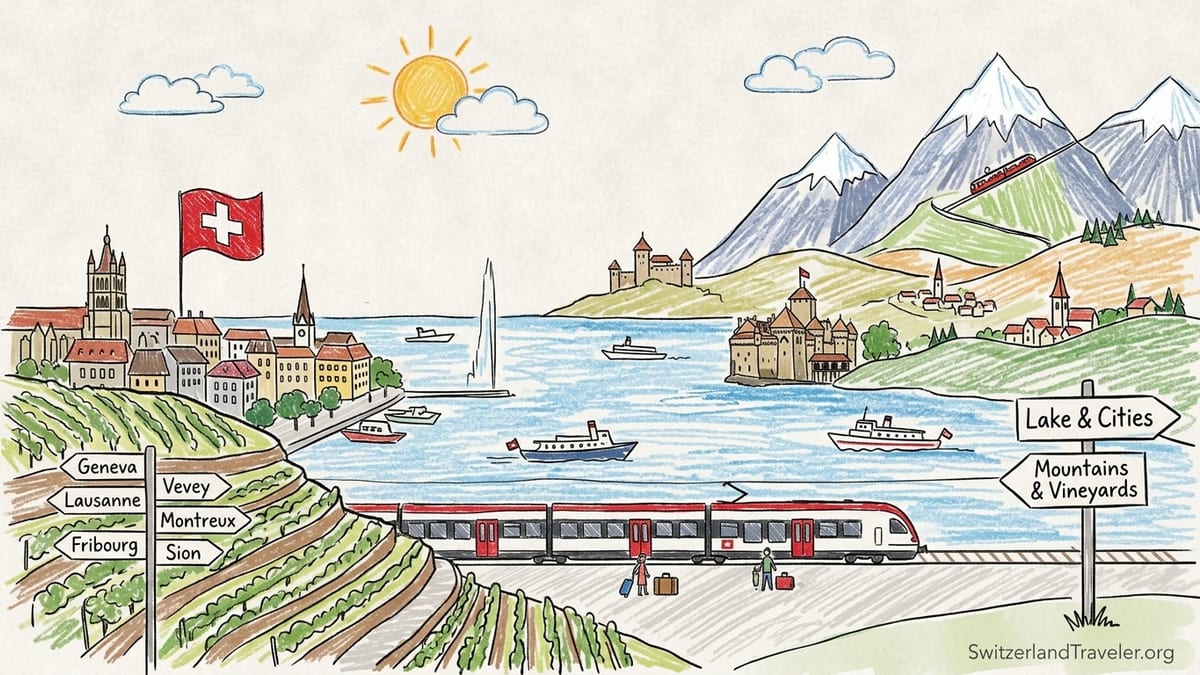
How to Structure a Trip in French-speaking Switzerland
The key decision for this part of Switzerland is where to base yourself. Geneva, Lausanne, Vevey or Montreux, Fribourg, Neuchâtel and Sion all work as practical hubs with strong rail connections. From any of these, you can reach smaller, more rural destinations like Gruyères, Lavaux’s vineyard villages or the Creux du Van on easy day trips. That means you spend less time packing and more time actually walking lakesides, tasting wine or hiking ridge trails.
As an example, many visitors pair three nights in Geneva or Lausanne with two or three nights further east in Vevey or Montreux, then add a night or two in either Fribourg, Neuchâtel or Sion for a different landscape and culture. A traveler arriving by plane into Geneva might spend day one around the Jet d’Eau and Old Town, day two in Lausanne and Lavaux, day three around Montreux and Chillon Castle, and then move inland to medieval Fribourg, alpine Gruyères or south to Sion for vineyards and mountain views.
Public transport is reliable and frequent. A regional train from Geneva to Lausanne typically takes about 40 minutes; Geneva to Montreux is around 1 hour 15 minutes on direct services; Lausanne to Sion is roughly 1 hour. These short hops make it viable to base in one place and still see multiple regions. If you plan several rail days, many travelers find that a Swiss Travel Pass or a canton-specific pass for Vaud or Valais pays off, especially when it includes discounts on lake cruises and mountain transport.
Costs can be high, so using bases strategically helps control your budget. Staying in business-focused cities like Geneva from Friday night into Sunday can be cheaper than midweek, while smaller towns such as Vevey, Fribourg or Neuchâtel often offer better value year-round than the most famous resort villages. Self-catering apartments close to train stations are common and can quickly balance out the price of dining out, especially in wine regions where a simple picnic in the vineyards feels like a highlight in itself.
Geneva: International Hub and Short-Stay Base
Choose Geneva when you want an easy international arrival, a compact city experience and a soft landing before exploring the rest of French-speaking Switzerland. The city’s airport connects widely across Europe and has its own rail station, with trains to Geneva main station usually under 10 minutes. For a short stay, the lakefront, Jet d’Eau and the Old Town fit naturally into a walkable loop. Many visitors combine a morning around the Jardin Anglais and Flower Clock with an afternoon climbing the tower of St Pierre Cathedral for a view over red roofs, the Rhône and distant mountains.
Geneva works best as a base for two or three nights. From here, you can add a lake cruise without giving over an entire day. Short cruises typically last between one and two hours and run frequently in season, allowing time for an evening swim at Bains des Pâquis or a stroll through the Parc de la Perle du Lac. Public boat-bus services on the lake, known locally as Mouettes, count as regular public transport, so a city ticket or hotel transport card will cover quick crossings between the two shores.
The city also serves as a springboard for cross-border and mountain excursions. While this guide focuses on French-speaking Switzerland, it helps to know that day trips to Chamonix or Annecy in nearby France are common and usually under two hours from central Geneva by coach. Within Switzerland, you might use one day to visit Lausanne and Lavaux by train, returning to Geneva the same evening. A traveler with only three full days could easily experience two countries, one lake city and at least one vineyard region without moving hotels more than once.
Neighborhoods like Carouge, just a 10 to 15 minute tram ride from the center, give Geneva a more local and Mediterranean-feeling side. Its Sardinian-era streets, independent boutiques and café terraces are a strong contrast with the international district around the Palais des Nations and the Red Cross Museum. If you book accommodation in the Plainpalais or Carouge area rather than right at the station, you often find more characterful hotels and apartments at comparable or lower prices, and you still stay within easy reach of trams and the lake.
Lausanne and Lavaux: Cultural Capital and Vineyard Slopes
Lausanne makes sense as a base when you want an energetic city with steep streets, nightlife and culture, plus fast access to the lake and Lavaux vineyards. The city climbs sharply from the lakeside at Ouchy up to the Gothic cathedral and pedestrian shopping streets. That vertical layout means many hotels and apartments come with lake views, even several blocks back from the shore. The metro line that runs between the lakeside and the upper town keeps the hills manageable and connects directly to the main train station.
Travelers interested in Olympics history often visit the Olympic Museum in Ouchy, pairing it with a lakeside lunch and a short cruise. Prices for museum admission are typically similar to other major European city museums, so a family can budget for an afternoon there much as they would for a major exhibition in Paris or Berlin. At night, the Flon district above the station fills with bars and restaurants that stay open later than many lakeside towns, making Lausanne attractive for visitors who want more evening energy.
Lavaux, a UNESCO-listed terraced vineyard landscape stretching roughly between Lausanne and Montreux, works best as an excursion rather than a base, due to its small village size and limited accommodation. From Lausanne, frequent local trains bring you in under 15 minutes to villages such as Lutry, Cully or Saint-Saphorin. Some travelers ride the so-called “train of the vines,” the regional line between Vevey and Puidoux that climbs through the terraces and stops at small stations with direct access to hiking paths and cellar doors.
On the ground, a typical Lavaux day might involve taking a morning train from Lausanne to Cully, walking the vineyard path toward Rivaz or Saint-Saphorin, stopping at a cellar for a glass of Chasselas, then continuing to Vevey by train or boat. Tastings at smaller cellars often cost less than in famous international wine regions, though advance reservations are wise on weekends and during harvest. Because the vineyards are exposed, it is worth planning for hat, sunscreen and enough water, especially in July and August when temperatures on the terraces can feel significantly warmer than in the shade of Lausanne’s streets.
Vevey & Montreux: Riviera Feel and Mountain Gateways
Vevey and Montreux share the same sweep of Lake Geneva shoreline, but each offers a distinct reason to choose it as a base. Vevey feels more low-key and residential, with a large market square, lakeside promenades and a compact Old Town. Montreux leans more toward resort style, with grand Belle Époque hotels, a long lakefront lined with flower beds and easy access to mountain railways. Both towns sit on the main rail line, with frequent trains to Lausanne, Geneva, and inland toward the Alps.
Choose Vevey when you prefer a quieter base that still has strong food and wine options. Many apartments here sit only a few minutes’ walk from the lake and station, which is ideal if you plan to travel by public transport. Grocery stores and weekly markets on the central square make self-catering straightforward, and the lakeside is rarely as crowded as Montreux in high summer. Families often appreciate the playgrounds along the promenade and the ease of catching short boat rides to nearby villages.
Montreux works well for travelers looking for lake views plus quick access to classic excursions like Chillon Castle and the Rochers-de-Naye mountain railway. The walk from Montreux along the shoreline to Chillon takes about 45 minutes at an easy pace, passing lakeside sculptures and swimming spots. In summer, combined tickets that include castle entry and boat or train transport are widely available, offering modest savings over booking each piece separately. The rack railway up to Rochers-de-Naye brings you to over 2,000 meters, where you can step off into cool air and alpine views even on a hot July afternoon by the lake.
Vevey and Montreux also sit at the eastern edge of Lavaux, making them natural bases if vineyard walks are central to your trip. A visitor could, for example, spend a morning in the Lavaux terraces above Rivaz, descend to the lake for lunch, then board a boat back to Montreux in time for a sunset drink on a hotel terrace. Because these towns are smaller than Geneva or Lausanne, accommodation can sell out earlier for major events such as the Montreux Jazz Festival in early July, so booking several months ahead is wise if your dates are fixed.
Gruyères, Fribourg & Rural Excursions
Gruyères is one of French-speaking Switzerland’s most photographed villages, a compact medieval town on a hilltop in the canton of Fribourg. It works best as a day trip rather than a base, primarily due to its small size and visitor numbers. From both Montreux and Lausanne, regional trains connect to Gruyères in around 1 hour 30 minutes, usually with a change at Montbovon or Bulle. On arrival, most visitors walk up from the station past the cheese dairy to the car-free main street, lined with restaurants serving fondue and raclette, and on to the château at the top.
A typical visit combines the demonstration dairy at La Maison du Gruyère, the château museum and time for lunch on the cobbled square. Prices in the dairy restaurant are generally lower than in high-end Geneva or Lausanne dining rooms, so it can be a good place to experience a full fondue without overspending. Just above the village, the small Moléson resort offers panoramic views of the Pre-Alps and family-friendly activities such as summer sled runs and mini-golf, accessible by bus and cable car from the Gruyères area.
Fribourg city itself is a compelling base when you want a bridge between French- and German-speaking Switzerland. The upper town sits on a loop of the Sarine River, with Gothic architecture, covered bridges and a steep funicular linking the higher and lower quarters. From here, trains run directly to both Lausanne and Bern in around 50 minutes, making it easy to explore two linguistic regions in a single stay. Accommodation prices in Fribourg are often a notch below the Lake Geneva hotspots, which appeals to travelers watching their budgets.
Using Fribourg as a base, you can easily visit Gruyères, the nearby Schwarzsee lake area or small countryside villages in La Gruyère region. Weekend bus timetables can be more limited than weekday commuter schedules, so checking departure times the day before and planning an earlier return is sensible. Visitors who rent a car for a couple of days often choose to do so in Fribourg or Bulle, where rental offices sometimes offer lower rates than the big Geneva airport locations.
Neuchâtel & Creux du Van: Lakeside Belle Époque and Jura Cliffs
Neuchâtel, on the shore of its namesake lake, provides a different personality from the Lake Geneva towns. The Old Town climbs from the lake up toward a château and collegiate church, with sandstone buildings that glow golden in late-afternoon light. Cafés and bars spill onto small squares, and the lakeside promenade feels more local than touristy outside peak weekends. Trains connect Neuchâtel to Lausanne in around 45 minutes and to Bern in roughly 30 minutes, making it an efficient base if you want to combine Jura landscapes with city visits.
The surrounding canton is known for precision industries and for the history of absinthe in the Val-de-Travers. Small distilleries still operate in that valley, and visitors can book tastings or short tours that explain how the drink returned to legality after decades of being banned. Combined tickets that include rail transport from Neuchâtel to Val-de-Travers plus entry to an absinthe experience are common, and they simplify logistics for travelers who prefer not to drive the winding Jura roads.
The Creux du Van, a vast natural rock amphitheatre in the Neuchâtel Jura, is one of the region’s signature hikes and works best as a day excursion from Neuchâtel or Lausanne. The cirque measures roughly 1.4 kilometers across and up to around 150 meters deep, with vertical cliffs that give sweeping views across forests and, in clear weather, toward the Alps. Most visitors access it by car or a combination of train and bus to trailheads such as Noiraigue or the Ferme Robert area, then hike up through forest and pasture to the rim.
Because the Creux du Van is a protected natural area without rail directly to the top, planning is important. Paths near the edge of the cliffs lack fencing in many places, so sturdy shoes and a realistic assessment of everyone’s comfort with heights are essential. In spring and autumn, the weather can change rapidly between the valley and the plateau; temperatures at the rim are often several degrees cooler than in Neuchâtel, and fog can move in quickly. Simple mountain restaurants around the plateau serve hearty dishes based on local cured meats and cheeses, and many travelers time their hike to arrive for a late lunch before heading back down.
Sion & Valais: Sun, Vines and Alpine Views
Sion, capital of the canton of Valais, offers a strong alternative base if your priority is wine country, sunshine and mountain excursions. The town is dominated by two hills topped with the Valère and Tourbillon sites, which give it a distinctive skyline visible from the train as you arrive. Walking time from the station to the historic center is around 10 minutes, and the compact streets are lined with wine bars and restaurants that pour regional specialties like Fendant and Cornalin. Valais is one of Switzerland’s driest and sunniest regions, and that climate is evident in the terraced vineyards that rise above the Rhône valley on both sides.
From Sion, local buses and small funiculars link quickly to vineyard villages and irrigation-channel paths known as bisses, where walking routes follow gentle gradients along old water channels. These walks are particularly appealing for visitors who enjoy scenery but prefer to avoid very steep ascents. Many are suitable from late spring through autumn, and some remain accessible in winter when higher alpine trails are under snow. Wine-tasting is straightforward to arrange through local tourism offices or directly with producers, although you should expect to make reservations in advance, especially on Saturdays.
Sion also works well as a base for day trips deeper into the Alps. Direct trains connect to resort towns like Zermatt and Crans-Montana via Visp and Sierre, often in under 90 minutes. That makes it possible to ride mountain railways or cable cars up to glacier viewpoints during the day and return to a more relaxed and less expensive valley base at night. In winter, skiers sometimes choose Sion for a long weekend, traveling up to different ski areas on consecutive days rather than committing to a single resort.
Compared with Geneva or Montreux, Sion feels distinctly Alpine and less international, which many travelers find refreshing after a few days around Lake Geneva. Restaurant menus lean heavily on local ingredients: cured meats, raclette cheese from nearby alpine pastures, and seasonal produce from the Rhône valley. Prices for a glass of local wine on a terrace here are often slightly lower than on the lakefront in Montreux, which adds up quickly over the course of several evenings.
Smaller Stops that Solve Specific Trip Needs
Beyond the main bases, a few smaller places in French-speaking Switzerland are worth including when they answer a particular travel need. In the Lake Geneva region, towns like Nyon and Morges provide quieter lakeside stops within 20 to 30 minutes by train from Geneva or Lausanne. They work well for travelers who want a final night closer to the airport without staying in a big city, or for those seeking a more local-feeling lake promenade with fewer hotel blocks.
In the Jura, villages in the Val-de-Travers such as Couvet or Fleurier are practical starting points for hikes to the Creux du Van or visits to absinthe distilleries. Accommodation options here are more limited than in Neuchâtel, but staying one night can reduce early-morning travel if you plan a full-day hike. Similarly, in the Gruyère region, Bulle makes a useful transit town with supermarkets, hotels and bus connections to Gruyères village and the surrounding countryside, though it has fewer sights than the hilltop village itself.
Travelers combining work and leisure sometimes look for places with good connectivity and a relaxed setting. Vevey and Neuchâtel are particularly strong for remote workers who need reliable rail access to Geneva or Bern but prefer a less intense atmosphere day to day. Both towns have lakeside cafés that serve as informal workspaces, and typical Swiss mobile data coverage is strong across the region, including many lakefront promenades and village squares.
If you are driving, parking can be challenging in compact historic centers like Geneva, Lausanne, Gruyères or Neuchâtel. Using park-and-ride facilities on the edge of town or choosing smaller bases such as Morges, Nyon or Bulle for nights when you have a car can reduce stress and cost. Many hotels in these smaller towns include discounted parking or simple on-site spaces, something less common at equivalent price points in central Geneva or Lausanne.
The Takeaway
French-speaking Switzerland rewards travelers who look beyond a quick circuit of Lake Geneva. By using a few well-chosen bases such as Geneva, Lausanne, Vevey or Montreux, Fribourg, Neuchâtel and Sion, you can link urban culture with vineyards, medieval villages and high Jura cliffs without long transfers. Each base offers a clear reason to choose it, whether that is international convenience, nightlife, quiet lakeside atmosphere, linguistic diversity or access to Valais wine country.
Excursions to places like Lavaux, Gruyères, the Creux du Van and the smaller lakeside or mountain villages fit easily into day trips from these hubs. The public transport network makes it realistic to travel between lake, vineyard and mountain in a single day, while still returning to the same hotel or apartment at night. With thoughtful planning around bases, excursions and your own interests, French-speaking Switzerland can deliver a varied and satisfying trip in as little as a week, or fill a longer itinerary with a mix of city streets, vineyard paths and alpine horizons.
FAQ
Q1. How many days do I need to see the highlights of French-speaking Switzerland?
Most travelers are satisfied with 7 to 10 days, which allows time for at least two bases, such as Geneva or Lausanne plus either the Vevey and Montreux area or Sion, and several day trips to places like Lavaux, Gruyères or the Creux du Van.
Q2. If I have only a long weekend, where should I base myself?
For a three-night stay, Lausanne or Vevey work well. Lausanne gives you city energy and fast trains to Geneva and Lavaux, while Vevey offers a calmer lakeside base with easy access to Montreux, Chillon Castle and the vineyards.
Q3. Do I need a car to visit Lavaux, Gruyères and the Creux du Van?
No, but it can be convenient. Lavaux and Gruyères are well served by trains and local buses from Lausanne, Vevey and Fribourg. The Creux du Van is more remote; you can reach trailheads by a mix of train and bus from Neuchâtel or Lausanne, but a car gives more flexibility with start times and routes.
Q4. Which city is better as a base, Geneva or Lausanne?
Geneva is best if you prioritize an easy airport connection, international institutions and a compact old town. Lausanne suits travelers who want stronger nightlife, a more local feel and faster access to Lavaux and the eastern side of Lake Geneva.
Q5. Is Sion worth including if I am already visiting Zermatt or other alpine resorts?
Yes, if you are interested in Valais wine and a less resort-focused atmosphere. Sion offers historic sites, vineyard walks and easier access to multiple ski or mountain areas, while still being on the main rail line for onward travel.
Q6. When is the best season to hike in Lavaux and around the Creux du Van?
Late April to October is generally the most comfortable period. Vineyards are green from late spring through early autumn, and the Creux du Van trails are usually clear of snow in this window, though conditions can vary with the year and altitude.
Q7. Are these regions suitable for families with children?
Yes. Gruyères and Moléson offer family-friendly attractions like a demonstration cheese dairy and summer sledding. Lake promenades in Vevey, Montreux and Neuchâtel have playgrounds and safe walking paths, and many trains and boats are stroller-friendly.
Q8. How expensive is eating out in French-speaking Switzerland?
Restaurant prices are generally high compared with many European countries. A main course in a mid-range restaurant often costs roughly what you would pay in an expensive Western European capital. To manage costs, many travelers combine picnics from supermarkets with a few sit-down meals focused on regional specialties like fondue, raclette and lake fish.
Q9. Can I visit non-French-speaking areas easily from these bases?
Yes. From Fribourg, Bern is around half an hour by train. From Neuchâtel, German-speaking cities such as Biel and Bern are also close. Day trips across the language border give a quick sense of Switzerland’s cultural diversity without changing hotels.
Q10. Do I need to book trains, boats and mountain railways in advance?
Regular intercity and regional trains usually do not require reservations, and you can buy tickets on the day. For popular lake cruises, scenic trains and some mountain railways in peak season, advance booking is recommended, especially if you are traveling on weekends or with a larger group.