


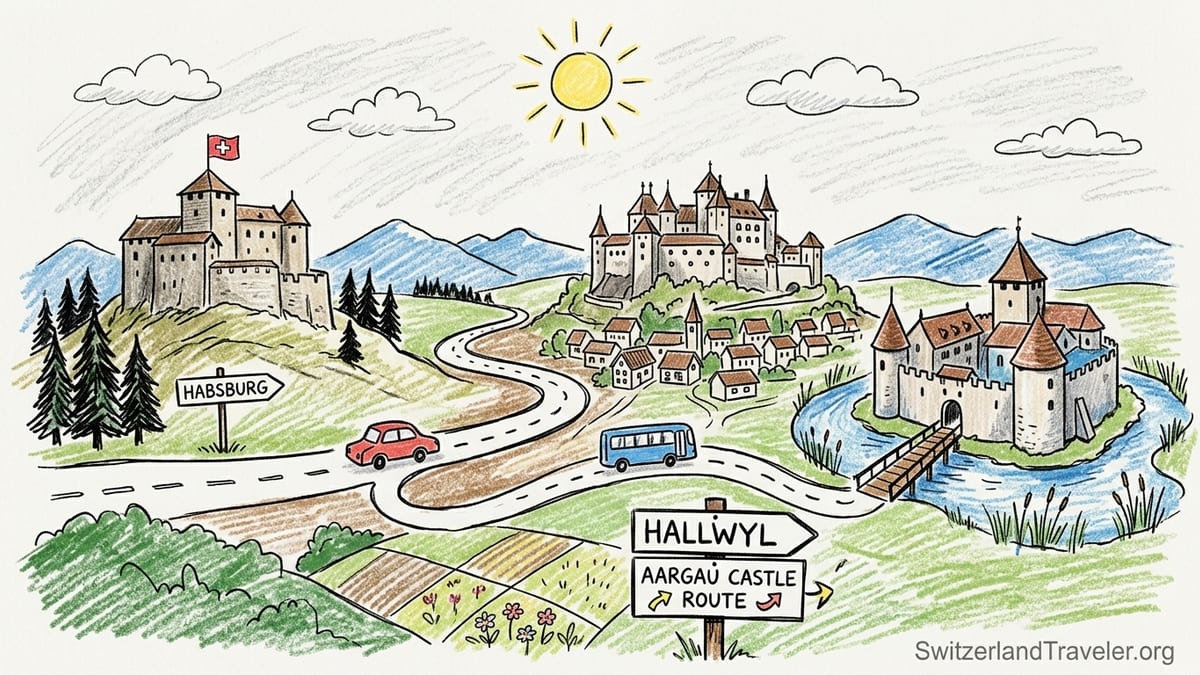
Aargau is one of those regions that surprises even seasoned Switzerland travelers. Between Zurich and Basel, many people simply stay on the motorway or in the train, unaware that a few kilometers away are hilltop fortresses, moated castles and monastic treasures that once shaped European power politics. The Aargau Castle Route turns this overlooked stretch of Mittelland into a compact heritage road-trip, linking the origins of the Habsburg dynasty with some of the country’s most atmospheric castles and a jewel of medieval stained glass.
Why Aargau Is Switzerland’s Castle Country
The official Tour of Aargau promoted by regional and national tourism bodies describes the canton as a crossroads of Roman roads, Habsburg power, medieval aristocracy, monasteries and fortress towns. That description is not marketing exaggeration. Within an area you can comfortably traverse in a day by car, you can stand where the Habsburg story began, wander through one of Switzerland’s largest hilltop castles, cross wooden bridges into a picture-book moated fortress and end the day in a quiet abbey choir surrounded by 14th century stained glass.
Unlike generic “best of Mittelland” lists that mix lakes, towns and viewpoints, an Aargau castle trip works because it is thematically tight. Every stop you make on this route tells a different chapter of the same story. Habsburg Castle explains how a minor local dynasty became a European superpower. Lenzburg demonstrates what a major medieval fortress and aristocratic residence looked like. Hallwyl shows the defensive and prestige value of a watery setting, while Königsfelden Abbey brings in piety, royal murder and high medieval art all at once.
This density matters when you are planning a short trip from Zurich, Basel or Bern. You do not have to choose between scenery and substance. The landscapes are bucolic rather than dramatic, with soft hills, patchwork fields and the distant Jura, but almost every viewpoint comes with a tower parapet, castle courtyard or cloister attached. For travelers who like their road-trips to be about heritage as much as horizons, Aargau is one of Switzerland’s most satisfying regions to explore.
The practical side also works in your favor. The three flagship castles on this route, Lenzburg, Hallwyl and Habsburg, are all part of Museum Aargau or partner institutions, which means coordinated seasonal opening times and a shared “3 Castles Pass” covering entry to Lenzburg, Hallwyl and Wildegg. In 2026, Lenzburg and Hallwyl are open from 1 April to 1 November, Tuesday to Sunday, generally from 10:00 to 17:00, with adults paying around 14 Swiss francs for full castle and museum access and families benefiting from reasonably priced family tickets. Always check current details before travel, but you can plan a spring to autumn castle-focused road-trip with confidence.
Habsburg Castle: Where an Empire Began
No Aargau castle route is complete without starting at Habsburg Castle, the modest but atmospheric hilltop stronghold that gave its name to one of Europe’s most powerful dynasties. Sitting on a wooded ridge above the Aare valley in the small village of Habsburg, the site dates back to around the 11th century and was the original seat of the counts who would eventually become Holy Roman Emperors and rulers of a vast European empire. Today it feels almost rural compared to the grandeur associated with later Habsburg palaces, which is precisely what makes a visit compelling.
Habsburg is operated as a site of Museum Aargau, with exhibitions explaining the early history of the dynasty, local archaeology and castle life. The complex is smaller than Lenzburg or Hallwyl, but the interpretation is engaging and designed to be accessible for families as well as history enthusiasts. You can climb up to vantage points over the Aare valley and the Jura hills, wander through courtyards and reconstructed interiors, and follow discreet panels and multimedia elements that explain how a frontier stronghold became the springboard for imperial ambition.
Access is straightforward by car, with signposted parking close to the castle. Drivers from Zurich typically exit near Brugg and follow local roads up to Habsburg in under an hour, traffic permitting. From Basel, you reach it via the A3 and then local roads in roughly a similar time. Public transport travelers can take trains to Brugg or Wildegg and connect by bus to Habsburg village, then walk up to the castle in about 10 to 15 minutes. The ascent is short but includes some gradient, so comfortable shoes are worthwhile.
Habsburg is less about spectacular interiors and more about context, views and storytelling. If your schedule is tight, you may choose to focus on the exterior and the panorama, but the museum exhibits give useful background for the rest of the route. An hour is usually sufficient for a first visit, perhaps 90 minutes if you engage fully with the displays or join a guided tour. Because the site is relatively compact, it also suits families with younger children who may not manage longer visits elsewhere. Combined with a coffee or simple meal at the onsite restaurant or nearby inns, it makes a relaxed historical starting point before you continue deeper into Aargau.
Lenzburg Castle: Hilltop Fortress and Living History Museum
From Habsburg, your route naturally leads to Lenzburg Castle, often described as one of the largest and most important hilltop castles in Switzerland. Perched prominently above the small town of Lenzburg, it was originally built in the 11th century as the seat of the Counts of Lenzburg and later passed through the hands of the Kyburg, Habsburg and Bernese authorities. Today it houses major exhibitions of Museum Aargau and offers one of the most complete castle experiences in the country, mixing archaeology, period rooms, interactive displays and family-focused exhibits.
Lenzburg’s 2026 season runs from 1 April to 1 November, Tuesday to Sunday and on public holidays from 10:00 to 17:00. Museum Aargau lists the full castle complex and museum entry at around 14 Swiss francs for adults, 10 francs for students up to 26 and 8 francs for children aged roughly 4 to 16, with family tickets in the range of 25 to 35 francs depending on whether one or two adults are included. The same organization offers a 3 Castles Pass that includes Lenzburg, Hallwyl and Wildegg for a combined price, which is attractive if you are planning a dedicated heritage weekend.
Approaching Lenzburg is part of the appeal. Drivers can park in marked lots below the castle or in town and then walk up. The final approach is via steep cobbled paths and stone steps, winding between old town houses and through forested slopes, so allow at least 15 to 20 minutes from the lower car parks, a little more if you stop for photographs. By train, Lenzburg is well connected, with regular services from Zurich taking about 20 minutes and from Basel or Bern around an hour with at least one change. From Lenzburg station it is roughly a 20 to 30 minute uphill walk; those with limited mobility may prefer to use local buses or taxis to get closer to the castle entrance.
Once inside, you move through courtyards, defensive walls and residential wings that reveal different eras of castle life. There are exhibitions on medieval arms and armor, noble domestic interiors, regional history and the later period when the castle became a private residence for wealthy families, including an American owner in the 19th and early 20th centuries. Children are particularly well served, with hands-on displays, themed rooms and activity stations that allow them to dress up, try period games or learn about daily life in earlier centuries. Special events, such as medieval markets or seasonal family programs, are common across the Museum Aargau sites, so if your trip coincides with one, you can expect costumed interpreters and extra activities.
Plan to spend at least two to three hours at Lenzburg if you want to see the main museum exhibits, explore the courtyards at a relaxed pace and stop for a drink in the bistro. Serious history enthusiasts or families taking advantage of all the activities can easily fill half a day. Photography is rewarding both inside the courtyards, where you can frame towers and walls against the sky, and outside on the ramparts, where there are classic views across the old town rooftops and the surrounding plateau. Tripods and drones are restricted; the castle specifically notes that drone flights around the hill are only allowed with written permission, and interior photography rules can vary by exhibition, so always follow on-site signs and staff instructions.
Hallwyl Castle: A Romantic Moated Fortress
If Lenzburg is the archetypal Aargau hilltop stronghold, Hallwyl is its romantic, watery counterpart. Situated near the northern end of Lake Hallwil, the castle sits on two small islands in the Aabach stream, surrounded by dark green water and reached via wooden and stone bridges. The effect is striking: rounded towers mirrored in the moat, half-timbered galleries overhanging the water and bridges leading through gate after gate into inner courtyards. It is one of the most important moated castles in Switzerland and arguably the most photogenic stop on this route.
Like Lenzburg, Hallwyl is a Museum Aargau site with coordinated opening times. For the 2026 season, official information indicates that the castle and its bistro are open from 1 April to 1 November, Tuesday to Sunday and on public holidays from 10:00 to 17:00. Admission to the full complex including museum exhibits is listed at about 14 Swiss francs for adults, 10 francs for students up to 26 and 8 francs for children from approximately 6 to 16, with family tickets around 25 to 35 francs. School groups and larger parties benefit from reduced per-person rates.
Access by car is straightforward, with signposted routes from Lenzburg and Seengen and parking near the entrance. The drive from Lenzburg takes about 15 to 20 minutes, making it an easy same-day pairing. By public transport, typical itineraries involve a train to Lenzburg, then a regional bus to Seengen or a nearby stop, followed by a short walk along signposted paths and lanes. The last stretch takes you through countryside and along the stream, building expectation as the castle towers come into view over the reeds and willows.
Inside Hallwyl, the experience is a mix of castle museum and evocative ruin, with intact buildings joined by wooden galleries and open sections that reveal older stonework. Exhibitions cover the history of the Hallwyl noble family, everyday castle life and the architecture of water castles. The route leads visitors across multiple bridges and through thick walls, so families with children often find it a natural adventure playground, though parents should keep a close eye on younger visitors near the water and stairs. Audioguides and panels add context without overwhelming the sense of place.
Photography at Hallwyl is exceptional. You can capture reflections of the towers and bridges in the moat, close-ups of rough stone and timber and atmospheric views through archways toward the surrounding wetlands. Morning and late afternoon light are particularly rewarding, with low angles accentuating textures and colors. Plan at least 90 minutes for a quick visit and closer to two or three hours if you want to explore thoroughly, visit the museum rooms and perhaps combine the castle with a lakeside walk or cruise on Lake Hallwil. For many travelers, Hallwyl is the emotional highlight of the route, the place they picture when they think back on their Aargau road-trip.
Adding Wildegg Castle and Königsfelden Abbey
While Habsburg, Lenzburg and Hallwyl form the core of most Aargau castle itineraries, adding one or two extra stops helps you appreciate the region’s broader heritage. Wildegg Castle, also a Museum Aargau site, sits on a terrace above the Aare near the village of Wildegg and offers a different angle on aristocratic life. Instead of a primarily medieval fortress, you find a baroque residential complex surrounded by terraced gardens, orchards and vineyards that look out over the river valley and the Jura. Interior rooms are furnished to evoke 18th and 19th century noble life, with period furniture, table settings and personal objects.
Wildegg pairs naturally with Habsburg, since they are only a short drive apart, and the castle is easy to reach by train from major cities via the Wildegg station, plus a walk or short bus ride uphill. Exact opening times and prices vary but generally align with the 1 April to 1 November Museum Aargau season and are similar to Lenzburg and Hallwyl. If you purchase the 3 Castles Pass that includes Lenzburg, Hallwyl and Wildegg, it becomes a cost-effective way to see three distinct castle types in one region: dynastic hilltop fortress, moated residence and baroque country seat.
Königsfelden Abbey, near Brugg and Windisch, introduces the ecclesiastical and memorial side of Aargau’s history without turning the itinerary into a church crawl. Founded in the early 14th century on the site where King Albert I of Habsburg was assassinated, the abbey became an important royal foundation and burial place. The surviving church is relatively austere on the outside, but inside the choir you find an extraordinary cycle of medieval stained glass windows dating from the 14th century, depicting biblical scenes, donors and saints in rich but harmonious colors.
Today Königsfelden is also managed within the Museum Aargau network, with visiting arrangements that often include guided tours or specific opening hours for the choir and glass. It is a much quieter site than the big castles, usually taking around 45 to 60 minutes to visit, but it adds emotional depth to the road-trip. Standing in the filtered light of the windows, you are reminded that the political and military histories told at Habsburg and Lenzburg were intertwined with dynastic tragedies and posthumous commemorations. Photography inside is often restricted or controlled to protect the glass; visitors are usually asked to avoid flash and to follow the guidance of staff regarding where pictures are permissible.
Because Königsfelden lies close to the transport hub of Brugg, it can be slotted into your route either at the beginning, before driving or taking buses to Habsburg, or at the end as a reflective final stop before returning to Zurich or Basel. Parking is available nearby and public transport links are good, making it an easy addition that requires relatively little extra planning.
Designing Your Aargau Castle Road-Trip
The beauty of the Aargau Castle Route is its flexibility. You can treat it as a single very full day, a relaxed weekend or a thread running through a longer Swiss itinerary. Distances between the main sites are short, with typical drives of 15 to 30 minutes on secondary roads, so you spend more time exploring than in transit. However, to do justice to the interiors, museums and walks, it is worth thinking realistically about how many castles to attempt in one day and what kind of travel you enjoy.
Travelers based in Zurich often choose Lenzburg and Hallwyl as a straightforward day trip by train and bus. A common pattern is an early train from Zurich Hauptbahnhof to Lenzburg, arriving mid morning, then walking or taking a taxi up to Lenzburg Castle for a two to three hour visit. After lunch at the bistro or in town, you continue by bus to the Hallwil area and walk to Hallwyl Castle for an afternoon visit, returning to Zurich in the early evening. This gives you one major hilltop fortress and one moated castle without needing a car, with enough time to see interiors rather than just courtyards.
Drivers have more options. A classic loop from Zurich might involve starting at Königsfelden Abbey, continuing to Habsburg for the dynastic origin story, crossing to Wildegg for a short garden and interior visit, then spending the afternoon at Lenzburg or Hallwyl. From Basel, you can make a similar loop in the opposite direction. Those coming from Bern might choose to focus on Lenzburg and Hallwyl and perhaps Habsburg on the way back. In each case, build in extra time for the walks up to hilltop castles, occasional roadworks on regional roads and breaks for photographs.
Parking is generally available at or near all the sites mentioned, though some car parks can fill on school holidays, sunny weekends and during special events. Expect to pay typical Swiss parking rates in town locations such as Lenzburg, while more rural sites may have free or low-cost parking. Public transport is reliable and a good option if you prefer to combine short walks with train and bus travel; Swiss national and regional passes can reduce overall costs, and Museum Aargau sometimes cooperates with Swiss Railways on combined ticket offers, so checking for RailAway deals before you travel can be worthwhile.
Time management is the main constraint. If you want meaningful interior experiences, allow roughly one hour for Habsburg, two to three hours each for Lenzburg and Hallwyl and at least 45 minutes to an hour for Königsfelden, plus driving or public transport time. That means a realistic maximum of three major sites in a single day if you like to absorb stories rather than rush photographs. For a slower pace, spread the route over two days, overnighting in Lenzburg, Aarau or on Lake Hallwil, which also allows you to experience the castles in different lights.
Family Experiences, Accessibility and Photography
Museum Aargau has built a reputation for family-friendly heritage experiences, and the castle sites on this route reflect that. At Lenzburg and Hallwyl in particular, exhibits are designed to be tactile and story-driven, with specific trails and activities for children. Special programming across the season often includes medieval-themed days, craft activities and storytelling sessions that help younger visitors connect with the sites. Information from the museum highlights that thousands of school classes use these castles as open-air classrooms each year, which gives a sense of how embedded they are in regional educational life.
Families considering whether to pay for interiors rather than settling for exterior views should note that the exhibitions are central to the experience at Lenzburg and Hallwyl. At Lenzburg, castle courtyards are impressive, but the furnished rooms, children’s areas and interpretive zones are where the site comes alive. At Hallwyl, the route through exhibitions takes you across bridges and into towers that are not accessible without a ticket. For Habsburg, much of the value lies in the historical interpretation, but travelers on very tight budgets or timelines could, in principle, enjoy some views and the general atmosphere with a shorter stop.
Accessibility varies by site. Castle hills and medieval staircases are inherently challenging, and while Museum Aargau improves access where possible, not every tower or gallery is reachable for visitors with limited mobility. Lenzburg notes that parts of the grounds are accessible for wheelchairs and that accessible restrooms are available, but several major exhibition areas can only be reached by stairs. At Hallwyl and Habsburg, similar limitations apply, though external paths and some indoor spaces may be adapted. For detailed, up-to-date information, it is sensible to consult accessibility resources and, if necessary, contact the site directly ahead of time.
For photographers, Aargau’s castles are rewarding but call for a respectful approach. Interior flash is often discouraged or forbidden to protect objects and maintain atmosphere, and tripods can be restricted, especially in smaller rooms and during busy periods. Exterior photography is generally welcomed, and the surroundings lend themselves well to natural light work. At Lenzburg, early morning or late afternoon light on the hill and old town makes for strong images. At Hallwyl, overcast days can actually enhance reflections in the water and avoid harsh contrast between white walls and dark moats. Habsburg offers panoramic shots over the Aare valley, especially if you are prepared to walk short additional paths along the ridge.
Many visitors are tempted to use drones to capture aerial views of moated castles and hilltop fortresses. However, at least one major site on this route, Lenzburg, explicitly restricts drone flights around the castle hill without written permission, and similar restrictions or general aviation rules apply elsewhere. For a stress-free visit, plan to work from ground level vantage points. With a moderate wide-angle lens, you can still capture whole courtyards and castle profiles, while a short telephoto is useful for details such as stained glass at Königsfelden (where photography rules must also be checked on site) or defensive features at Hallwyl.
The Takeaway
The Aargau Castle Route is not about ticking off the most famous Swiss icons or chasing high alpine drama. Instead, it offers a concentrated encounter with the layers of power, faith and daily life that shaped central Switzerland over nearly a thousand years. In one compact region, you can stand in the birthplace of the Habsburg dynasty, roam through one of the country’s largest hilltop fortresses, cross bridges into a storybook moated castle, stroll baroque terraces and step quietly into a choir bathed in 14th century colored light.
For history-focused travelers, this coherence is its greatest strength. Every visit builds on the last, with exhibits and viewpoints that refer back to names and events you met earlier in the day. For families, the mix of adventurous spaces, hands-on exhibits and short driving distances keeps energy levels positive. For photographers, the combination of hill, water, stone and glass offers countless compositions at every turn.
Whether you are based in Zurich, Basel or Bern, the castles of Aargau are close enough for a well-planned day trip yet rich enough to justify a dedicated weekend. With coordinated seasonal openings, clear signage, reliable public transport links and thoughtful interpretation, the region invites you to treat it not as a detour but as a destination in its own right. If you are looking for a road-trip that connects Europe’s grand narratives with quiet Swiss landscapes, Aargau’s castles belong high on your list.
In the end, what lingers is not just the sight of towers and walls but the sense of walking through spaces where fortune was made and unmade. From the modest ridge of Habsburg to the grand courtyards of Lenzburg, from the moated calm of Hallwyl to the luminous windows of Königsfelden, Aargau offers a heritage journey that feels cohesive, human and refreshingly different from standard sightseeing circuits.
FAQ
Q1: When is the best time of year to follow the Aargau Castle Route?
The main castle season runs roughly from 1 April to 1 November, when Lenzburg and Hallwyl are open from Tuesday to Sunday during the day. Within that window, late spring and early autumn are especially pleasant for walking approaches and photography, but summer offers more special events and family activities.
Q2: Do I need a car, or can I visit the castles by public transport?
You can visit the key sites by public transport. Lenzburg is on main rail lines from Zurich, Basel and Bern, and buses connect to Hallwyl and the surrounding villages. Habsburg, Wildegg and Königsfelden are also reachable via regional trains and buses, though a car offers more flexibility to link several locations in one day.
Q3: How much should I budget for castle admissions?
For 2026, adults typically pay around 14 Swiss francs per castle for full museum access, with reduced rates for students and children and family tickets around 25 to 35 francs. If you plan to visit Lenzburg, Hallwyl and Wildegg, a combined 3 Castles Pass offered through Museum Aargau can reduce overall costs.
Q4: Are the interiors worth paying for, or is it enough to see the castles from outside?
At Lenzburg and Hallwyl, the interiors and museum routes are central to the experience, giving access to courtyards, towers and exhibition rooms that you cannot explore otherwise. Habsburg is smaller but its interpretive displays help explain the dynasty’s origins. For travelers interested in history or visiting with children, paying for full entry is strongly recommended.
Q5: Is the route suitable for children and older travelers?
Yes, with planning. Museum Aargau designs many exhibits and events with families in mind, and children usually enjoy the bridges, towers and interactive elements. However, hilltop approaches, cobbled paths and stairs can be demanding for some older visitors or those with limited mobility, so allow extra time, use public transport or car drop-offs where available and focus on the most accessible parts of each site.
Q6: How much time should I allow for each castle?
As a guideline, plan about one hour for Habsburg, two to three hours for Lenzburg, two to three hours for Hallwyl, and 45 to 60 minutes for Königsfelden Abbey. Wildegg sits somewhere in between, often taking 90 minutes to two hours. These estimates include time for walking approaches, casual photography and a short café stop.
Q7: Can I combine the castles with other activities like hiking or lake cruises?
Yes. Short hiking trails link some sites to nearby towns and viewpoints, and Hallwyl sits close to Lake Hallwil, where seasonal boat services operate and lakeside paths invite gentle walks. Around Wildegg, terraced gardens and vineyard paths add scenic detours, while the ridges near Habsburg offer broader views of the Aare valley and Jura.
Q8: Are there food and drink options at the castles?
Both Lenzburg and Hallwyl operate bistros or cafés during opening hours, serving simple meals, snacks and drinks. Additional options are available in nearby towns such as Lenzburg, Seengen and Brugg. For flexibility, many travelers combine one sit-down meal with a picnic, especially when traveling with children or aiming to visit multiple sites in one day.
Q9: What should I know about photography and drone use?
Handheld photography is generally allowed outdoors and in many exhibition spaces, but flash and tripods may be restricted indoors. Drone flights are tightly controlled; at Lenzburg, for example, use of drones around the castle hill requires written permission, and similar constraints apply near other sites. Always follow local signage and staff guidance.
Q10: What is the best one-day castle itinerary from Zurich, Basel or Bern?
From Zurich, a strong one-day public transport option links Lenzburg Castle in the morning with Hallwyl Castle in the afternoon. With a car and an early start, you can add Habsburg or Königsfelden for context. From Basel and Bern, focusing on Lenzburg and Hallwyl still makes sense for a balanced mix of major fortress and moated castle, with the option of adding a brief stop at Habsburg if driving.