


Western Switzerland is compact enough for easy train-hopping yet varied enough to feel like several trips in one. Within ninety minutes you can glide from a glassy international lakefront in Geneva to terraced vineyards in Lavaux, a Belle Époque promenade in Montreux, storybook ramparts in Gruyères and sheer limestone cliffs at Creux du Van above Neuchâtel. The key is choosing the right bases and treating the rest as rewarding excursions. This guide focuses on Geneva, Lausanne, Lavaux, Montreux and Vevey, Château de Chillon, Gruyères, Fribourg, Neuchâtel and Creux du Van, showing how they fit together in a selective itinerary that highlights the contrasts between lake, city, vineyard and Jura plateau.
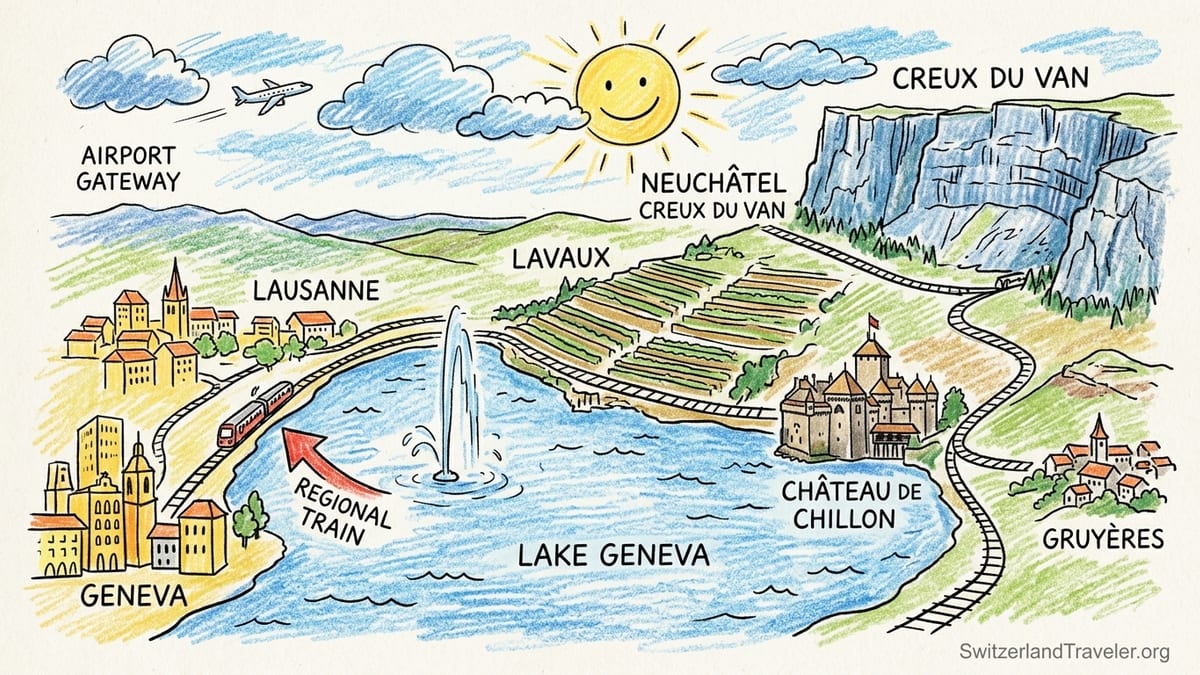
How to structure a Western Switzerland itinerary
Distances in Western Switzerland are short, but each area has a distinct character. Geneva and Lausanne sit at the western end of Lake Geneva, with frequent rail connections up and down the shore. Montreux and Vevey form the heart of the Montreux Riviera, a resort strip framed by steep hillsides and vineyards. Neuchâtel and Fribourg, to the north, open the door to the Jura plateau and quieter medieval quarters. Rather than changing hotels every night, most travelers do best with two or three bases and a handful of focused day trips.
For many visitors, Geneva or Lausanne works well as an arrival and departure hub, but they do not need to dominate your time. Geneva is the main international gateway, yet it is easy to continue directly by train to Lausanne in around 40 minutes or to Montreux in roughly 1 hour 15 minutes, often on the same ticket you used from the airport. From these bases, day trips to Lavaux, Vevey, Château de Chillon, Gruyères, Fribourg and even Neuchâtel are straightforward, with journey times commonly between 20 and 90 minutes.
If you want to feel the contrast between the Alps and the Jura, plan at least one move north to Neuchâtel. From there, Creux du Van becomes an achievable half or full day outing, revealing a very different landscape from the lakeside promenades farther south. With four to seven days, you can comfortably combine lakes, vineyards, castles and high cliffs without rushing.
Geneva and Lausanne: practical gateways, not the whole story
Geneva is often the first stop thanks to its busy international airport and direct rail links to Paris and Lyon. The city’s lakeside setting and fountain are photogenic, and a walk from the Jardin Anglais past the Jet d’Eau and into the Old Town gives a solid half day introduction. Prices for central hotels are typically among the highest in Switzerland, especially midweek when business travel peaks. As a result, many leisure travelers choose to spend just one night here at the beginning or end of their trip, or treat Geneva purely as a transit point and head straight to Lausanne or Montreux after landing.
Lausanne, about 60 kilometers along the lake, works far better as an overnight base for most people. It has a young, lived-in feel thanks to its universities, and the elevation change from the medieval Cité district around the cathedral down to the lakeside neighborhood of Ouchy gives it more visual drama than Geneva. You can spend a full day exploring the steep streets, riding the metro between Ouchy and the upper town, and visiting the Olympic Museum or the collection at Plateforme 10 near the main station. In the evening, wine bars around Rue de Bourg or the Flon district give a concrete sense of local nightlife that many visitors find missing in Geneva’s more reserved center.
Crucially, Lausanne positions you closer to the rest of the region. Local trains run every 15 to 30 minutes to Montreux, taking about 25 minutes, and to the Lavaux villages in as little as 10 minutes. If you base yourself around Lausanne’s main station or in Ouchy, you can walk to the platforms in a few minutes and step straight onto regional trains bound for Vevey, Fribourg or Neuchâtel. That convenience makes Lausanne a logical base for three or four nights, with Geneva functioning primarily as an entry and exit point.
Lavaux: terraced vineyards between lake and sky
Lavaux is one of Western Switzerland’s signature landscapes: around 800 hectares of terraced vineyards stepping down 30 kilometers of south facing slopes above Lake Geneva between Lausanne and Château de Chillon. Centuries of stone walls hold the narrow terraces in place, and small wine villages such as Cully, Epesses and Chexbres cluster at different levels above the water. The result feels like a Swiss take on the Amalfi coast, but with vines instead of citrus trees and a train line weaving through the terraces rather than clinging to cliffs.
Lavaux is small enough that you do not need to stay overnight to appreciate it. From Lausanne, local trains reach Cully or Epesses in under 15 minutes and Chexbres-Village in about 25 minutes. A popular real world routine is to board a late morning train to Cully, follow the clearly signposted vineyard paths toward Epesses and Rivaz, then either continue on foot or drop down to the lake to catch an afternoon train back. Along the way, simple cellars and tasting rooms offer glasses of local Chasselas with prices typically starting around 5 to 7 Swiss francs, alongside small plates of cheese or cured meats.
If you prefer more structure, many visitors book a two hour guided tasting in a village like Epesses or Lutry and combine it with lunch on a terrace above the lake. Although there are guesthouses and apartments in villages such as Grandvaux or Chexbres, transportation can be less convenient in the evening and services are limited. For most travelers, Lavaux works best as a day or half day excursion from Lausanne or Montreux, ideally timed for late afternoon when the low sun warms the stone walls and the lake reflects the golden slopes.
Montreux, Vevey and Château de Chillon: Riviera base and classic day trips
Montreux and Vevey share a sheltered stretch of Lake Geneva framed by steep hillsides and vineyard terraces, often marketed as the Montreux Riviera. Montreux feels slightly more resort oriented, with stately hotels and a long lakeside promenade dotted with sculptures. Vevey is a touch quieter and more residential, with a handsome market square and a strong link to Charlie Chaplin, whose former home is now a popular museum on the hillside above town. Both towns are connected by frequent trains and buses, and a level lakeside path links them on foot in just over an hour.
Either Montreux or Vevey makes an excellent base for two or three nights. Train connections to Lausanne take about 20 to 30 minutes, and slow regional trains up into the hills link to destinations such as Les Avants and the Rochers de Naye rack railway. In practical terms, staying near Montreux’s main station or Vevey’s lakeside means you can leave your hotel after breakfast and be at Lavaux trailheads, Gruyères or Fribourg before midmorning. Accommodation ranges from Belle Époque grand hotels to modest family run places a few blocks inland, and prices are often slightly lower than equivalent lakefront options in Geneva.
Just a few kilometers from Montreux, Château de Chillon sits on a small rocky islet at the edge of the lake. Trains stop at Veytaux-Chillon, buses from Montreux and Vevey drop passengers near the entrance, and lake boats dock at a pier next to the fortress, so it is easy to combine different modes of transport. Most visitors spend one and a half to two hours exploring its courtyards, towers and lakeside ramparts. A realistic day out from Montreux might involve a midmorning boat ride to the castle, an early afternoon visit, and then a leisurely lakeside walk back along the scenic shore path, catching a bus if legs get tired. Because of the limited interior space and cobbled passages, Chillon is best treated as a focused excursion rather than a full day, leaving time for a stroll along the Montreux promenade or a late afternoon drink in Vevey.
Gruyères and Fribourg: medieval hill towns as rewarding excursions
Heading inland from the lake, the small medieval town of Gruyères and the larger city of Fribourg show a more rural, traditional side of western Switzerland. Gruyères sits on a low hill above the Sarine valley, its cobbled main street leading to a castle with panoramic views. The village itself is compact enough to cross in five minutes, which is part of its charm but also why it works so well as a half day trip rather than a base. In practice, many visitors combining the region take a morning train from Montreux or Lausanne, arrive just before the main tour buses, and then leave by midafternoon once the cobbles begin to fill.
Real world routines here often revolve around cheese. The demonstration cheese dairy near the train station shows the basic steps of making Gruyère AOP, with tastings and small plates available in the adjoining restaurant. Up in the village, traditional restaurants serve fondue and raclette to shaded terraces, with prices for a shared fondue pot for two typically starting around 28 to 35 Swiss francs per person. For contrast, some visitors duck into the H. R. Giger museum and its bar, where biomechanical designs and sculpted chairs provide an unexpected counterpoint to cowbells and chalets.
Fribourg, about 30 minutes by train from Gruyères’ regional hub of Bulle or about an hour and a quarter from Montreux with one change, is larger and far more suited to an overnight stay. The upper town sits on a rocky spur above the Sarine River, with the Gothic cathedral tower and bridges defining the skyline. The lower town, or Basse-Ville, preserves timbered houses and riverside lanes. Visitors with time often walk between viewpoints on the city walls, step inside the cathedral to see its stained glass, and then descend to the river for a quieter perspective. With a dense center, varied dining options and good onward train links, Fribourg is best seen either as a full day excursion from Montreux, Vevey or Lausanne or as a one or two night stop when heading toward Bern or central Switzerland.
Neuchâtel and Creux du Van: a different world in the Jura
North of the main lake corridor, Neuchâtel shifts the mood. The town rises from a broad lakeshore into a honey colored old town and a hilltop castle, with the Jura mountains forming a blue backdrop. Travel times from Lausanne or Fribourg are usually between 45 and 75 minutes by direct or one change trains, making Neuchâtel feasible as either a long day trip or a distinct base for a night or two. Staying near the station or within the old town reduces the need for local buses and puts the lake promenade, restaurants and departure points for Jura excursions within walking distance.
Neuchâtel is the most practical base for exploring Creux du Van, a striking natural amphitheater etched into the limestone of the Jura. The cirque is roughly 1400 meters wide and around 150 meters deep, with cliffs more than 160 meters high forming a vast horseshoe above the Val de Travers and Lake Neuchâtel. From the rim, on a clear day, you can look across a patchwork of fields and forests to the line of the Alps, while closer ridges of the Jura roll away to the horizon. The contrast with the cultivated vineyards of Lavaux or the manicured promenades of Montreux is immediate and memorable.
There are two main ways visitors reach Creux du Van in practice. Hikers often take a regional train from Neuchâtel to Noiraigue and follow marked trails that climb through forest and pasture to the rim, typically requiring three to four hours of steady walking with a substantial elevation gain. Others opt for buses or cars up to farmsteads such as La Ferme du Soliat, from which it is only a short walk to viewpoints along the edge. In all cases, sturdy footwear, layers and caution near the unfenced cliff edge are essential, and conditions can change quickly even in summer. Because of its location and hiking times, Creux du Van works best either as a full day outing or, at minimum, a long half day from Neuchâtel rather than from the Lake Geneva bases.
Choosing your bases vs planning excursions
With so many appealing places in a compact area, it is tempting to change hotels frequently. In practice, travelers usually enjoy Western Switzerland more by selecting two or three strategic bases and treating most other places as day trips. Geneva functions best as a short stop or transit hub at the start or end of the journey. Lausanne, with its metro, central station and proximity to Lavaux, makes a strong candidate for a three or four night base if your focus is Lake Geneva and vineyards. Montreux or Vevey pair well with Lausanne, especially if you want an easy walk to the lakeside and quick access to mountain railways.
To experience the northern side of the region and the distinctive Jura landscapes, adding Neuchâtel as a final base for one or two nights gives you reasonable time for Creux du Van and a stroll through the old town. Fribourg, while close enough for a day trip from the lake, can also replace Neuchâtel as a base if your onward route leads toward Bern, though in that case you would likely visit Creux du Van as a long day outing with an early start. Smaller places such as Lavaux villages, Gruyères and the surroundings of Château de Chillon are consistently better handled as excursions so that you can enjoy their atmosphere without worrying about limited evening services or infrequent late night connections.
Concrete itineraries that work well in real life include combinations such as three nights in Lausanne, two in Montreux and one in Neuchâtel, or four nights split between Lausanne and Montreux with a separate one or two night detour to Fribourg. In each scenario, days are anchored by a clear base but filled with contrasting excursions: one afternoon among the Lavaux vines, another inside the halls of Château de Chillon, a morning in the medieval streets of Gruyères and a full day above the cliffs of Creux du Van. The goal is not to tick off every viewpoint, but to let the variety of landscapes sink in without constant packing and unpacking.
FAQ
Q1. Is Geneva or Lausanne a better base for exploring Western Switzerland?
For most leisure travelers, Lausanne is the better base. It has a more compact, lively center, easier access to Lavaux and quicker connections to Montreux, Vevey, Fribourg and Neuchâtel, while Geneva is best treated as an arrival and departure hub with perhaps a short stay.
Q2. Do I need a car to visit Lavaux and Creux du Van?
You can comfortably reach Lavaux by train and on foot from bases like Lausanne or Montreux, and many travelers hike or use public transport to reach Creux du Van from Neuchâtel. A car is convenient for flexible timing, especially for shorter walks from farms near the Creux du Van rim, but it is not essential.
Q3. How many nights should I spend in Montreux or Vevey?
Two or three nights in either Montreux or Vevey works well. That allows time for a relaxed lakeside day, a visit to Château de Chillon and at least one excursion inland or up into the nearby hills, without feeling rushed.
Q4. Is Gruyères worth an overnight stay or just a day trip?
Gruyères is compact and most visitors find a half day to be enough for the cobbled village, castle and a meal featuring local cheese. Because evening services are limited and nearby towns have more accommodation, it usually functions best as a day trip from Montreux, Vevey, Lausanne or Fribourg.
Q5. What is special about Creux du Van compared with the Alps?
Creux du Van is a vast natural amphitheater carved into the Jura plateau, with cliffs more than 160 meters high and panoramic views across lakes, the distant Alps and rolling Jura hills. Its open grassy tops, limestone edges and forested slopes feel very different from the sharper Alpine peaks and cultivated vineyards near Lake Geneva.
Q6. Can I visit Château de Chillon and Lavaux on the same day?
Yes, many travelers combine both. For example, you might spend a late morning at Château de Chillon reached by boat or train from Montreux, then return to Lausanne or Vevey and take an afternoon train into Lavaux for a vineyard walk and an early evening tasting before heading back to your base.
Q7. Is Neuchâtel a good place to stay, or only for a day trip?
Neuchâtel is an excellent overnight base if you want to explore the Jura and Creux du Van. One or two nights gives you time for a full day hike or scenic outing to the cliffs, plus a relaxed walk around the old town and along the lakefront.
Q8. What time of year is best for visiting Lavaux and the Montreux Riviera?
Late spring through early autumn is ideal. From May to October, vineyards are green, lake boats run regular schedules, and outdoor terraces in Montreux, Vevey and the Lavaux villages are open. Harvest season in early autumn adds color but can be busier and more expensive.
Q9. Are these destinations suitable for travelers without hiking experience?
Yes, as long as you choose routes carefully. Lavaux offers gentle vineyard paths and lakeside promenades, while Montreux, Vevey, Geneva, Lausanne, Gruyères, Fribourg and Neuchâtel all have central areas that are easy to enjoy on foot. For Creux du Van, non-hikers often choose shorter walks from higher trailheads, but should still be cautious near the cliff edges.
Q10. How expensive is Western Switzerland compared with neighboring countries?
Western Switzerland is generally more expensive than nearby parts of France or Italy, especially for hotels and restaurant meals. Travelers often manage costs by choosing midrange accommodation a few blocks away from prime lakefronts, using fixed-price lunch menus, and relying on the extensive public transport network instead of taxis.