

I have been to Ticino, the Italian-speaking corner of Switzerland, several times, always torn between lakefront dolce vita and jagged alpine valleys. On my most recent trip I focused on the stretch from Lugano to the Ascona–Locarno region, and I kept asking myself a simple question after each activity: would I genuinely do this again with my own money and limited vacation days? The answer was not always yes. What follows is a candid account of the experiences I actually completed, what they cost, how long they took, how crowded they felt, and which ones I am already plotting to repeat.
Strolling Lugano’s Lakefront From Parco Ciani to Paradiso
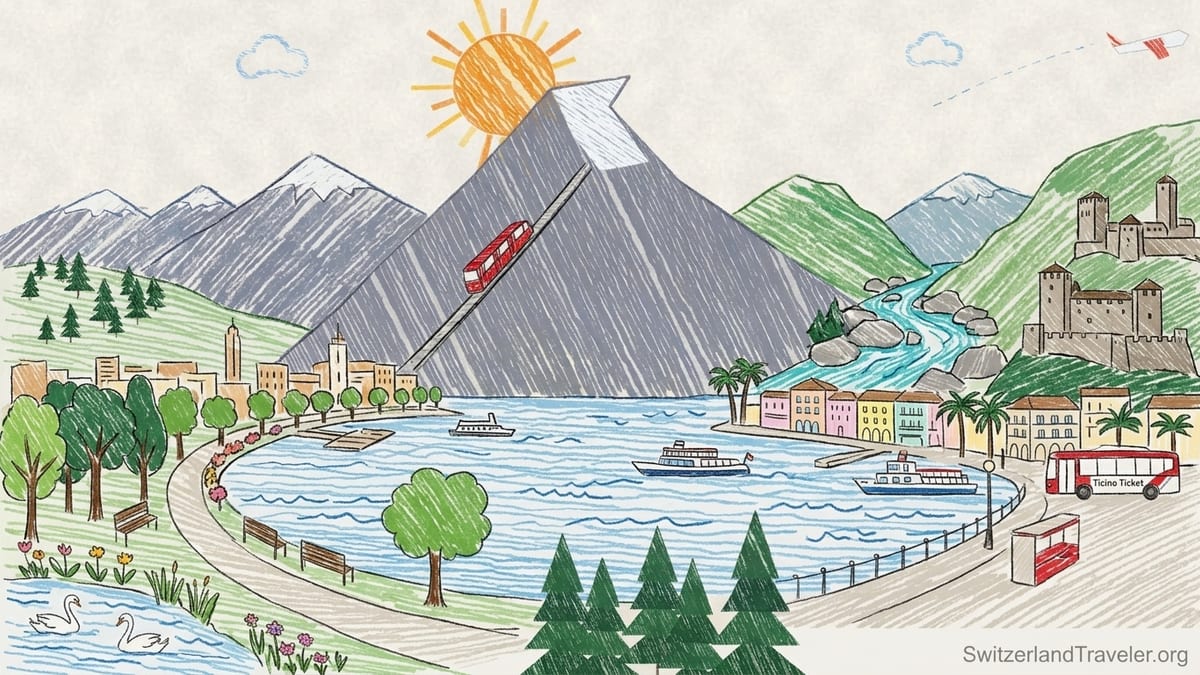
On my first afternoon in Lugano I did something delightfully simple: I walked the lakefront from Parco Ciani to Paradiso and back. I started near the Cantonal Library and entered Parco Ciani, the historic city park with lawns, flowerbeds and lakeside benches under plane trees. The route hugs the shore of Lake Lugano, with regular openings in the balustrade where you can look down at the water and the swans. I continued past the municipal lido and the small pier where boats of the Lake Lugano Navigation Company arrive and depart, then followed the promenade all the way south through the neighborhood of Paradiso, with Monte San Salvatore rising steeply behind the hotels.
In practical terms this walk cost me nothing but time and an espresso. I spent about two hours including photography stops and a coffee at a bar close to the Lugano Centrale funicular. I visited in early September, arriving around 4 p.m. The first stretch through Parco Ciani was lively but not packed, with families and joggers. Closer to Paradiso there were noticeably more hotel guests and people waiting for lake cruises, but I never felt hemmed in. The biggest variable is the weather. On my sunny afternoon the lake was a mirror and the mountains were crisp. On a previous winter visit the same walk felt much more subdued and grey, so I now try to time it for late afternoon golden light.
Transport is straightforward. I reached Parco Ciani on foot from the old town after taking the short funicular up from Lugano’s main railway station. Because I stayed in Ticino overnight, I had the Ticino Ticket from my hotel, which gave me free local public transport including the city buses. I used it later that evening to ride a bus back from Paradiso when a brief shower rolled in and I did not feel like retracing my steps. Would I repeat this lakefront stroll? Absolutely. It is the one experience in Lugano that fits any itinerary, costs almost nothing, and works with kids, older travelers and solo visitors alike.
The only change I would make next time is to add a structured stop. I would either plan a gelato break near the main square or time my walk to connect with a short sunset cruise, since many boats depart right from the same waterfront I was already using as my sidewalk.
Riding the Monte Brè Funicular for Views Over Lake Lugano
The following morning I headed for Monte Brè, the panoramic mountain that towers over Lugano. I reached the lower funicular station at Cassarate by city bus using my Ticino Ticket, then bought a return ticket for the two-section funicular that climbs from the lakeside up to the village of Brè sopra Lugano. The company that runs the line publishes prices that, on my visit, were a little over 30 Swiss francs for a round trip adult ticket from Cassarate to the top, with discounts for holders of Swiss nationwide rail passes. The ride itself took about 15 minutes including the mid-station change, and there were departures roughly every half hour during the main season.
I chose a mid-morning slot around 10:30 a.m. on a clear weekday. The lower section was moderately busy with day trippers, but the upper section thinned out, and at the summit I had no trouble finding a bench facing the water. The views are the real reason to come. From the top terrace and the short path above it, you look down across Lake Lugano, the city, and the folded green ridges that head toward Italy. I spent a little over an hour walking the marked viewpoints, taking photos and sitting with a coffee at the summit restaurant. It would have been easy to stretch that into a half-day with a hike, such as walking down toward Gandria, but on this trip I kept it simple.
Accessibility and logistics were easy. From central Lugano I took a bus along the lakeshore to Cassarate, walked a few minutes to the base station, and bought my ticket on site. On busy summer weekends it is wise to allow extra time or consider buying in advance through Swiss railway channels, but when I visited outside peak holiday periods I was able to board the next departure. Would I repeat Monte Brè? Yes, though not every trip. For a first or second visit to Lugano, the combination of a classic funicular ride and an aerial view of the lake feels special enough to justify the cost, particularly if you can use the summit as a gateway to a longer hike.
If I returned in high season I would either go very early to catch softer light and smaller crowds, or plan it for late afternoon so that the sun illuminates the city and the western shore rather than glaring directly into my lens.
A Slow Day Between Ascona and Locarno on Lake Maggiore
After a couple of nights in Lugano, I moved to the Ascona–Locarno region on Lake Maggiore, which local tourism boards present as a contrasting destination. Lugano feels urban and businesslike along its shore, while Ascona and Locarno lean hard into a Mediterranean atmosphere, with palm-lined promenades and low pastel facades touching the water. I based myself near Locarno’s train station and spent one full day simply wandering between Locarno and Ascona along the lake and through the historic cores.
In the morning I started at Locarno’s Piazza Grande, the main square a few minutes from the station, then wandered down to the lakeside promenade where ferries for Lake Maggiore depart. I did not book a cruise that day, but I watched boats leave for the Brissago Islands and the Italian shore and made a mental note to return. I walked west along the flat lakeside path toward Ascona, a route that takes around 45 minutes at an unhurried pace. The path is almost completely level, with separate space for cyclists, and passes small beaches and lawn areas where locals sunbathe in summer.
Ascona itself feels more intimate than Locarno. The town clusters around a curved waterfront lined with restaurant terraces. I spent a couple of hours here, paying around 5 to 6 francs for a cappuccino at a lakeside cafe and a little more when I finally sat down for lunch at a simple grotto-style restaurant one row back from the water. In terms of crowds, Ascona’s promenade can be quite busy on sunny weekends, but during my shoulder-season visit in late May it felt lively rather than hectic. Prices reflected its resort character. A basic pasta dish cost me roughly 22 to 25 francs, and a scoop of gelato on the lakeside cost about 4 francs, not cheap but within the usual Swiss holiday range.
For transport back to Locarno, I used my Ticino Ticket to ride a regional bus that took about 15 minutes from the Ascona bus stop near the promenade back to Locarno station. Total out-of-pocket cost for the day, besides food and drink, was essentially zero. Would I repeat this slow Ascona–Locarno loop? Without doubt. It is exactly the kind of low-effort, high-reward day where you can adjust the pace to your mood, step onto a lake cruise at the last minute if the schedule lines up, or simply sip another coffee while watching the boats.
Exploring Locarno’s Old Town and Cardada Without Overplanning
On another day based in Locarno I decided to weave together the old town and a short mountain excursion above the city. I started again on Piazza Grande, which in everyday life functions as a relaxed plaza with arcades and cafes but is widely known for hosting the Locarno Film Festival in August. From there, narrow lanes climb uphill toward the Sanctuary of Madonna del Sasso, a pilgrimage church that overlooks the city. To save my legs I took the funicular from the base near the railway station up to the sanctuary level. A return ticket for this urban funicular was in the range of 7 to 10 francs, with discounts available using the Ticino Ticket.
At the top I visited the church, wandered through the cloisters and then stepped out to the main terrace. From here you can see Lake Maggiore, the flat delta of the Maggia River, and the mountains that funnel into the valleys behind Locarno. Entry to the sanctuary itself was free, and I spent about 40 minutes between the church, viewpoints and photographs. The crowds were manageable when I arrived around 9:30 a.m., mostly small tour groups and independent travelers.
From the sanctuary level there is a separate cable car system that continues uphill to Cardada and Cimetta, alpine viewpoints that the regional tourism board often highlights. I chose to ride only as far as Cardada, buying a ticket at the small station just uphill from the sanctuary. The return fare to Cardada was a few dozen francs, with price variations depending on season and any current offers. The ride took roughly five minutes and deposited me in a small mountain station area with a restaurant and signed walking trails. I walked an easy loop to the Cardada viewing platform, which stretches out above the forest with a view of Lake Maggiore and the Maggia delta below.
Door to door, from Locarno station through the funicular, sanctuary visit, cable car to Cardada, walk and coffee at the mountain restaurant, I spent around four hours. Crowds increased noticeably after 11 a.m., so if I repeated this I would aim to be on the first or second cable car of the day. Would I do it again? Yes, but selectively. The combination of historic sanctuary and quick access to a cooling mountain breeze is appealing, especially during summer heat, though families or groups on a tight budget might find the accumulated lift prices high compared with a pure valley hike.
Swimming and Walking in the Verzasca and Maggia Valleys
No part of this trip stuck in my memory as strongly as the river valleys behind Lake Maggiore. Valle Verzasca and Valle Maggia are central to how official tourism promotes the Ascona–Locarno region, and on this visit I deliberately left an entire day for each valley. They are easy to day trip with public transport, but they feel like a different world from the lakeside promenades.
In Valle Verzasca I based my day around the stretch between Lavertezzo and a quieter upstream section. To reach the valley I took a regional train from Locarno to Tenero using my Ticino Ticket, then changed to a yellow PostBus signed for Sonogno. The bus climbed into the valley in about 40 minutes. I got off with most passengers at Lavertezzo, the village famous for the stone Ponte dei Salti bridge over turquoise water. The stop was crowded, even on a weekday in late June. Coaches unloaded just above the village, and the stone slabs along the river near the bridge were already dotted with swimmers and sunbathers.
I wanted a less congested experience, so after taking a short look and a few mandatory photos, I walked upstream on the marked trail that follows the river. Within 20 to 30 minutes the crowds thinned dramatically, and I found several deeper pools with smooth rock shelves where small groups were swimming. Swimming is free, of course, but I paid close attention to local safety signs and avoided areas where the current looked strong or the river narrowed. I spent roughly four hours in the valley, split between hiking sections of the riverside path, swimming, and having a simple lunch at a grotto-style restaurant in a village farther up the valley. The cost of the day came primarily from food and the modest PostBus supplement when riding outside my free zones.
Valle Maggia felt different again. Instead of a single narrow gorge, the valley opens and closes in a series of basins with hamlets on terraces above the river. I reached it by regional bus from Locarno to villages like Maggia and Someo. On my main day there I got off near Maggia, walked across the bridge to see the stone church and then followed a track down to the river. Here, wide gravel banks and multiple channels created several shallow swimming spots ideal for wading and picnicking. Families set up shade tents, locals brought portable grills, and I found a quiet spot for my packed lunch. Later in the afternoon I followed a signed path up to a small waterfall, adding an easy hour of walking to the day.
Would I repeat these valley days? Without hesitation, but with refinements. In Verzasca I would either arrive on the earliest possible bus to enjoy Lavertezzo before the crowds or simply stay on the bus an extra few stops and skip the busiest section entirely. In Maggia I would consider pushing farther up-valley on a subsequent trip to explore side valleys such as Val Bavona, which I only glimpsed in passing. In both cases the combination of accessible public transport, free swimming and spectacular granite scenery makes these valleys experiences I recommend to anyone comfortable with simple hiking.
Walking the Walls and Towers of Bellinzona’s Castles
Bellinzona, the capital of Ticino, lies on the main north–south rail line and makes an easy stop between Lugano and the Ascona–Locarno region. On this trip I set aside a full afternoon to explore its three castles, a complex recognized as a UNESCO World Heritage site. I arrived by train just before noon, stored my luggage in a station locker, and walked ten minutes to Castelgrande, the largest fortress that rises directly above the old town.
At the visitor center I bought a combined ticket that grants access to all three castles and their museums. At the time of my visit the combined ticket for adults was a few tens of francs, with discounts for children and holders of certain public transport passes. From the entrance courtyard I climbed the interior stairs and emerged on the wide grassy top of the fortress surrounded by high stone walls and angular towers. Views reached down into Bellinzona’s arcaded streets and up the valley toward alpine passes.
I then followed the marked path descending from Castelgrande into the old town and up again to Montebello, the second castle perched on a narrow ridge. The walk between the two took about 20 minutes at a leisurely pace. Montebello felt more compact and defensive, with high walls, inner courtyards and a small museum. After exploring its ramparts I caught a town bus for the steep final section to Sasso Corbaro, the highest and smallest of the trio. This last castle sits apart from the others on a rocky knoll with open views across the entire valley. Inside I found another museum space and a small cafe terrace where I ordered a drink.
All told, I spent around four hours in Bellinzona between the three castles, the museum exhibits and short breaks. Crowds were light when I visited on a weekday in early autumn, though staff told me spring weekends and midsummer can see significantly more visitors. Would I repeat the Bellinzona castles? Yes, especially as a break on a longer journey through Switzerland. The combined ticket felt like solid value considering the amount of accessible history, views and photography opportunities. If I returned with limited time, I would prioritize Castelgrande for its commanding position and Sasso Corbaro for its dramatic outlook, and leave Montebello for a future visit.
A Lake Lugano Cruise as a Moving Balcony
Back in the Lugano area on another trip, I dedicated half a day to getting out on the water. The lakefront is beautiful from shore, but I wanted to see Lugano and its mountains from the waterline. I went to the main boat landing near the old town and checked the schedule of the Lake Lugano Navigation Company, which operates a network of regular services and excursions. Instead of a full-day program, I chose a simple circuit that would give me a taste of the lake without dominating my schedule.
I bought a ticket for a mid-morning round-trip to a lakeside village and back, which cost in the range of 25 to 35 francs depending on the exact route and any current offers. A flexible day pass covering multiple routes was also available at a higher price for travelers planning to make several stops. My boat was one of the traditional white vessels with an open upper deck. As we pulled away from Lugano’s quays, the city quickly fell behind and the focus shifted to green slopes dotted with villas, church spires and the occasional vineyard. The captain announced stops including Gandria, a stone village clinging to the eastern shore that many travelers combine with a lakeside hike.
The entire outing, from boarding in Lugano to disembarking back at the same pier, took about two hours. The cruise was popular but not overrun, with independent travelers, small tour groups and a mix of locals using the boat as practical transport between villages. Seating on the open deck filled first, but I was able to find a spot along the railing by boarding ten minutes before departure. I timed my trip for a weekday outside school holidays, and I suspect peak summer weekends would feel more crowded.
Would I repeat a Lake Lugano cruise? Yes, with a slight change of plan. Next time I would use the same ticket to disembark in Gandria, walk part of the lakeside path toward Lugano, then catch either another boat or a bus back to the city. The navigation company’s schedule and the integration with regional public transport make it easy to improvise a mix of walking and sailing, which strikes me as the best way to appreciate this folded, fjord-like lake.
The Takeaway
Looking back over my time in Italian-speaking Switzerland, a pattern emerges. The experiences I would happily repeat are rarely the most complicated or expensive ones. They tend to combine straightforward logistics, flexible timing and a strong sense of place. Walking Lugano’s lakefront, riding a funicular up to Monte Brè, wandering between Ascona and Locarno, dipping into the Verzasca and Maggia rivers, tracing the walls of Bellinzona’s castles, and watching Lugano’s shoreline slide by from a boat all fit that mold.
What surprised me most was how clearly the region splits into two complementary moods. Lugano feels like a compact lakeside city, with pleasant promenades and quick access to viewpoints. Ascona–Locarno anchors a wider playground where river valleys, historic villages and softer lake light invite slower days. Official tourism bodies often stress this contrast, and from my experience they are not exaggerating. The two areas work best as a pair. I now plan future trips around at least one urban day in Lugano and several valley days based in or near Locarno.
If you are planning your own itinerary, my strongest recommendation is to leave gaps for unscripted time. Build your schedule around a few anchor experiences you know you want, such as Bellinzona’s castles or a day of swimming in Valle Maggia, then leave the remaining space open. In Ticino, some of the most satisfying hours are not the heavily marketed attractions but the in-between times: a long lakefront walk at sunset, an unplanned stop at a riverside bar, or an extra hour on a bench high above Lugano while the next funicular car climbs toward you.
FAQ
Q1. Is it realistic to visit Lugano, Ascona–Locarno and Bellinzona in one trip without a car?
Yes. All three are linked by frequent trains and buses, and hotel guests receive a Ticino Ticket that covers most local public transport, so you can move between them easily without driving.
Q2. How expensive were the activities you describe compared with other parts of Switzerland?
They were broadly similar to the rest of the country. Mountain lifts and boat trips usually cost a few dozen francs, while walking the lakeshores, swimming in the rivers and exploring old towns were either free or very low cost.
Q3. When is the best time of year to swim in Valle Verzasca and Valle Maggia?
The most comfortable swimming conditions are usually from late June to early September, when air temperatures are warm and river levels are stable, although the water remains refreshing rather than truly warm.
Q4. Were the famous spots like Lavertezzo in Valle Verzasca unbearably crowded?
The area around the Ponte dei Salti bridge can be extremely busy in peak season, but walking 20 to 30 minutes along the river quickly led me to much quieter pools and rock slabs.
Q5. Do I need to reserve the Monte Brè funicular or Lake Lugano cruises in advance?
For regular daytime services I was able to buy tickets on the spot, though on very busy summer days or when traveling with a group, checking schedules and allowing extra time is sensible.
Q6. How much walking is involved in visiting Bellinzona’s castles?
There is a fair amount of uphill and downhill walking between the three castles, but town buses connect the higher castle with the center, and you can tailor your visit by focusing on one or two sites.
Q7. Is Ascona really different from Lugano, or does it feel like another similar lakeside town?
In my experience Ascona felt more intimate and purely resort-like, with a compact promenade and slower pace, while Lugano had a busier, more urban character with offices and shopping streets behind the lakefront.
Q8. Can I explore the Verzasca and Maggia valleys with children?
Yes, provided you choose gentle riverside paths, supervise swimming carefully, and stay clear of fast current or deep water. Buses and short walks to the riverbanks make family-friendly outings possible.
Q9. Did you find the Ticino Ticket useful, or is it just a minor discount card?
I found it genuinely helpful. It covered my local trains and buses within Ticino and gave small discounts on certain lifts and attractions, which reduced the cost of moving between valleys and towns.
Q10. If I only have two full days in the region, what would you personally repeat first?
With just two days I would spend one based in Lugano for the lakefront walk, a Monte Brè outing and a short cruise, and the other based in Locarno for a valley day in either Verzasca or Maggia.